
Raise your eyes to the sky on a clear summer night, far from the city lights, and you might spot curious bright points streaking in a straight line. They are neither shooting stars nor planes, but satellites, ever more numerous as they orbit above our heads. They are now more than 14,000 in low Earth orbit, and their multiplication is turning into a headache for astronomers around the world. Each bright trail sweeping across a telescope’s field could potentially waste hours of observation. But a British team may have just found the most elegant remedy: a paint of absolute black, capable of swallowing almost all the light it receives. Here is why this innovation is making so much noise.
When the sky becomes a luminous highway for telescopes
The low Earth orbit, this zone relatively close to Earth, is turning into a genuine celestial traffic jam. With more than 14,000 satellites already racing around there, and a number on the rise, the night sky is gradually transforming into a kind of blinking highway. The problem is that these craft do not just sit there: they reflect sunlight, sometimes as bright as stars.
For ground-based observatories, it’s a nightmare. When a satellite crosses the field of a telescope at the wrong moment, it leaves a bright trail that interferes with the image and spoils data painstakingly collected. As these objects multiply, the probability that they ruin an observation increases. The question is therefore no longer theoretical: it already affects astronomical research in practical terms.
Vantablack 310: the light trap that absorbs 98% of rays
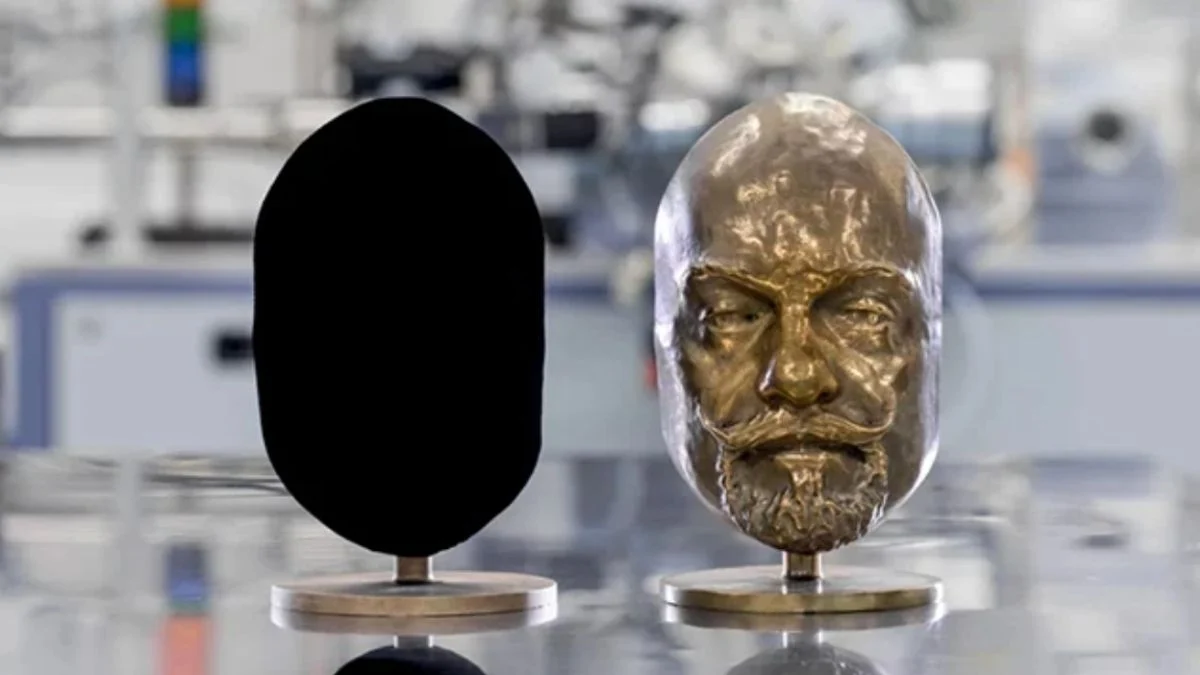
It is here that an unusually clever and unexpected counterstrike steps in. A team of researchers from the University of Surrey, in the United Kingdom, believes they have found the solution: Vantablack 310, a specific formulation of one of the blackest materials ever developed, designed to coat spacecraft. Its principle is astoundingly simple: if a satellite reflects almost no light, it becomes virtually invisible to our instruments.
And the laboratory results are impressive. A coating of Vantablack 310 reflects only 2% of the incident light, which corresponds to absorbing 98%. In other words, it acts as a true light trap. Viewed under an electron microscope, the material reveals what are called coralline structures, speckled with tiny cavities where light rays get captured with no escape. A bit like a microscopic sponge that would absorb light rather than water.
The verdict from simulations: what camouflaged satellites are really worth
To assess the coating’s performance, astronomers use a unit that may seem counterintuitive: the AB magnitude. Keep one simple rule in mind: the lower the value, the brighter the object. By way of comparison, an untreated satellite, tested by SpaceX, reached a magnitude of 3.7, making it highly visible.
With Vantablack 310, the picture changes radically. In its most reflective state, the coated satellite reaches a magnitude of 6.7 to 7.0, and even 7.1 to 7.8 in many simulated orbits, i.e., a far more discreet object. Reflectivity, moreover, depends on position: a satellite is brighter when it passes over snowy terrain than over the ocean. Notably, this coating seems comparable to or even better than the DarkSat and VisorSat solutions already tested by SpaceX. One caveat: the worst measured case, at 6.7, just falls below the magnitude 7 threshold recommended by the International Astronomical Union. The margin is slim, but the direction is promising.
Jovian-1 and the challenges to darken the sky
As promising as it is, this paint has not yet said its final word. The study conducted focused only on optical performance, i.e., the material’s ability not to reflect light. Yet a satellite must face many other constraints: its thermal behavior, its long-term durability, and its integration with spacecraft still need to be evaluated through further testing. Good news, however, is that Vantablack 310 has been designed to be easier to apply and more resistant than its original version.
The next step will play out beyond the laboratory. The material must equip a future mission named Jovian-1, a CubeSat that will enable real luminosity measurements from the ground. It is this real-world test that will determine whether this solution lives up to all its promises.
Between a rapidly advancing space race and astronomy that needs a preserved sky, the conflict seemed almost inevitable. Yet a simple ultra-black paint could indeed offer an unexpected common ground. If future tests confirm the hopes placed in Vantablack 310, we could keep populating the low Earth orbit without extinguishing our view of the stars. The real question remains: will satellite manufacturers tomorrow agree to repaint their fleets in black to restore a bit of the sky’s darkness?
