
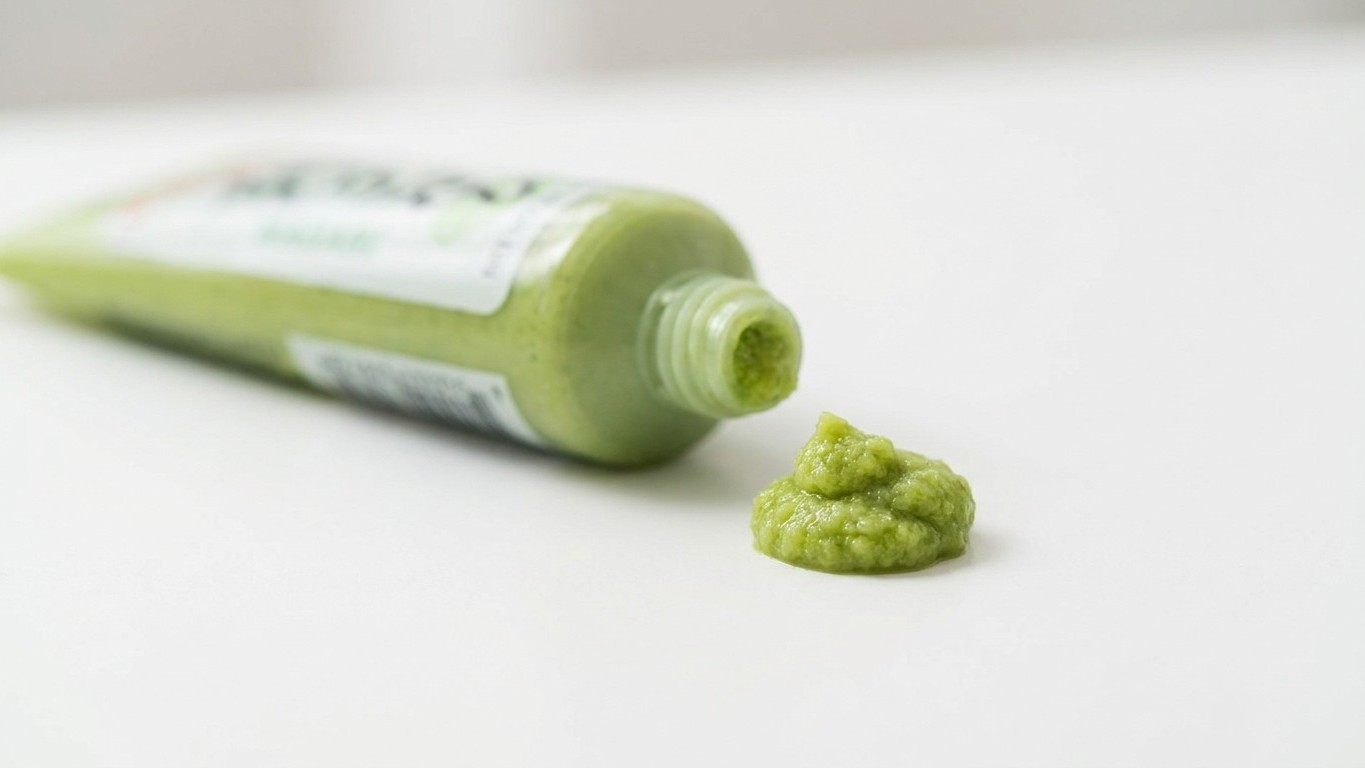
Open your fridge and take a look at that green tube you spread on your Friday night sushi. There is a strong chance what you take for wasabi is actually a European horseradish paste, artificially colored to resemble the precious Japanese root. This is not an urban legend but an industrial reality openly acknowledged by manufacturers themselves, who print it plainly on their labels.
Key takeaways
- Why does your tube of wasabi contain barely 4.5% real wasabi?
- What is the secret behind that neon green that stings the nostrils?
- How do restaurants around the world bypass the scarcity of the real plant?
What the ingredient list really reveals
Take any tube of wasabi sold in supermarkets and turn it over. You’ll find horseradish dominating at 20 to 30% of the product, while the wasabi itself only reaches 1% to 4% and sits around the fifth position in the ingredient list. A concrete example: the composition of a European wasabi-horseradish tube lists 31.7% horseradish, humectant E420, rice bran oil, salt, dextrin, only 4.5% Wasabi japonica, starch, water, flavor, turmeric, thickener E415, acidulant E330 and colorant E133.
That famous neon-green shade that bites the nose? It has nothing natural about it. The fake wasabi sold in tubes or powder in the majority of restaurants and grocery stores is composed mainly of horseradish, mustard powder, and a green dye, such as chlorophyll or artificial color E102/E133. Tartrazine (E102) and Brilliant Blue FCF (E133) combined produce this vivid green hue that does not exist in nature. Some brands even use Brilliant Blue alone, mixed with turmeric to achieve the green shade expected by consumers.
The taste outcome bears little resemblance to the original. The substitute’s flavor is harsh, one-dimensional, and delivers a burning sensation on the tongue that masks the delicate flavors of the raw fish, contrary to the genuine wasabi’s role as a flavor enhancer. That sting that brings a tear is not a signature of authentic wasabi; it’s precisely the mark of its absence.
Why the real plant remains almost unobtainable
Wasabia japonica is not a simple vegetable that one plants and harvests three months later. This plant requires mountain freshwater, a constant temperature between 8 and 20°C, shaded exposure and well-drained soil, with slow growth taking 18 to 24 months before harvest, which drastically limits global production, concentrated in a few regions of Japan such as Shizuoka, Nagano and Shimane. Two years of waiting for a root the size of a fist, when a potato is harvested in four months: that is the economic equation that pushed the industry toward a substitute.
This rarity has a price, literally. The price can exceed 200 euros per kilogram, and some suppliers go well beyond. In December 2024, the price offered by a Swiss online supplier was around 750 CHF/kg, and the price of 580 €/kg from a German supplier was not negligible. The horseradish, by contrast, costs almost nothing: it has a per-kilogram price about 20 times lower than its Japanese cousin, which explains why it is massively used in its place. Even in Japan, homeland of the plant, real wasabi remains a luxury reserved for the tables of the most discerning restaurants.
The scale of substitution crosses far beyond French or European borders. In truth, more than 95% of the “wasabi” consumed outside Japan is not real wasabi. And the situation is not very different on its homeland: in Japan itself, it’s estimated that less than 5% of wasabi served in restaurants is real wasabi. A secret that everyone in the trade knows, without shocking many there.
How to distinguish authentic from imitation
Color is the first clue that betrays the ruse. Real wasabi has a pale, natural green tone, almost pastel, while horseradish paste bears a garish, uniform green, a sign of colorants. Next up is texture: freshly grated wasabi has a chunkier, almost pulp-like texture, made of fine bits of the plant, whereas the substitute forms a perfectly smooth, homogeneous paste, like toothpaste. A detail that doesn’t lie when you know where to look.
On the label, a single move suffices: look for the plant’s name. The real product must list “Wasabia japonica” or “Eutrema japonicum” at the top of the ingredients. If horseradish appears first, there is no doubt about the product’s nature. Some premium brands, often sold in fine grocery stores rather than in mass markets, offer pastes containing a significant portion of real plant, identifiable by the mention “hon wasabi” (true wasabi in Japanese).
Then the tasting, the ultimate judge. The authentic taste is more vegetal, more complex, less fiery than the imitation, and true wasabi fades quickly without leaving a bitter aftertaste. Nothing like the stubborn burn of the industrial tube, which lingers in the mouth long after the sushi has disappeared. Some producers are also rising to the challenge beyond Japan: Japanese and foreign start-ups are attempting to cultivate wasabi outside the archipelago, notably in New Zealand, Canada or the United States, with varying degrees of success. Could we hope, someday, to encounter real wasabi outside the depths of a secluded Japanese valley?
Sources: delablousealatoque.fr | chefcuisto.com
