
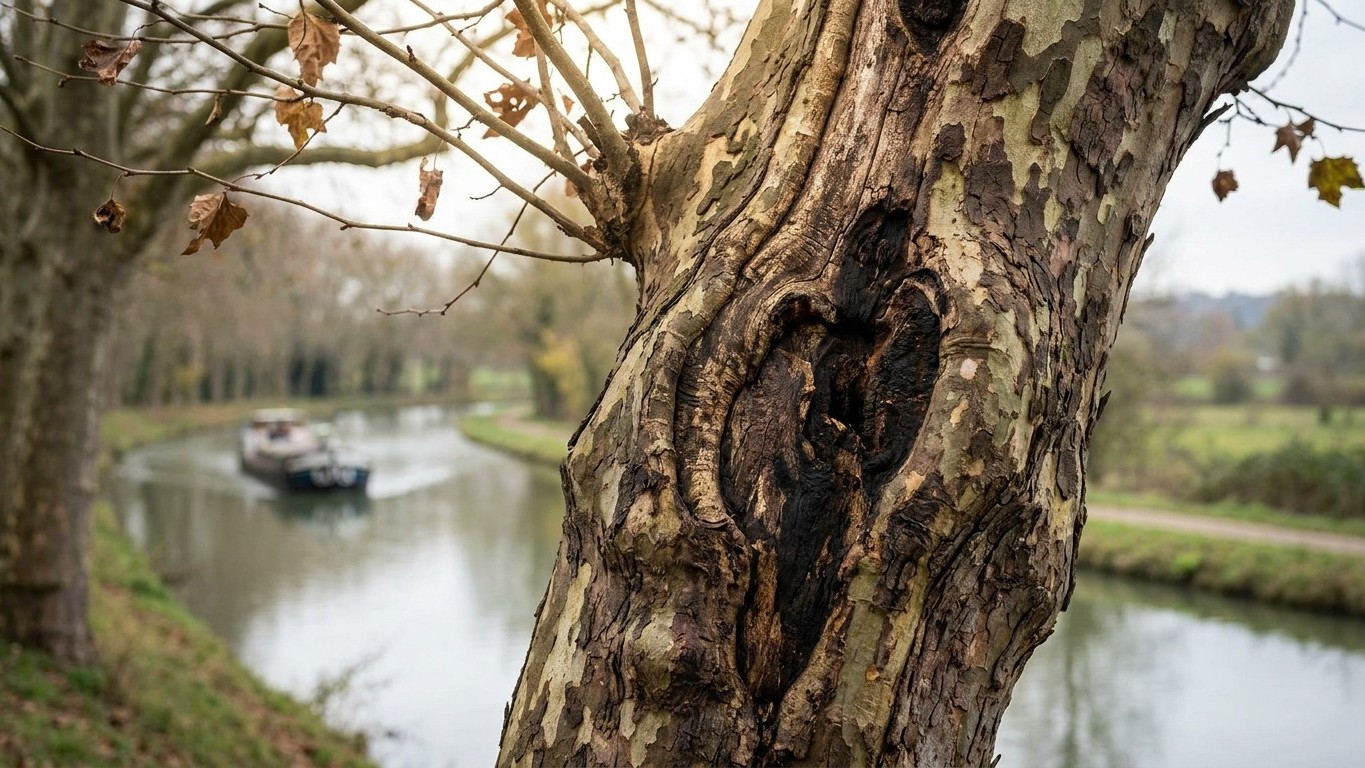
A microscopic fungus, invisible to the naked eye, has taken less than a century to transform one of France’s most photographed landscapes. Along the Canal du Midi, 33,350 plane trees have been felled out of the 42,000 recorded before the disease appeared, according to the figures from Voies navigables de France dated January 2026. Four trees out of five of this two-hundred-year-old leafy archway have already disappeared, and to this day, no one knows how to stop the phenomenon.
Key takeaways
- A biological bomb planted 80 years ago continues to devastate a UNESCO heritage site
- The destruction mechanism is almost flawless: the fungus leaves little chance for the trees
- A colossal reconstruction estimated at 220 million euros to reinvent what nature has destroyed
A time bomb planted in 1945
The origin of this ecological catastrophe borders on a noir tale. The spread of the colored canker in France dates back to the Allied landings in Provence in 1945, when the ammunition crates of American soldiers were made from plane wood, already infected by the colored canker, which began to spread slowly from that point. This contaminated timber came directly from North American forests, where the responsible fungus, Ceratocystis platani, had circulated for a long time without causing major damage, the local plane trees being more resistant.
Once landed in Marseille, it found ideal conditions: tens of thousands of plane trees planted in tight rows, exactly the kind of population that favors rapid spread. The fungus first struck the Provence-Alpes-Côme-Tôte d’Azur region for decades before moving westward. In 2006, the first outbreak of canker was discovered on the Canal du Midi at Villedubert, east of Carcassonne. Since then, the disease has continued to advance.
The destruction mechanism, meanwhile, is almost surgical. The colored canker is a microscopic fungus that attacks plane trees only by blocking the sap tubes, killing them in as little as 6 months to 5 years. Worse still, the trees essentially arrange their own demise: underground, their roots naturally fuse through a process called anastomosis, creating an underground network that becomes a fungus highway, so that when one plane tree falls ill, it is not only its branches that must be felled, but often all those around it in an impressive radius. In the field, this translates into clearings that can extend up to 35 to 50 meters around a single contaminated tree in some cases.
No treatment, a single weapon: the chainsaw
In the face of this plague, plant health science remains utterly powerless. There is no preventive or curative treatment available today. The only method of control is to cut down the trees to prevent the disease from spreading. This radical solution isn’t even a choice: the ministerial decree of July 31, 2000 classifies the fungus responsible for the canker as a harmful organism and thus makes felling and burning on site mandatory to reduce the spread of spores.
The pace of the disease is dizzying. A recent Franceinfo report recalled that in 20 years, 80% of the trees along the Canal du Midi have been felled, which is extremely rapid, and on average about 1,000 new trees are cut down each year as they become infected. At this rate, expert projections leave little room for optimism: the VNF experts estimate that there will be no original plane trees left on the canal within about a decade.
The transmission of the fungus is not limited to roots. Water effectively carries the fungus spores, and human activities also contribute to its spread: earthworks, landscaping maintenance, hull impacts on tree roots. Even a poorly disinfected staple on a worksite can be enough to contaminate a healthy tree, which explains the almost obsessive vigilance of VNF teams on cleaning tools and machinery.
220 million euros to reinvent the vaulted canopy
Faced with the inevitable, Voies navigables de France chose not to simply endure the situation. Since 2012, a major replanting project has been launched with a clear objective: recreate, with different species, the shade that makes canal navigation so charming. New tree species are gradually replacing the plane trees, and more than 22,000 trees have already been replanted out of the 33,000 that were felled.
The choice of replacement is not insignificant. The new identity species selected is the hairy oak, a sturdy tree of roughly similar height to the plane, which will be planted on large sections from one end of the linear park to the other and will occupy 40% of it. Other species supplement this new vegetal mosaic, chosen for their resilience to the Mediterranean climate. Each winter, between 1,300 and 1,500 trees are planted, a tireless ant effort that will continue for several more years.
This reconstruction carries a vertigo-inducing price tag. The overall planned budget for the project is estimated at 220 million euros according to Voies navigables de France, of which a portion is already allocated: VNF has invested nearly 110 million euros in this project, including 13 million from local authorities and 11 million from donations. Financing thus partly relies on public generosity, via a dedicated philanthropy mission, proof that the safeguarding of this UNESCO-listed heritage goes beyond the state’s budget alone.
The project extends beyond the trees themselves. The disappearance of the plane trees has also disrupted an entire ecosystem: fauna and flora surveys have shown that the loss of plane trees destroyed habitats for certain protected species, notably birds and bats that used to shelter in the tree cavities. To compensate, more than 1,800 nesting boxes and bat roosts have been installed along the length of the line. And because the plane tree roots held the banks for nearly two centuries, their disappearance now weakens the banks, forcing VNF to carry out reinforcement work in parallel with each planting campaign. In 2026, the Canal du Midi celebrates its thirtieth year on the UNESCO World Heritage List. A birthday with mixed feelings: the landscape that, in ten years, will hardly resemble the one fixed in the memory by generations of painters and postcards.
Sources: franceinfo.fr | replantonslecanaldumidi.fr
