
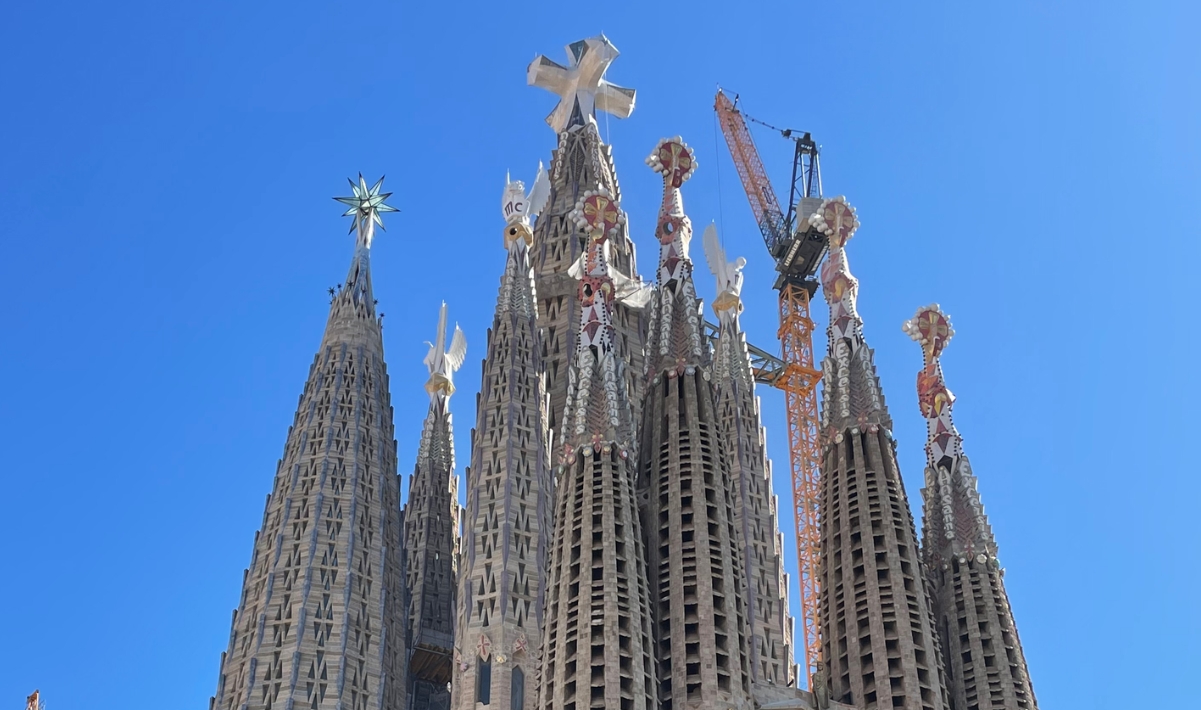
In Barcelona, a company specialized in 3D printing contributed to the perpetual project of the famous Sagrada Família. This technology partner helped create the ceramic pieces that cover the monumental cross on the Jesus Christ tower, a feature that has been recently completed.
13,000 Ceramic and Glass Tiles
First, let us recall that the Sagrada Família is an iconic basilica in the city of Barcelona (Spain), conceived by the Catalan architect Antoni Gaudí. Renowned for its architecture that blends Gothic style with Art Nouveau, the building is especially notable for being under construction since 1882, with a possible completion around 2035. February 2026 marked the conclusion of the main architectural structure, with the cross positioned at the summit of the Jesus Christ tower which, at a height of 172.5 meters, is the tallest feature of the structure.
The element of interest in this article is the cross on the Jesus Christ tower. Rather imposing, this three-dimensional, four-armed cross measures 17 m in height and 13 m in width, weighing in at nearly 13 tons. It is clad in a glazed white ceramic and glass coating, the fabrication of which by the historic Cerámica Cumella workshop received backing from 3D printing, as described by the media VoxelMatters in a March 2026 article.
The local company Lamaquina contributed its expertise, but contrary to common belief, the cross itself was not printed in 3D. In fact, this technology was used to produce the molds and other clay supports that enable the production of the 13,000 ceramic and glass tiles. It should be noted that these tiles have complex geometries, notably Gaudí’s characteristic double torsion.
What Type of 3D Printing?
Concretely, the technology that Lamaquina adopted is a large-format robotic clay-based additive manufacturing. In this project, the company employed multi-axis industrial robotic arms equipped with extrusion heads from the Italian brand WASP, which specializes in 3D printing with earth and ceramics. It should be noted that the support molds are made of technical construction clay, a material chemically and thermally compatible with the final cross tiles. Moreover, the robotic arms did not lay the clay down flat, layer by layer. Instead, these machines followed genuine 3D trajectories—multi-axis movements—to precisely fit the cross’s complex double-torsion curves.
However, Lamaquina’s true expertise lies more in the computational optimization before printing. Firing ceramics induces a natural shrinkage, a contraction that must be anticipated. A proprietary software workflow was used to model each mold, with the 3D geometry accounting for the shrinkage rate during firing.
Substantial Time and Money Savings
It is important to note that due to the pyramid-like and curved shape of the cross on the Jesus Christ tower, the 13,000 tiles are not all identical. In fact, they come in 500 distinct and complex shapes. In conventional manufacturing, producing that many steel or plaster molds would have taken years and would have been exceedingly expensive.
Finally, Lamaquina’s involvement does not replace the work of Cerámica Cumella. Indeed, artisans apply the glaze to each tile by hand—a monumental undertaking. In reality, Lamaquina’s expertise helps to remove certain technical manufacturing constraints and thus achieve substantial time and cost savings. It is worth noting that the project receives no external funding: only donations and revenue from tours fund the budget.
