
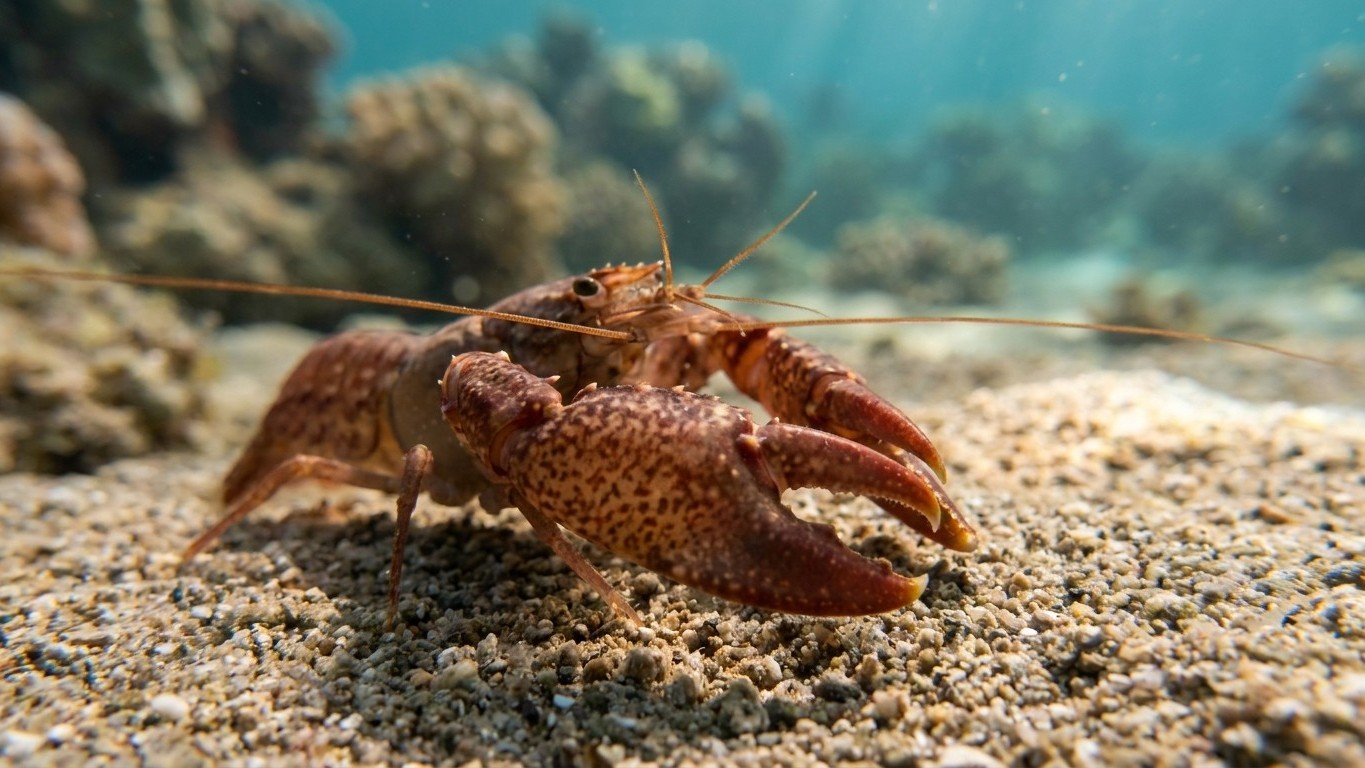
It measures only 3 to 5 centimeters, hides two nearly blind eyes beneath its shell, and yet it produces one of the loudest sounds in the animal kingdom. For a long time, the noise was attributed to a simple claw-clack, but this din is not a mechanical smash nor a cry: it is the implosion of a gas bubble, created by a jet of water expelled at extremely high speed, which triggers this underwater detonation capable of producing a blast of nearly 220 decibels and temperatures reaching up to 5,000 kelvin. In the water, it can rival the sound of a firearm.
Takeaways
- It isn’t just a simple claw snap, but a far more complex physical phenomenon
- A bubble collapses at dizzying temperatures, equal to or greater than those of the Sun
- This microscopic weapon could be threatened by warming and acidification of the oceans
A claw that acts like a trigger
The secret does not lie in a shell-to-shell friction, but in a precision mechanism worthy of an engineer. The pistol shrimp’s large claw, of the genus Alpheus, consists of three distinct parts: the dactyl, a sort of plunger that fits into a base called a socket. The dactyl, the broad curved front part of the claw, opens to let water fill the socket inside the claw; the plunger, which protrudes beneath the dactyl, inserts into the socket when it closes at high speed with force, which expels water from the socket through a small aperture at the front of the claw, ejecting it at about 25 meters per second.
This detail changes everything. Contrary to what had long been believed, the claw never truly slams against its counterpart. A study published in Scientific Reports even showed, through advanced numerical modeling, how this ultra-fast closure triggers a swirling vortex of water around the ejected jet, a phenomenon that explains the formation of the cavitation bubble. The water movement is so abrupt that it locally creates a pressure drop sufficient to vaporize the water itself, just like a boat propeller cavitating at too high a speed. The jet speed was estimated at around 25 m/s by a team using high-speed imaging of a real pistol shrimp in the act of closing—a velocity sufficient to locally vaporize water and form a cavitation bubble.
Hotter than the Sun, louder than a gunshot
The bubble thus formed grows in a fraction of a second before it collapses as soon as the surrounding pressure returns to normal. This extremely rapid collapse compresses the gas trapped inside to dizzying temperatures. An explosion that exceeds 200 decibels underwater, ranging from 210 to 220 decibels according to the most precise measurements. In open air, such a sound level would far surpass human tolerance thresholds.
The phenomenon goes even further: the collapse of the bubble also produces a brief flash of light, somewhat like sonoluminescence observed in laboratories when a bubble implodes under ultrasound. Researchers have named this shrimp-specific phenomenon “shrimpoluminescence.” Not magic here, merely fluid dynamics pushed to its extreme, in a microscopic space and over a span of merely a few microseconds. And the animal repeats the operation again and again, without ever damaging its own claw with each shot, contrary to what one might imagine for a weapon so powerful.
Stun, Hunt, Communicate
This detonation is not a mere accidental byproduct. It constitutes a true hunting weapon. The shock of pressure and the heat generated by the implosion are enough to stun, or even kill on the spot, small fish or other shrimp that pass within range. Some species also use it to defend their burrow or to communicate with their fellows, somewhat like other animals use vocalizations to mark territory, except that here everything relies on the physics of fluids rather than vocal cords.
The noise is so common on coral reefs and in seagrass beds that it forms a real acoustic background, capable of interfering with submarine sonar. Japanese researchers even studied, across several sites in a oyster bay between 2022 and 2024, how this collective racket varied with water temperature, depth, and the time of day: the rate of snaps increased with water temperature and depth, as well as at night, and tended to be higher inside shellfisheries than outside. This makes these tiny shrimp true acoustic sentinels of marine ecosystems, useful for tracking the health of a reef without sinking a single sensor.
Yet there remains an astonishing fragility behind this firepower. Microstructural analyses have shown that the snapping claw is more brittle than other rapid raptorial appendages, such as the mantis shrimp’s club, because it is not directly subjected to direct contact forces. Unlike the marine mantis shrimp that strikes its prey with a direct blow, the pistol shrimp never actually touches its target with its claw: it is solely the shock wave and the heat of the implosion that do the work. A detail that is anything but trivial in the face of warming and ocean acidification, phenomena that could, in the long run, weaken this mechanism and mute one of the quietest, yet most deafening, sound-makers of our ocean floors.
Sources: tirsportifchabris.fr | nature.com
