
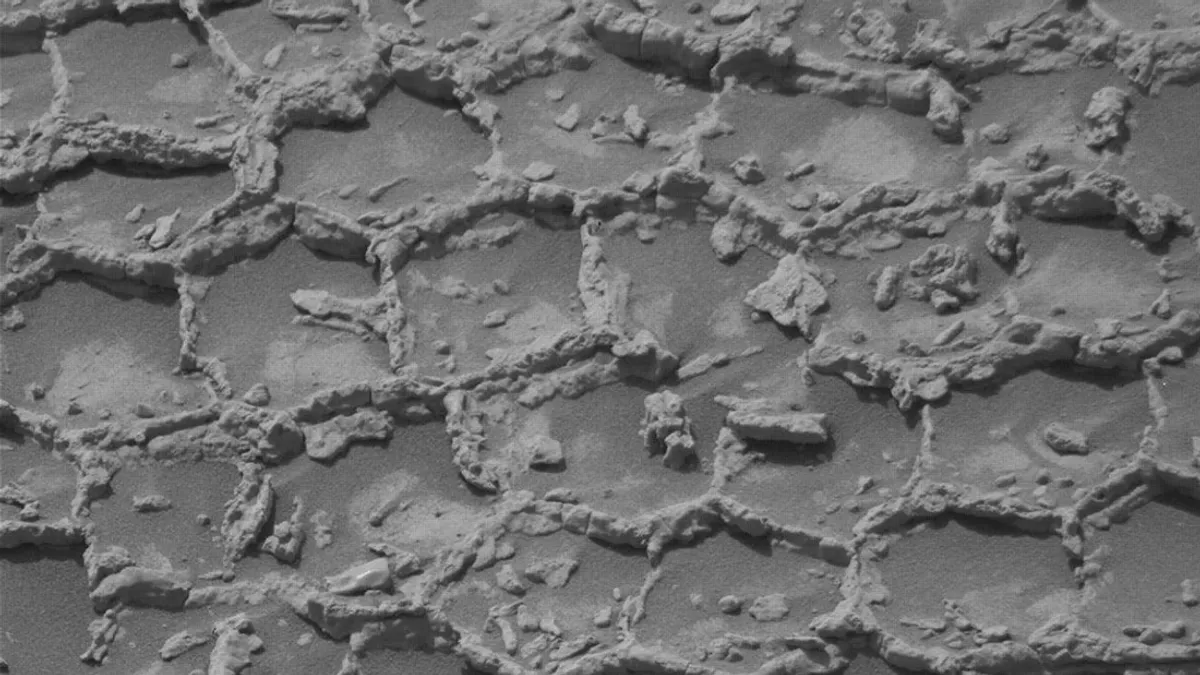
The Curiosity rover has just uncovered a strange pattern that resembles a giant Martian honeycomb — polygonal structures etched into the floor of Gale Crater. There is no sign of extraterrestrial origin on the horizon: this kind of natural pattern appears just as often in Saturn’s hexagonal storms as in Ireland’s Giant’s Causeway. Yet the area hides another puzzle: dark rocks that could be meteorite fragments.
What you will learn
- Why these Martian “honeycomb” structures are not evidence of alien intervention despite their unsettling appearance
- Which other natural terrestrial and celestial phenomena produce similar geometric patterns
- Why the nearby dark rocks could be meteorites that landed on Mars
A Spectacular Pattern in a Region Deemed Smooth from Orbit
Curiosity, less in the spotlight lately than its younger sibling Perseverance, continues to methodically explore Gale Crater despite a seriously damaged wheel. Recently, the rover team sent it to investigate an area that looked brighter from orbit, but seemed smooth according to prior surface observations.
The surprise was immediate: the area was covered with polygonal structures reminiscent of “the top of a giant Martian honeycomb,” NASA reports. The ridges of these features appeared increasingly eroded as Curiosity advanced into the formation.
Not Aliens, Nor Mysterious Mosaics
Despite the captivating appearance of these geometric motifs, nothing points to an artificial or extraterrestrial origin. Nature routinely produces such geometrically regular patterns through purely physical processes. The hexagonal storm persisting at Saturn’s north pole is a spectacular example in the solar system. On Earth, the Giant’s Causeway in Northern Ireland — more than 40,000 polygonal basalt columns formed by the cooling of lava flows — illustrates the same principle of natural formation.
These Martian structures nonetheless deserve thorough study, and the scientific team promises further analyses soon.
Dark Rocks with an Unresolved Mystery
Near these polygonal structures, Curiosity also detected a scatter of small dark-toned rocks. Mars’ atmosphere, much thinner than Earth’s, offers less protection against meteorite impacts — making it plausible that these rocks originated from such an event.
But the exact origin remains uncertain. The team wonders: are these rocks Martian fragments that have “drifted” from upper stratigraphic layers, debris ejected by distant impacts located outside Gale Crater, or genuine meteorites from elsewhere in the solar system?
One troubling clue already exists: the analysis of similar dark rocks studied previously revealed nickel — an element common in meteorites but rare in native Martian rocks. It remains to be determined whether all these dark rocks share the same extraterrestrial origin, or if some are simply local fragments.
The Next Steps in Exploration
The team has already performed measurements on these structures and rocks using the ChemCam instrument, with results due to be published soon. Curiosity continues its examination of the formation before heading toward another polygonal ridge and a dark rock zone spotted from orbit — potential new discoveries for this veteran rover that, despite its age, continues to surprise scientists.
