
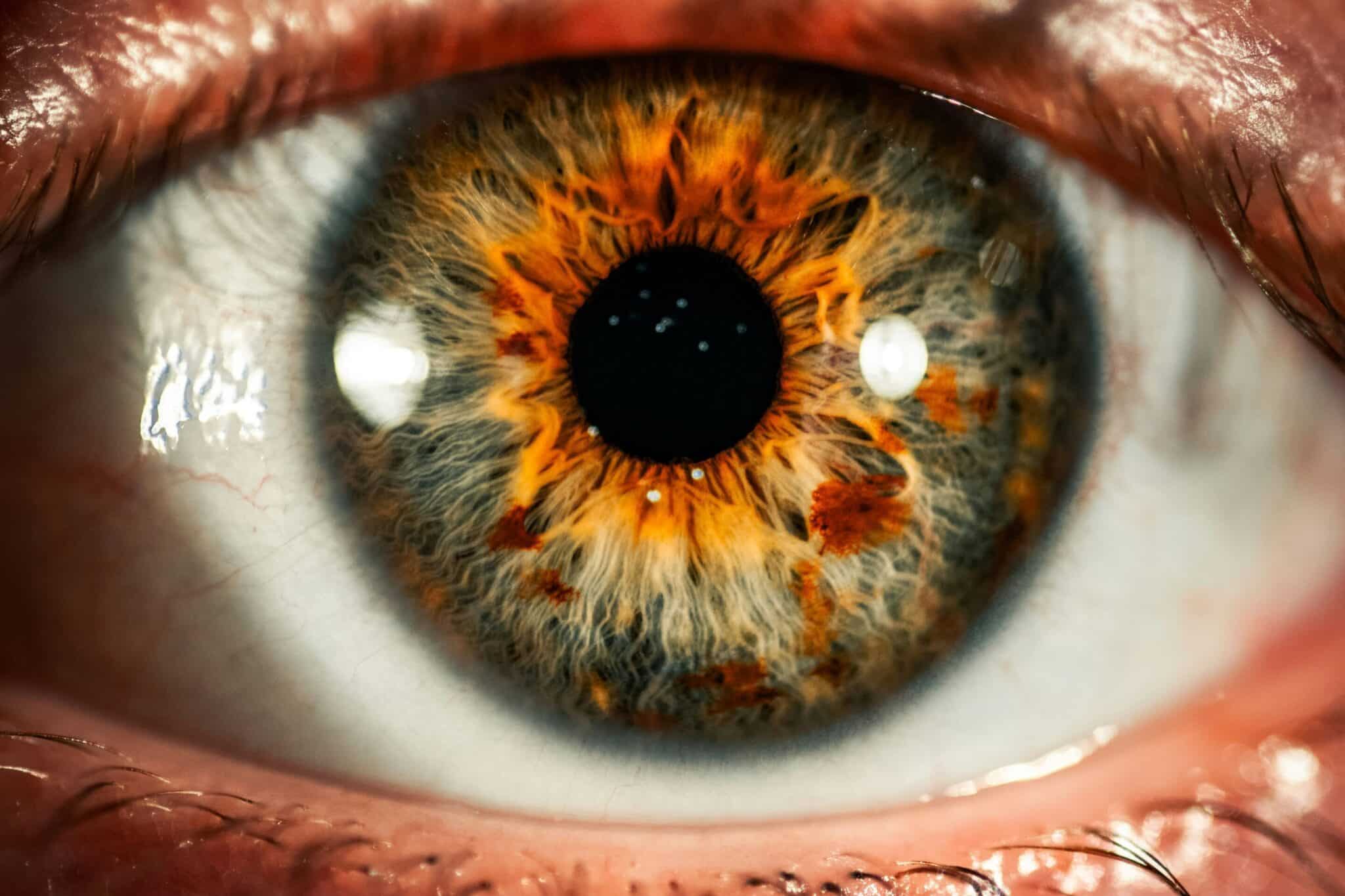
Fixate intensely on a point in front of you: you may feel that your eyes are completely still. Yet they are stirred by tiny, perpetual tremors, entirely invisible to you. For a long time, these “fixational eye movements” were thought to be errors in our motor system, but they prove to be a biological tour de force. A new study published in Physical Review Research shows that these micro-vibrations are tuned with mathematical precision to optimize our vision, allowing us to perceive details that would otherwise vanish.
What you will learn
-
Why total eyeball immobility would render the world invisible around us.
-
The mathematical mechanism that turns an involuntary tremor into a perfect visual signal.
-
How this discovery could revolutionize visual prosthetics and artificial intelligence.
The Paradox of the Immobile Eye
The human brain hates stagnation. If our eyes remained perfectly still, the cells in the retina would habituate to the light signal and the image would gradually fade away.
That’s where these drift-like micro-movements come into play. By gently vibrating the image on the retinal surface, they prevent this neural adaptation and keep our vision active.
However, too much movement would produce a permanent blur. Scientists therefore sought to understand how the body manages this delicate balance between sharpness and the fading of the image.
A millimeter-precise flicker
Using a complex mathematical model that blends neural noise with the natural blur of our optics, researchers have uncovered a fascinating tuning. Our eyes do not tremble randomly.
These minuscule drifts convert the spatial details of an object into a shimmering signal. This temporal “flicker” is far easier for our neurons to decode than a static, dull image.
The study shows that the speed of these tremors is close to the ideal physical limit. They’re just fast enough to counter the brain’s adaptation, yet slow enough not to blur the finest details.
It’s an optimal trade-off: if we trembled a bit more or a bit less, our visual acuity would drop drastically.
Applications Beyond Biology
This refined understanding of the eye’s “dance” opens unexpected doors. If these movements dictate the sharpness of what we see, any variation could help explain certain visual disorders.
Engineers are now examining these results to design more capable artificial vision systems. By mimicking human tremor, future cameras could extract far more information from their surroundings.
Likewise, visual prosthetics for the visually impaired could incorporate these micro-vibrations to deliver a clearer and more stable image to patients.
Ultimately, what we once took as a flaw of the human body is in fact a high-precision setting, refined by millions of years of evolution to give us crystal-clear vision.
