
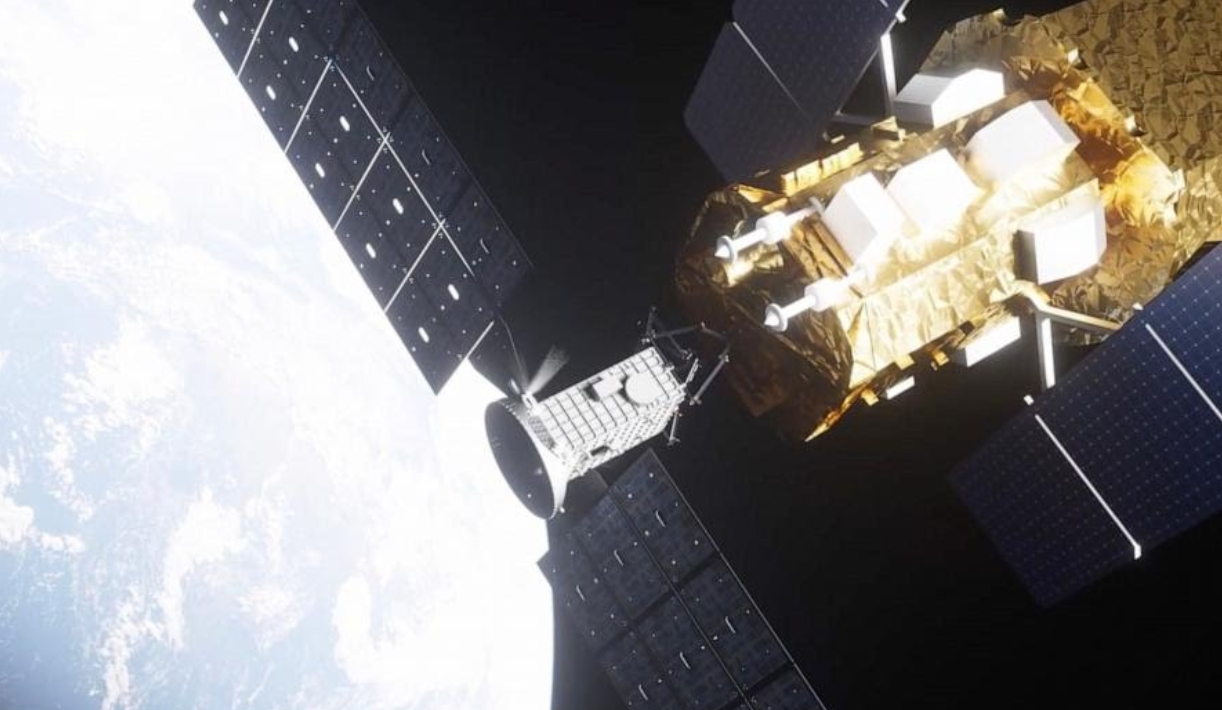
A private startup has developed a compact robotic spacecraft to raise the Swift telescope’s orbit as quickly as possible. NASA’s ongoing operation to salvage this aging satellite, which was never designed to interact in orbit, appears to be proceeding smoothly for now.
Saving the Swift Space Observatory
Launched in 2004 for an initial mission of two years, the Swift Space Observatory (Neil Gehrels Swift Observatory) is still operational after more than two decades. Its specialty? Detecting and studying gamma-ray bursts (GRBs), that is, the universe’s most violent and energetic explosions since the Big Bang. Capable of autonomously slewing to a target in under about twenty seconds, Swift sends alerts to telescopes around the world, including, notably, the famous James Webb Space Telescope.
Because Swift was intentionally built without any internal propulsion system to reduce mass and costs, it began a slow descent from its orbit as soon as it was deployed. However, this descent accelerated dramatically toward the end of 2024 due to solar activity—the “Solar Maximum.”
Since its deployment into a 600 km altitude orbit, the telescope has reached a critical threshold of 340–360 km. Thus, Swift is currently the subject of a rescue mission: the Swift Boost Mission, unveiled about six months ago. As NASA explains on the mission’s information page, a robotic rescue spacecraft was launched on July 3, 2026. Its objective? To dock with the satellite in order to raise its orbit and thereby, avoid uncontrolled disintegration in Earth’s atmosphere. Without intervention, the telescope would have crossed its point of no return by October 2026.
A Small Space Tug Named Link
To design the rescue vehicle, NASA urgently enlisted the private U.S. startup Katalyst Space Technologies. The device, named Link, is a refrigerator-sized space tow, with a mission that is quite ambitious. Indeed, Swift has never been designed to undergo towing, or any form of interaction whatsoever, regardless of its nature. The tug uses Hall-effect ion thrusters, an electrically powered system that ejects xenon at very high speed. This is a very gentle, fuel-efficient propulsion method, ideal for pushing heavy loads over long periods.
It should be noted that the launch was conducted by Northrop Grumman’s Pegasus XL rocket, released from the Stargazer carrier aircraft at an altitude of 40,000 feet (over 12 km) above Kwajalein Atoll (Marshall Islands). Despite three days of weather-related delays and minor technical issues, the deployment encountered no problems.
What is the Current Status of the Mission?
As this is written, ground engineers are performing a full health check of the Link robot. This involves testing its battery power, its sensor systems, and the responsiveness of its ion thrusters. If no major issues are detected, Link will soon embark on a month-long autonomous journey to approach Swift. According to NASA’s official flight plan, the craft should come within about 9.6 kilometers of the telescope before commencing its final approach phase.
After its approach, Link will need to synchronize its movements with those of Swift. Unstable, the telescope wobbles and slowly spins, a motion the robot will have to imitate using its micro-thrusters. Next will come the capture and diagnostic steps by the ground engineers, involving a verification of the three robotic arms’ structural integrity and the alignment of the center of mass of the two-body system that will comprise both objects.
Finally, Link will regain control and direct its ion thrusters toward Earth, before beginning to push the Swift telescope. Over roughly six weeks, this thrust will first drag the telescope away from Earth’s gravity, then raise it to an altitude of 600 km.
