
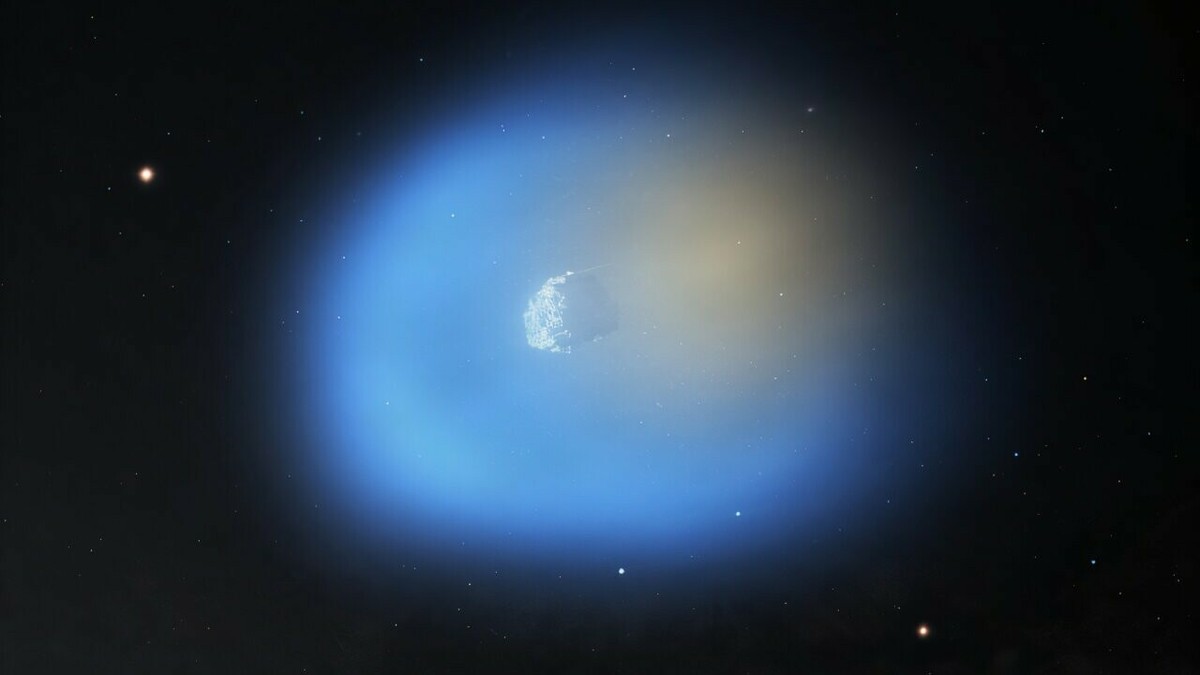
A cosmic tombstone is currently crossing our celestial neighborhood. Comet 3I/ATLAS, first spotted in July 2025, has just revealed its best-kept secret: its age. Combined with an enrichment in deuterium, the measured composition indicates formation in the outer regions of an old metal-poor stellar system, implying that 3I/ATLAS is probably more than twice the Sun’s age. Concrete terms: this block of ice and dust would have formed between 10 and 12 billion years ago, when our own star, by comparison, is only about 4.5 billion years old.
The figure is enough to make one dizzy. The Big Bang itself dates back 13.8 billion years. 3I/ATLAS would thus trace back to a time when the cosmos was only about 13% of its current age. When this icy clump formed, the Milky Way was still a turbulent teenage galaxy, and our Sun did not even exist in the solar nebula’s pipeline.
Key takeaways
- A cosmic visitor twice as old as our Sun is currently traversing our neighborhood
- Isotopic ratio signals reveal chemistry from a primordial universe
- Astronomers seized a unique observing window before this ice blob vanishes forever
The VLT, isotopic detective in the Atacama Desert
To establish this dating, the astronomers did not need to bring a sample back to Earth, a technical feat beyond reach for an object speeding through the Solar System without stopping. They used a subtler method: isotopic spectroscopy. With the UVES instrument mounted on the ESO’s VLT, the team measured the isotope ratios of carbon and nitrogen in the cyanide molecules present in the gas around the comet. These ratios are a good indicator of a comet’s origin, because they are highly sensitive to the physical conditions of the formation environment and change little during the object’s journey through space.
The results obtained literally stand out from standard reference tables. The measured ratios, about 147 for carbon and 343 for nitrogen, are well above the Solar System reference (roughly 90 and 130–170, respectively) and lie entirely outside the range of any Solar System comet measured to date. Such a pronounced deviation is far from trivial: it signals a chemical origin radically different from anything known around the Sun.
This discovery, published in Nature Astronomy by the team of Cyrielle Opitom, Jean Manfroid and Damien Hutsemékers, does not come from nowhere. It confirms and extends work conducted in parallel with other instruments. These results align with those from another team led by Martin Cordiner at NASA’s Goddard Space Flight Center, which also detected high fractions of carbon and much higher levels of deuterium, this “heavy hydrogen,” thanks to the James Webb Space Telescope. Three different techniques, three independent teams, one single conclusion: this comet comes from elsewhere, and from a very distant time.
A fossil born even before the Sun
Why does a simple isotope ratio betray such a vertigo-inducing age? The answer lies in the chemistry of the primitive universe. A marked enrichment in deuterium only occurs under extreme cold conditions, below 30 Kelvin, about -243°C, and in an environment poor in heavy elements—those that successive generations of stars produce and disperse over time. The fewer metals there are, the older the star that gave birth to the comet.
The researchers think 3I/ATLAS could be a relic from a period nicknamed the “Cosmic Noon,” this intense phase of star formation that occurred about 10 billion years ago. A cascade of nucleosynthesis, in short, of which today only a wandering ice cube remains. Rosemary Dorsey, a researcher at the University of Helsinki and co-author of the study, sums up the scientific stake: 3I/ATLAS offers a truly exciting opportunity to study the composition of another planetary system that formed long before our Sun and our Solar System even existed.
An unsettling detail: this comet has not been bound to any star for a long time. Being unbound, 3I/ATLAS has likely spent billions of years on immense, unimaginable trajectories across our galaxy, according to Martin Cordiner. A silent drift of billions of years, punctuated by a single and brief pass in front of our telescopes.
The third visitor, and surely not the last
3I/ATLAS is only the third interstellar object ever detected, after ‘Oumuamua in 2017 and Borisov in 2019. But unlike its predecessors, it happened to be exceptionally bright. It was discovered as it approached the Sun, spending enough time in our Solar System for astronomers to study it in detail, whereas measuring the composition of the first two interstellar objects had been difficult: for the first, no gas was detected, and the second was too faint. This time, the observation window was wide enough to allow a genuine chemical analysis, a first for an object from another planetary system.
The icy vessel is now on its way and will never return. Peter Vereš, from the Minor Planet Center of the International Astronomical Union, stressed the urgency of studying it: the comet is leaving our solar system and will never come back, warning that future observations will become increasingly difficult. A one-way trip, in short, that had to be seized in the instant following its detection.
The good news is that such opportunities should become more frequent. The Vera C. Rubin Observatory, whose real-time alert pipeline began operating in February 2026, should discover more interstellar objects, and each of them, if bright enough for a thorough spectroscopic analysis, will become a new physical sample from a planetary system otherwise completely inaccessible. The question remains how long it will take before a fourth messenger, perhaps even older, crosses our sky in turn.
Sources: aquitaineonline.com | nouvelles-du-monde.com
