
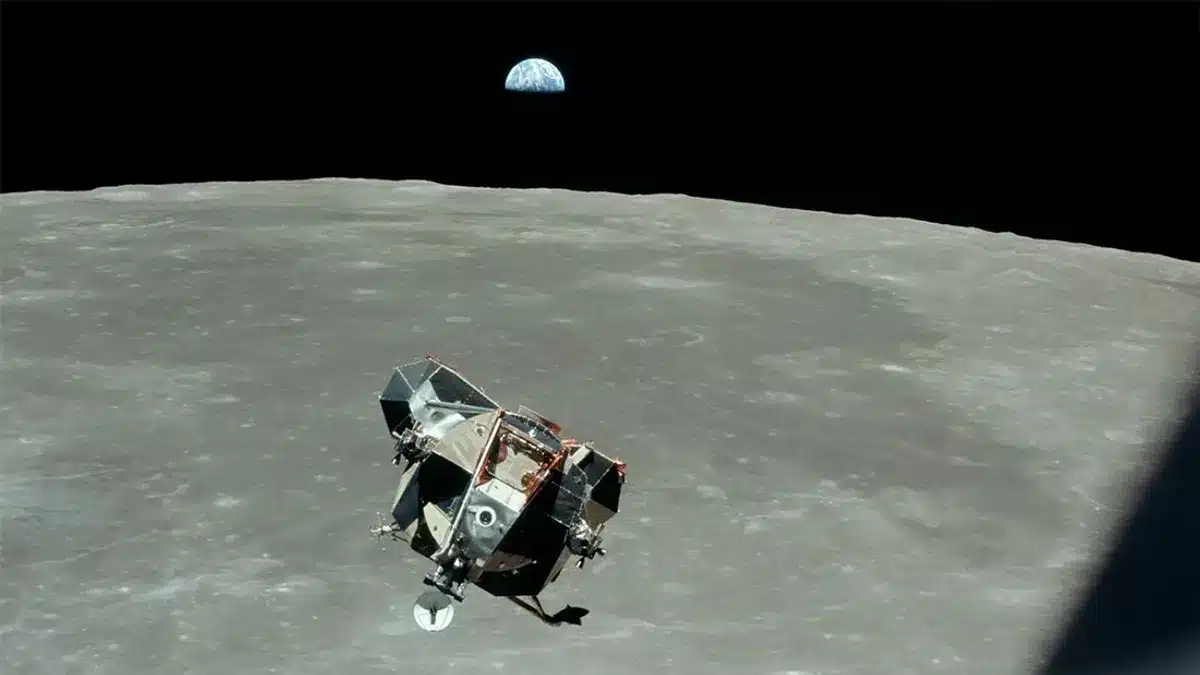
When Armstrong and Aldrin returned from their historic lunar excursion, they didn’t just bring back grand mementos. Their baggage held more than 21 kilograms of extraterrestrial rocks. Although NASA promptly placed the astronauts under quarantine, it also organized one of science’s quirkiest experiments: feeding lunar dust to cockroaches, shrimp, and fish. The objective wasn’t to pioneer space gastronomy, but to ensure that no invasive microbe would ravage Earth’s biosphere.
What you will learn
-
Why the American space agency feared unprecedented biological contamination in 1969.
-
The radical (and unappetizing) method used to test the toxicity of extraterrestrial soil.
-
The astonishing resilience of insect stomachs to the abrasive texture of lunar regolith.
The fear of an extraterrestrial pandemic
In the summer of 1969, no one could be certain whether the Moon’s surface housed invisible yet hostile microorganisms. Out of an abundance of caution, the Apollo 11 crew had to endure 21 days in complete isolation. Yet the scientists’ real worry concerned the 21.6 kilograms of freshly delivered sediment.
The health stakes were enormous: the medical director of the era needed to prove to the world that opening these precious seals would not unleash a biological catastrophe on Earth, contaminating plants, animals, and humans. The top priority was to hunt down the slightest sign of dangerous life. And to test this hypothesis, NASA decided to enlist some unusually unconventional test subjects.
A space banquet for insects
Marion Brooks, an entomologist at the University of Minnesota, was entrusted with a surreal mission. Her team gathered cockroaches, common houseflies, oysters, and small aquarium fish (chosen for their robustness and ease of rearing). The testing protocol was brutally simple: introduce finely ground lunar rock into their habitat and into their meals.
While some groups gnawed on sterilized dust, others ingested the untreated raw form. Some test subjects were even forced to crawl daily in enclosures lined with these cosmic sediments. A direct approach to observe potential mutations, diseases, or rapid poisoning.
Indestructible cockroaches and a biosphere saved
The scientific suspense was short-lived: the extraterrestrial soil did not trigger any mass die-off. Ironically, the only notable mortality rate was observed among a control group of fish, victims of emissions from a commonplace Earthly disinfectant used near their jars.
What most fascinated Dr. Brooks was the complete absence of internal injuries in the insects. Lunar dust is renowned for its extremely abrasive texture, akin to tiny shards of glass. Contrary to expectations, the cockroaches’ digestive systems and exoskeletons sustained no scratches or abrasions despite ingesting these sharp grains. This peculiar tasting experiment allowed NASA to breathe a sigh of relief and confirm once and for all that our satellite was sterile, inert, and entirely harmless to Earth’s ecosystem.
