
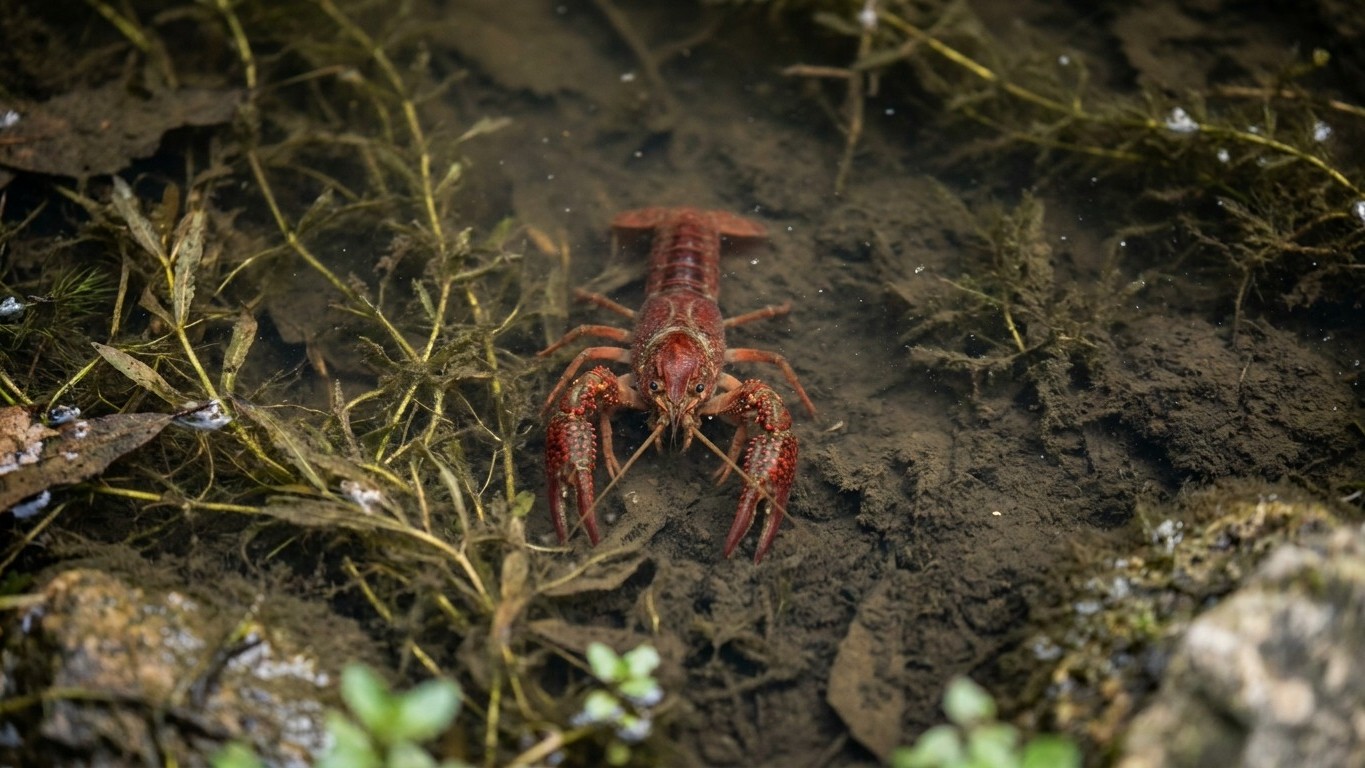
A prefect who aimed to curb an invasive species ends up with his order overturned on the grounds that his method could actually make things worse. This is the absurd situation in which the Indre prefecture has found itself since January 22, 2026: the administrative court of Limoges canceled a decree issued by the prefect of Indre intended to stem the proliferation of the Louisiana red crayfish by collecting and marketing it. And the irony is that judicial victory goes in part to those you would expect to be on the side of fighting the species: the fishermen themselves.
A judicial victory obtained, among others, by the departmental fishing federation, which raises a few questions. For on paper, everyone pursues the same objective: get rid of a crustacean that has no place in the ponds and waterways of Brenne. The Louisiana red crayfish is a real scourge for aquatic environments. Present in Indre since 2007, it markedly changes the vegetation of ponds, disrupts the local food chain, and continues to expand its territory, notably in Brenne. It digs burrows in dikes, devours tadpoles and fry, and transmits a deadly disease to local crayfish already weakened.
Key takeaways
- A prefect has his own anti-invasion order annulled by the courts
- The commercial solution concealed an unsuspected ecological trap
- Two decades of intensified struggle have yet to resolve the enigma
An order designed to fight the invasion, overturned on procedural grounds
In this context, the then-prefect Thibault Lanxade had, on May 3, 2024, issued an order authorizing the capture of these crustaceans to direct them toward food processing or outright destruction. The idea: transform a scourge into a productive chain, with about ten licensed catfish breeders for collection and transport, and two companies for processing and selling the crayfish. On paper, the argument is appealing: since eradicating the beast is not feasible, why not turn it into food.
But the Indre Federation for fishing and environmental protection, accompanied by the Indre Nature association, challenged the order before the Limoges administrative court, arguing primarily that the risk of spreading the species during trapping and transport, as well as the lack of prior public consultation, were problematic. The legal journey was not swift: an initial emergency-suspension request was denied on July 16, 2024 for lack of urgent character, before a full examination by three judges led to the annulment of the order for irregular procedure. On the substantive point, the ruling rests on a single, weighty sentence: “the said order was not the subject of any consultation,” the court noted in its decision issued January 22, 2026. The judges even dismissed the prefecture’s urgency argument, highlighting that the crayfish has thrived in the department for nearly twenty years. Twenty years of presence makes it hard to plead urgent necessity.
The trap that could worsen the problem
Here lies the crux of the case, and the reason the matter goes beyond a mere formality. The associations argued that net trapping lacks selectivity and could paradoxically promote the very expansion of the targeted species, advocating instead habitat restoration measures. Specifically, the director of the fishing federation summed up the core concern bluntly: “On a plate, we like big crayfish; very small ones we don’t eat, and when we fish for profit, we only capture the big ones, which would further boost reproduction.” A commercial supply chain would mechanically push fishermen to spare juveniles—the only ones capable of repopulating ponds at a rapid pace.
In response to this critique, the prefecture offered its own counterpoint. The head of planning at the Indre Departmental Directorate of Territories defended the use of nets that could collect individuals of all ages, including juveniles. A technical point that failed to convince the court, which ultimately anchored its decision on a stronger juridical ground: the absence of dialogue. France Nature Environnement captured the underlying issue in its statement: combating this species is difficult and complex, and the greatest caution is required to avoid measures that could worsen the situation and, conversely, promote its spread. This is the full difficulty of managing an invasive species that has been established for two decades: any ill-calibrated intervention can backfire on its initial objective.
And now, management without a commercial safety net?
In practice, the historic trapping program has never stopped. Since 2009, a control program has been run by the Regional Natural Park through trapping and destruction, spanning hundreds of ponds in collaboration with landowners, helping to curb the spread. It is these nets, lent free of charge to fish breeders, that allowed testing first an purely ecological approach before the idea of commercialization gradually took hold. The quantitative overview gives a sense of the scope: more than 500,000 individuals captured and destroyed since the program began, without a lasting decline in the population.
The Limoges ruling thus does not resolve the fundamental question. The State was ordered to pay 1,800 euros in court costs to the applicants, but the substantive question remains entirely open: the Louisiana crayfish continues to proliferate in Indre, and no one appears to have reached agreement on the right way to get rid of it. The state services have now announced their intention to restart the dossier from scratch, this time involving fish breeders, environmental associations, and regional scientists before any new decision. It remains to be seen whether a future order can reconcile economic profitability with ecological effectiveness, two logics that, in this particular case, proved difficult to coexist in the same net.
Sources: indrenature.net | chassepassion.net
