
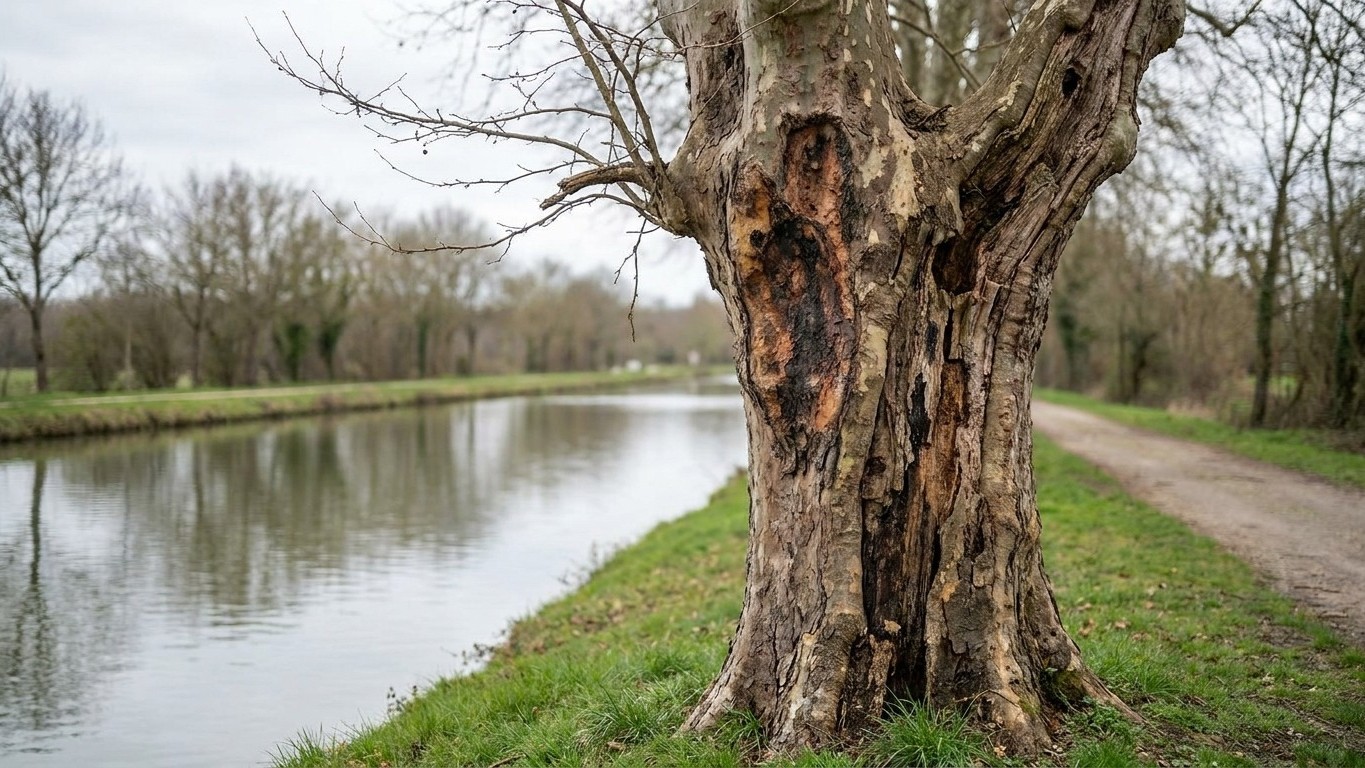
Half a century after the Liberation, France still bears the bill for an invisible error made amid the chaos of the Provence landings. The climate, often singled out for the gradual disappearance of the Canal du Midi’s iconic trees, is only an accelerant. The true culprit is a microscopic fungus, arrived in 1945 hidden in the wooden crates of American munitions, and which took six decades to reveal the full extent of its destructive power.
À retenir
- An invisible enemy that arrived 80 years ago continues its carnage
- Climate change is only a convenient scapegoat
- Tree roots create underground highways for the fungus
A fungus landed with the Allied troops
The story reads almost like a noir novel. The arrival of the canker colored (chancre coloré) in France goes back to the Allied landings in Provence in 1945; the munition crates used by American soldiers were made from plane-tree wood, already infected with the canker that would spread slowly from that moment. The wood came from American forests, where Ceratocystis platani circulated quietly. Once landed in Marseille, it found ideal ground: tens of thousands of plane trees planted in tight rows, precisely the kind of stand that favors rapid spread.
The fungus first wrought havoc in the Provence-Alpes-Coîte d’Azur region, before migrating westward. Arriving in France in the crates of American troops during the Provence landing, the fungus mainly flourished in the PACA region until the 1980s-90s before moving on to Languedoc-Roussillon and Midi-Pyrénées. The Canal du Midi, for a long time, seemed spared. Until that turning day in 2006, when everything shifted.
2006, the year when everything accelerates
A first outbreak is detected at Villedubert, between Carcassonne and Trèbes. Since then, the disease has never retreated. Forty-two thousand plane trees lined the waterway, forming the green vault that had defined its visual identity since the 19th century. In January 2026, according to Voies Navigables de France (VNF), 33,350 had been felled — nearly 80% of the original stand. Only one plane tree in five remains on what was the canal’s postcard for two centuries.
Against this fungus, medicine remains powerless. The canker of the plane tree is a disease caused by a microscopic fungus that attacks only plane trees. It penetrates the heart of a healthy tree and blocks the sap channels, causing the tree to dry out and die. No fungicide, no preventive treatment works. The only weapon is radical: cut, burn on the spot, and hope that spores have not reached the neighboring tree.
The worst part is that the trees themselves organize their own downfall. Underground, their roots naturally fuse in a process called anastomosis, creating an underground network that becomes a fungal highway. The result: when one plane tree falls ill, it isn’t just its branches that must be cut down; in many cases, all the surrounding trees must be removed within a substantial radius. Depending on the area, this can involve up to 35 or even 50 meters in certain cases.
110 million euros and a bet on the future
Voies Navigables de France (VNF) has been leading this battle for twenty years, with a budget that leaves one spellbound. Since the project began, VNF has invested nearly 110 million euros in this effort, including 13 million from local authorities and 11 million from donations. A colossal sum to save what can still be saved and to replant what has disappeared.
The reconstruction work advances leaf by leaf. New tree species are gradually replacing the plane trees, and more than 22,000 trees have already been replanted on the 33,000 felled. Each winter, between 1,300 and 1,500 new trees are planted along the banks. The plane tree, too vulnerable, gives way to a new identity: the hairy oak, a hardy tree of height comparable to the plane, will be planted along large stretches from one end of the line to the other and will account for 40% of it. Other species, chosen for their resilience and adaptation to the local climate, complete this new canopy under construction.
What is striking is the double penalty suffered by the canal. The loss of the plane trees is not only an aesthetic issue. Their roots held the banks for over a century, and their absence now weakens the embankments, which crumble in places. This structural fragility helps explain why last winter’s storms caused so much damage on certain sections of the canal, a phenomenon too often attributed solely to climate change when its roots lie, quite literally, in eight decades of silent disease.
2026 marks the thirtieth anniversary of the Canal du Midi’s UNESCO World Heritage inscription, and the anniversary is accompanied by a season of celebrations, with explorer Jean-Louis Étienne as its godfather. But behind the planned 120 events, the reality remains stubborn: VNF experts estimate that within about ten years there will be no original plane trees left along the canal. The next generation of walkers and pleasure-boaters will travel beneath a canopy of hairy oaks, a landscape different yet equally alive, inherited, albeit unwittingly, from a war long over.
Sources: echo-des-tribunes.com | echo-des-tribunes.com
