
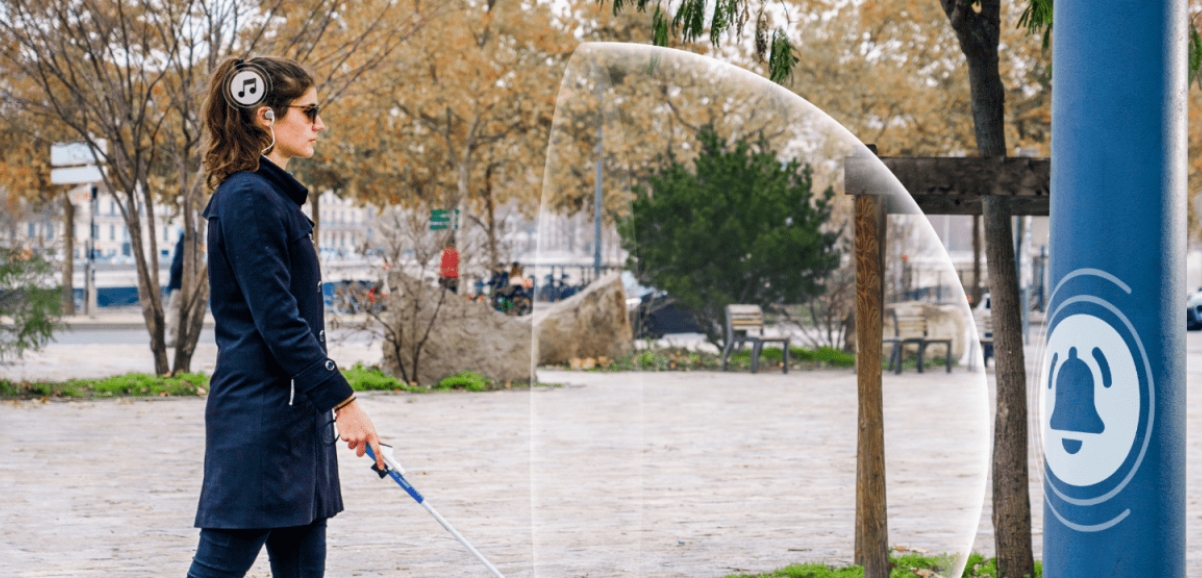
The French startup GoSense is the origin of a range of smart products designed for blind and visually impaired people. It concerns a complete ecosystem that integrates a community pedestrian GPS, an intelligent box for a white cane, and very special earbuds, all connected through a dedicated mobile application.
Revolutionizing mobility and independence for people who are blind
In France, nearly two million people are affected by visual impairment. Regarding the most pressing cases, between 60,000 and 70,000 people are completely blind. There are also more than 200,000 individuals with severe low vision and just under 950,000 who can be described as moderately visually impaired, that is to say with a corrected visual acuity below 3/10.
Based on this observation, the Lyon-based startup GoSense has set itself the mission of revolutionizing the mobility and independence of blind and visually impaired people. This company has been working for about a decade on a complete technological ecosystem built on spatial 3D sound, in order to create a genuine pedestrian “rear radar.”
« GoSense designs a totally unprecedented sensory augmentation technology in the service of the visually impaired. In an environment designed by and for sighted people, we found it necessary to improve accessibility for people with visual disabilities. », reads the “about” section of GoSense’s website.
A device to detect all obstacles
The brand’s flagship product is named Rango. It is a tiny, ultra-light electronic box. Weighing only 107 grams, it clips directly onto any standard white cane. The device uses ultrasonic sensors to scan the surroundings in real time up to a distance of 2.5 meters. Thus, the user benefits from a “virtual shield” capable of protecting them from head to toe and across shoulder width.
If traditional canes allow obstacle detection on the ground, the Rango device offers much more. Indeed, it detects objects at height (or at mid-height), such as tree branches, vehicle mirrors, or road signs. If the obstacle poses a real collision risk, the device emits an audible signal.
This signal is emitted into special earphones, named Noor. Unlike ordinary earphones that block the ear canal, those developed by GoSense sit in front of the ear. It is therefore a case of external air conduction.
A connected and community-based device
GoSense is also behind Wizigo, which is none other than a pedestrian GPS. It naturally works with the Rango box and the Noor earphones, via a dedicated mobile app. The app uses location data to guide the user with three-dimensional sounds that seem to come from the streets to be taken. The GPS can also remotely trigger physical audio beacons located near the entrances of shops, bus stops, and at traffic lights. Furthermore, the device incorporates a community dimension. Indeed, users can report in real time temporary obstacles, such as construction zones, scooters in the middle of the sidewalk, and also share points of interest of all kinds.
Finally, it should be noted that the GoSense ecosystem is fairly expensive (about 2,000 euros). However, it is nevertheless recognized as a medical device. Thus, it can be covered—at least partially—by aids such as the disability compensation benefit (PCH) from the Departmental House for Disabled People (MDPH). Also, it should be noted that GoSense manufactures its products in France, by people who are also visually impaired.
