
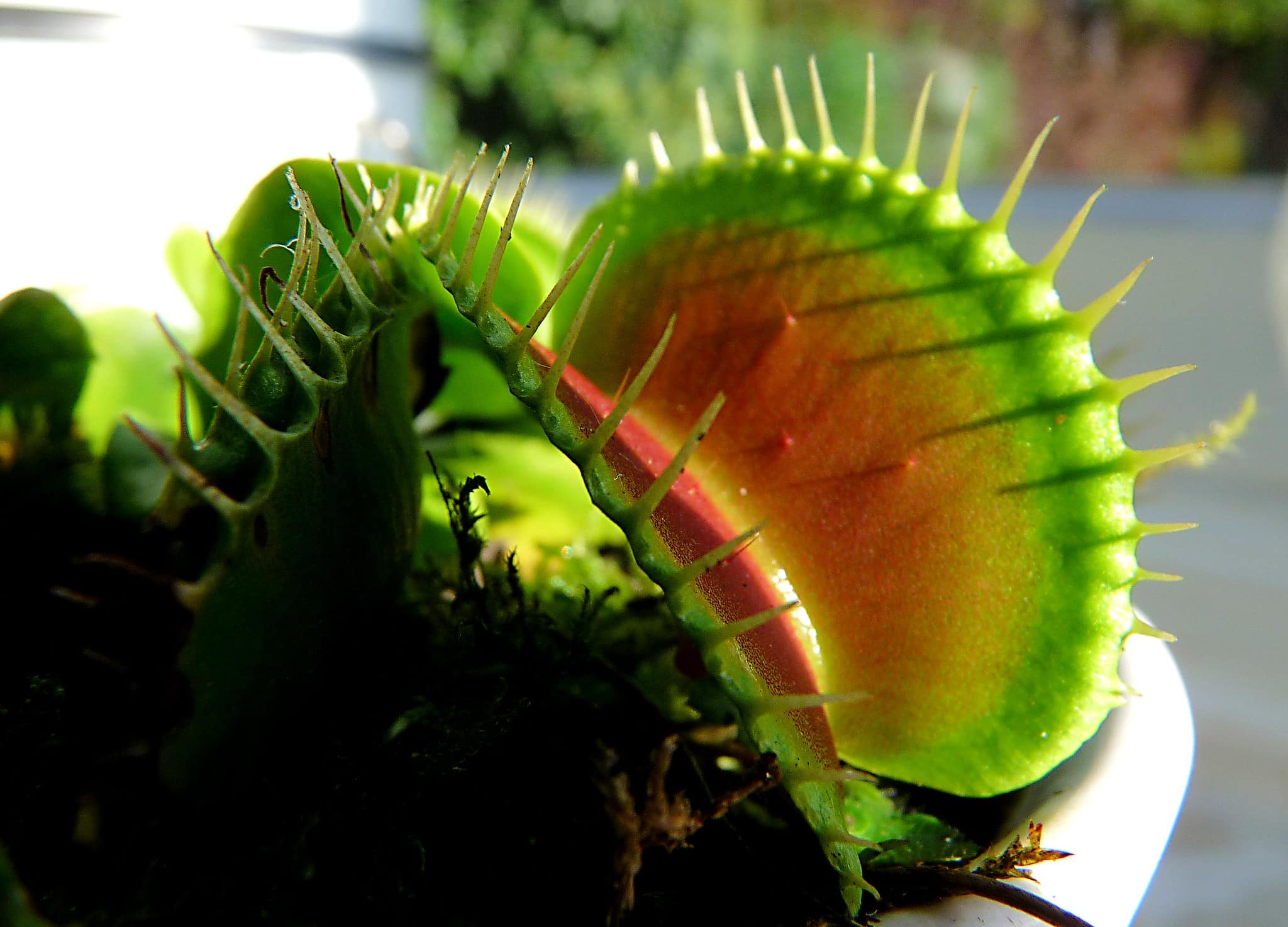
In Japan, biologists have sought to understand how a carnivorous plant could respond to the subtlest stimuli. According to the researchers, this concerns a highly sensitive electrical system that could reveal the potential presence of a surprisingly intelligent plant.
An Exceptional Sensing Capability
The Venus flytrap (Dionaea muscipula) is a carnivorous plant, perhaps the best-known species within its genus. Its distribution is confined to the United States, mainly across North and South Carolina. Its rosette-like leaves, measuring roughly 10 to 15 cm in diameter, bear on their upper portion the infamous “trap” that characterizes this group of plants, able to imprison flies, spiders, ants, and gnats. But how does the plant discern that prey is positioned at its trap?
A team from the Department of Biochemistry and Molecular Biology at Saitama University (Japan) published a study on the topic in the journal Nature Communications on March 30, 2026. The findings are striking because the Venus flytrap lacks a brain, a nervous system, or a ganglion. Moreover, the plant can precisely distinguish an insect from a mere drop of water, and a living prey from a dead one. It can also reject prey deemed too large to be handled.
A Primitive Nerve-Like Signal
According to the Japanese biologists, the trap is triggered by the leaf’s sensory hairs. Touching these hairs twice in rapid succession—within roughly twenty seconds—activates the trap, provided the pressures are sufficiently strong. Indeed, pressures that are too weak will not suffice to trigger the mechanism.
In practice, an electrical charge is generated via DmMSL10, a mechanosensor gene localized at the base of the hairs. A touch that is too light generates a very small charge, which remains confined within the plant cell and is effectively ignored. However, a touch strong enough generates a substantial charge, initiating a cascade that activates the trap and marks the start of the meal. For the study’s authors, the electrical charge in question can be likened to a primitive nerve signal.
“We developed a system for simultaneous recording at the single-cell level of calcium and electrical signals, as well as a micro-ecosystem to detect plant–insect interactions. A combination of innovative techniques allowed us to visualize the moment when external physical stimuli are converted into the propagation of intracellular biological signals; this facilitated the discovery of a two-step response system to mechanical stimuli in the sensory hairs: mechanosensing and signal triggering,” the study states.
Why Are These Findings Relevant?
For the researchers, the study’s results could open a new approach to understanding the exchanges between plants and their environment. The authors mention a possible “vegetal sensory intelligence” capable of responding to stimuli without a brain or nervous system. In the nearer future, further work using the Japanese team’s simultaneous-recording system could shed light on how these plants developed tactile detection systems by employing the DmMSL10 gene, which animals lack.
Ultimately, these findings could underlie projects across various domains, including biomimetics and soft robotics. It is also possible that certain innovations could impact agriculture, a sector where understanding the electrochemical language of plants could, in theory, help better anticipate and manage stress detection, pest control, or resilience in the face of ongoing climate warming.
