
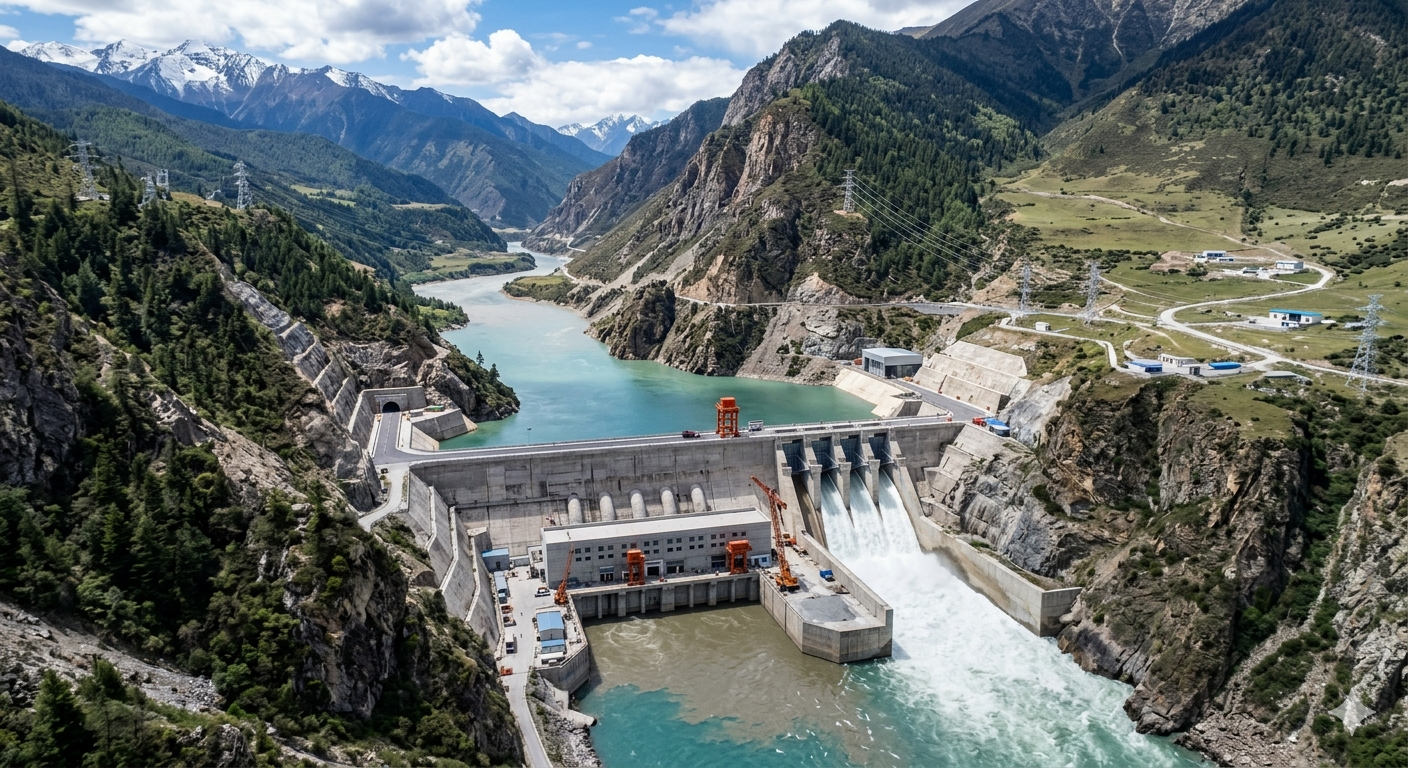
A year ago, China launched the largest hydroelectric project in human history. The Motuo mega-dam on the Yarlung Tsangpo is set to be rolled out gradually by 2033. What are the objectives of this project? Why does it raise serious concerns?
An annual production of 300 billion kilowatt-hours
First, it is worth noting that the Yarlung Tsangpo river is the highest on the planet. Its source lies in China at the Gyima Yangzoin glacier, and it flows at an average altitude of more than 4,000 meters. While it is the cradle of the Tibetan civilization, this river is also the upper course of the Brahmaputra, entering India from the northeast.
In July 2025, China launched the construction of the Motuo mega-hydro dam on this river, with phased operation expected to begin in 2033. The installed capacity will be 60 gigawatts (GW) and eventually, annual production should reach 300 billion kilowatt-hours (kWh). This output, equivalent to about three times that of the famous Three Gorges Dam on the Yangtze, is expected to meet the needs of around 200 million people.
For China, the aim is to address issues of electricity and water shortages in the most densely populated and industrialized areas of the country. It must be noted that energy demand is growing rapidly, while the country is also trying to reduce the use of fossil fuels as part of its carbon neutrality goal for 2060. Details of these objectives are outlined in a comprehensive article published by The Diplomat in February 2026.
A real technical challenge
The Motuo mega-hydro dam is not a conventional dam with a vast reservoir. Instead, the installation will take advantage of the unique topography of the Yarlung Tsangpo. The chosen site—the “Grand Canyon”—is where the river arcs around the Namcha Barwa mountain (the great “U”), losing more than 2,000 meters of elevation over barely 50 kilometers, generating extremely powerful rapids.
To harness the river’s power in this area, engineers are building a so-called “run-of-river” system. Concretely, the facility will take the form of five giant diversion tunnels piercing through the mountain, with the aim of directing water toward five hydroelectric plants in cascade before returning it to the river.
Diverse concerns surrounding the project
The future engineering masterpiece that the Motuo dam could become is unfortunately already at the heart of several controversies. Some observers fear serious geopolitical drift. Indeed, the Yarlung Tsangpo, becoming the Brahmaputra in India and then the Jamuna in Bangladesh, is vital for agriculture and the survival of roughly 130 million people in these two countries. As evidenced by a 2023 publication from the Takshashila Institute, India has already expressed concerns about China using this dam as a geopolitical lever to trigger droughts or artificial floods on its territory. This potential looming conflict is a reminder that the “water war” is not a theoretical concept.
There are also references to geological risks, more precisely seismic. Since the dam is being built in the heart of the Himalayas, geologists worry about possible collapses, landslides, or giant floods in the event of a major earthquake. It must be said that the Himalayan belt is an immense zone of tectonic collision spanning about 2,500 kilometers, one of the planet’s most active and dangerous seismic regions.
Finally, other concerns relate to environmental and human aspects. While construction is still underway, it is already disrupting the rich biodiversity of the Grand Canyon of the Yarlung Zangbo and is contributing to the displacement of indigenous populations.
