
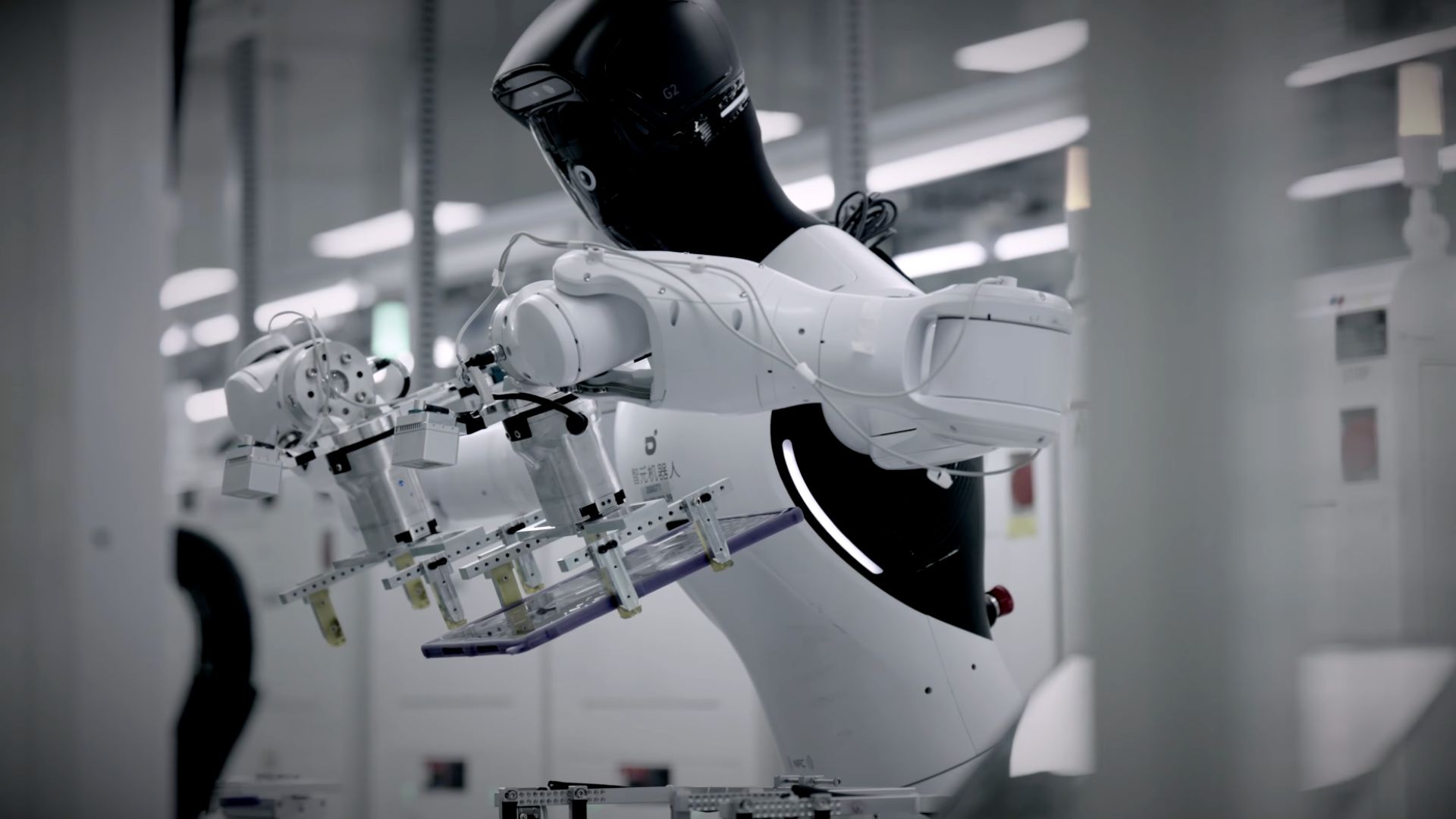
For six consecutive days, Chinese humanoid robots carried out quality checks in a real electronics factory, without interruption or staging. AGIBOT accumulated more than 64 hours of operation and a 99.99% success rate — precisely as the company announced the production of its 15,000th robot.
What you will learn
- How this six-day live demonstration differs from the usual staged robotics showcases
- At what speed AGIBOT has accelerated its humanoid robot production in recent months
- Why this rapid industrialization positions the company as a global leader in the sector
A demonstration in real-world conditions, not in a laboratory
The Chinese robotics manufacturer AGIBOT broadcast for six consecutive days a live operation from Longcheer’s electronics manufacturing plant in Nanchang. G2 humanoid robots performed real tablet quality-control tasks — inspection, defect sorting, material handling — alongside human operators, on an active production line, not simulated.
What sets this demonstration apart from the usual robotics showcases: the complete absence of staging. The robots operated on an already active production line, had to adapt to real task variations and real-time factory operations — an environment far more demanding than a controlled laboratory demonstration.
Figures confirming industrial reliability
Over the six days, the robots accumulated more than 64 hours of actual operation, completed 64,828 tasks spread across more than four distinct production streams, and directly contributed to the production of 17,625 tablets. The success rate reported: 99.99%.
According to Yao Maoqing, president of AGIBOT’s embodied AI business unit, the aim of this public broadcast was precisely to demonstrate a transparent answer to a core industry question: what embodied AI’s real-world industrialization actually requires, beyond marketing demonstrations.
This demonstration is not isolated in the sector. In May, the American company Figure AI completed a 200-hour autonomous broadcast with its Figure 03 robots, handling nearly 250,000 parcels without a single hardware fault — evidence of fierce global competition in the industrial reliability of humanoids.
A spectacular acceleration in production
Beyond the factory demonstration, AGIBOT announced the release of its 15,000th robot, delivered to its partner Longcheer — an AGIBOT G2, a wheel-driven mobile manipulator with a humanoid upper body designed for handling, inspection, and support on production lines.
The pace of production growth shows a marked acceleration. It took roughly a year for AGIBOT to move from 1,000 to 5,000 robots produced cumulatively. The jump from 5,000 to 10,000 units required only three months — more than a fourfold increase in production speed. This pace held steady up to the milestone of 15,000 units.
A dominant position in the global market
According to figures previously published by the company, AGIBOT claims the world’s leading share of humanoid robot deliveries, at 39% market share. This factory demonstration fits into a broader strategy to move humanoid robots from isolated pilot projects to widely deployed industrial production tools on a large scale.
