
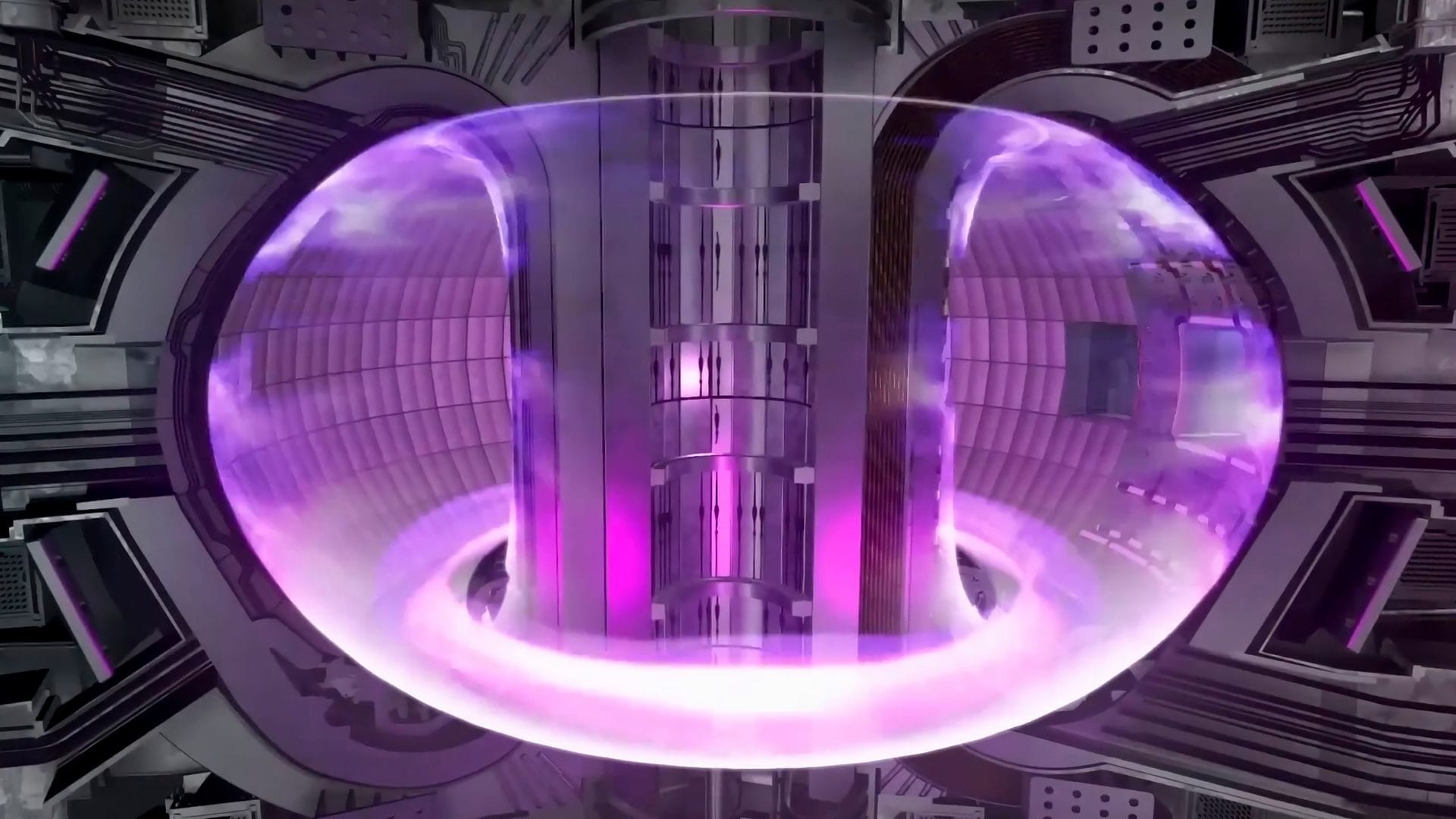
On January 20, 2025, in the control room of a laboratory in Hefei, Anhui province, a stopwatch crossed the 1,000-second mark. Seventeen minutes and forty-six seconds during which the EAST reactor sustained a plasma at temperatures exceeding 100 million degrees Celsius inside a chamber the size of a room. Six times hotter than the Sun’s core, held in check by superconducting magnets. That moment, seemingly modest in appearance, may represent the turning point physicists have awaited since fusion’s early promises were voiced around the 1950s.
To note
- Why 17 minutes feels like an eternity for plasma physicists
- This 1,000-second threshold: the benchmark no machine had crossed before EAST
- How a record broken in a matter of weeks re-energizes the global fusion race
A symbolic threshold finally crossed
The Advanced Superconducting Tokamak Experimental (EAST), nicknamed the “artificial sun,” sustained high-confinement plasma for 1,066 seconds on Monday, January 20, according to a statement from the Chinese Academy of Sciences, thereby surpassing its own previous world record of 403 seconds. In raw terms, the leap is a factor of 2.6. But what matters here is less the number than what it physically represents.
The 1,000-second threshold is regarded as a measure of operability. This milestone marks a major advance in fusion energy research, with this operating threshold representing the first condition demonstrating that a fusion reactor could theoretically run continuously. Before January 2025, no device anywhere had crossed this line. EAST did it, with 66 seconds to spare. Sixty-six seconds that, in plasma physics, are worth years of work.
To grasp the technical challenge, one must understand what a plasma is at this scale. Plasma is an unstable medium, particularly sensitive to temperature changes or fluctuations in magnetic fields. Stabilizing it demands constant adjustments and technological innovations. In January 2025, the reactor achieved this record thanks to technical improvements, notably a more powerful heating system. EAST has recently undergone several upgrades, including new plasma diagnostic tools and a doubling of the heating system’s power.
The phrasing of the director of the Institute of Plasma Physics at the Chinese Academy of Sciences, Yuntao Song, sums up the challenge with surgical precision: “A fusion device must operate in a stable and high-yield manner for thousands of seconds to enable autonomous plasma circulation, which is essential for the continuous energy production of future fusion power plants.” A thousand seconds, therefore, is the floor, not the ceiling.
A reactor designed to prepare ITER
EAST is not a lone reactor in its corner of Anhui province. It is part of the international ITER program after China joined the initiative in 2003, and it serves as a test bed for ITER technologies. The EAST tokamak can sustain plasma in the so-called “H-mode,” the high-confinement regime used by modern tokamaks, including ITER. This mode occurs when the plasma experiences intense heating by neutral beams, resulting in a sudden improvement in confinement by a factor of two.
Every second sustained by EAST is a precious datum for engineers assembling, at Cadarache, the reactor that must validate fusion on a large scale. In July 2024, ITER announced a new schedule that includes full plasma current by 2034, the start of operations with a deuterium–deuterium plasma in 2035, and deuterium-tritium operations in 2039. Now valued at roughly €25 billion, ITER represents one of the most significant scientific investments ever made in energy. A colossal investment, which presumes that experimental machines like EAST first prove that the underlying physics works.
The progress of EAST on this front is striking for its regularity. EAST became the first tokamak to maintain a plasma in H-mode for more than a minute at about 50 million degrees in November 2016. In July 2017, it was also the first tokamak to sustain that plasma for more than 100 seconds at the same temperature. EAST achieved its first stable H-mode plasma of 403 seconds worldwide on April 12, 2023. It then beat its own record 20 months later, on January 20, 2025, with 1,066 seconds. A trajectory that is almost exponential.
The French response, and what remains to be resolved
EAST’s record lasted only a few weeks. On February 12, 2025, the WEST tokamak, operated at the Cadarache center of the CEA, sustained a plasma for more than 22 minutes. A result that improves by 25% the previous duration record set by the Chinese EAST a few weeks earlier. The global scientific community finds itself in a productive form of competition: each record pushes the entire field higher.
One reality remains that triumphant press releases tend to minimize. Despite these steady advances, current reactors still consume more energy than they produce. Holding a plasma at 17 minutes and 100 million degrees is spectacular. Producing more energy than is input is another matter, which belongs to ignition, the holy grail of fusion. The best result achieved for fusion in general is a Q of 4.13, obtained during an inertial confinement fusion experiment at the National Ignition Facility in April 2025. This Q factor measures the ratio of energy produced to energy consumed: a commercially viable Q would require a much higher ratio.
What makes the January 2025 record particularly meaningful is its character: it is not a plasma at record temperature, nor a record of energy produced. It is a record of duration in high-confinement operation, the exact condition a commercial reactor will need to sustain continuously. This advance shows that knowledge of plasmas and long-duration technological control has become far more mature, allowing the prospect that fusion plasmas could be stabilized for long durations in machines like ITER. In a technology where progress has long been measured in seconds, jumping to seventeen minutes changes the very nature of the problem.
Sources: x.com | libremedia.ca
