
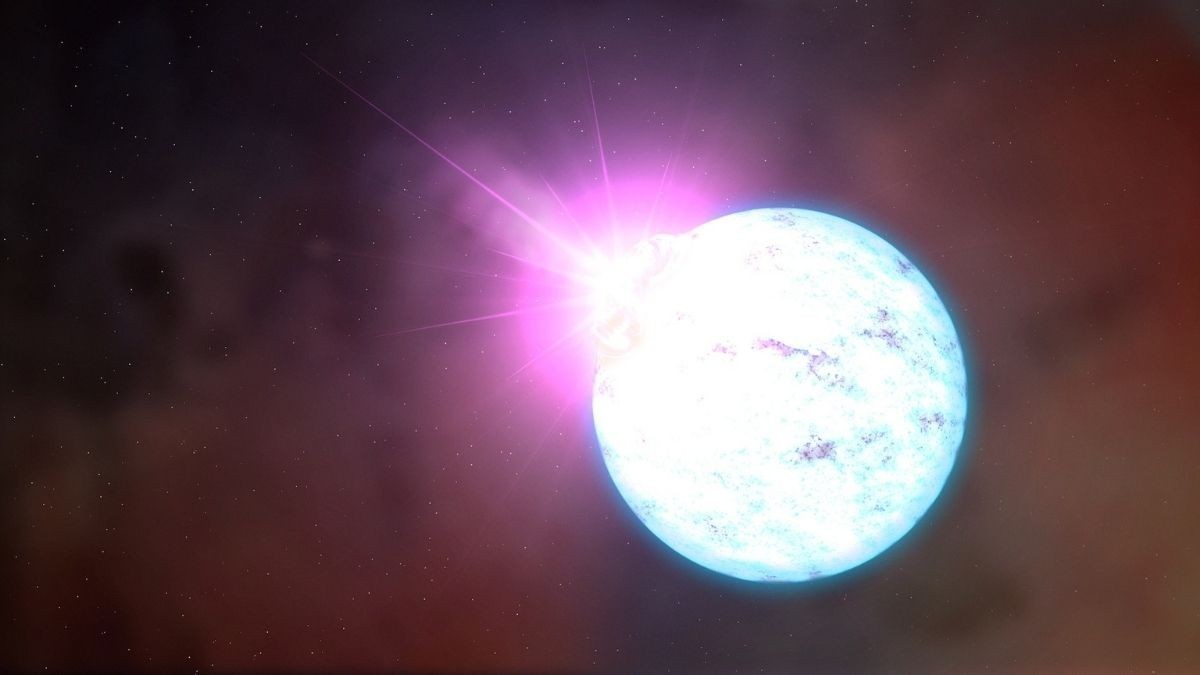
A teaspoon. Five milliliters. The kind of utensil that sits in any kitchen drawer. According to NASA, a teaspoon of neutron-star matter would weigh a billion tons on Earth, roughly the mass of Mount Everest compressed into a volume only slightly larger than the tip of your finger. This figure is not poetic metaphor. It’s plain, brutal physics.
Key takeaways
- Five milliliters of stellar matter outweigh the weight of all humanity: how is that possible?
- A star collapses in less than a second, squeezing two solar masses into a sphere about 20 kilometers across
- Magnetic fields so powerful that they could be deadly thousands of kilometers away: who is unlocking their secrets?
The most violent death in the universe
Neutron stars form after the demise of a star at least ten times as massive as the Sun. Toward the end of their lives, these giant stars fuse heavier and heavier elements in their cores, up to iron, which cannot fuse further. The star can no longer draw energy to balance gravity: its core collapses, and in less than a second, unimaginable pressures convert protons into neutrons. Less than a second. That is the time it takes for a giant star to flip into another realm of reality.
At the end of their lives, stars with masses eight times that of the Sun see their cores collapse under gravity. Their outer layers are expelled in a supernova, while the core contracts violently to form a neutron star. What remains after this explosion? A sphere about 20 kilometers in diameter, the size of a city, in which as much as twice the Sun’s mass can be compressed. To put it in scale: the Sun itself is about 330,000 times the mass of the Earth. All of that in an object the size of inner Paris.
When matter loses all of its emptiness
The density of a neutron star defies intuition, and for good reason: our everyday experience of matter misleads us. Atoms, around which electrons orbit, are normally mostly empty space. A classic physics analogy: if you placed a ball in the middle of a football field to stand in for the atomic nucleus, the electrons would orbit at a distance comparable to the stadium stands. Between the ball and the stands there is nothing. In a neutron star, all of that emptiness is eliminated.
The resulting density surpasses anything found in ordinary matter. Protons and electrons have been crushed together to form neutrons, hence the name. The mass density is on the order of a quadrillion kilograms per liter. For the human brain, accustomed to distinguishing solid from liquid, this is an unfathomable boundary. Keith Gendreau, the principal investigator of NASA’s NICER mission, described it this way: “If you took Mount Everest and compressed it into something the size of a sugar cube, that’s the kind of density we’re talking about.”
The numbers themselves invite a slow read. Five milliliters of neutron-star matter weigh about 5.5×10¹² kilograms, roughly 15 times the total mass of the world’s human population. A standard teaspoon contains about five milliliters. The entire human population, i.e., eight billion people with an average mass of 50 kilograms, sums to about 4×10¹¹ kilograms. A single teaspoon of neutron-star matter would exceed the weight of all living humans, by a factor of three to four.
Beacons in the darkness of the cosmos
These objects are not mere statistical curiosities. They spin on their axes at speeds that boggle the imagination. At birth, neutron stars bear a very high rotation rate, tens of revolutions per second. Some millisecond pulsars spin faster than 700 revolutions per second, which is more than a Formula 1 engine at full tilt, scaled to a 20-kilometer-diameter object containing two solar masses.
On November 28, 1967, Jocelyn Bell, a PhD student at the University of Cambridge, detected in her radio-astronomy data a perfectly regular signal, a pulse every 1.337 seconds, repeated with astonishing precision. Her supervisor, Antony Hewish, initially dubbed the signal LGM-1, for “Little Green Men 1,” because such perfect regularity seemed impossible to arise from natural causes. It was the first pulsar ever detected. The regularity of these signals is so exact that pulsars are considered for space navigation. “We use these pulsars the way we use atomic clocks in a GPS system,” explained Keith Gendreau of NASA’s Goddard Space Flight Center.
The magnetic field of a neutron star exceeds that of the Earth by a factor of a billion, a detail that often takes a back seat to the density figures, even though it is enough to make the object lethal at thousands of kilometers away. Some specimens, called magnetars, go even further: their emissions are believed to arise from the dissipation of extreme magnetic fields, a million billion times more intense than Earth’s.
What we still don’t know
The matter inside a neutron star is so dense that neutrons themselves could dissolve into their fundamental constituents—quarks and gluons—forming a state known as quark-gluon plasma. Equations of state for dense matter have been published, but there is no consensus on the exact internal structure. We are navigating at the very edge of what theoretical physics can describe.
The NICER X-ray telescope aboard NASA has, since 2017, been providing measurements of radii and masses that progressively constrain these models. It is estimated that there are roughly a billion neutron stars in the Milky Way. Each detection of a neutron-star merger via gravitational waves adds another constraint to the equations: it is through both gravitational waves and X-rays that the physics of extremes is gradually being deciphered. The first such merger, detected in 2017 and named GW170817, also confirmed that these collisions forge the universe’s heaviest elements, including platinum and uranium. The teaspoon you stir into your coffee this morning may contain atoms born from such a clash billions of years ago.
Sources: fr.quora.com | ck12.org
