
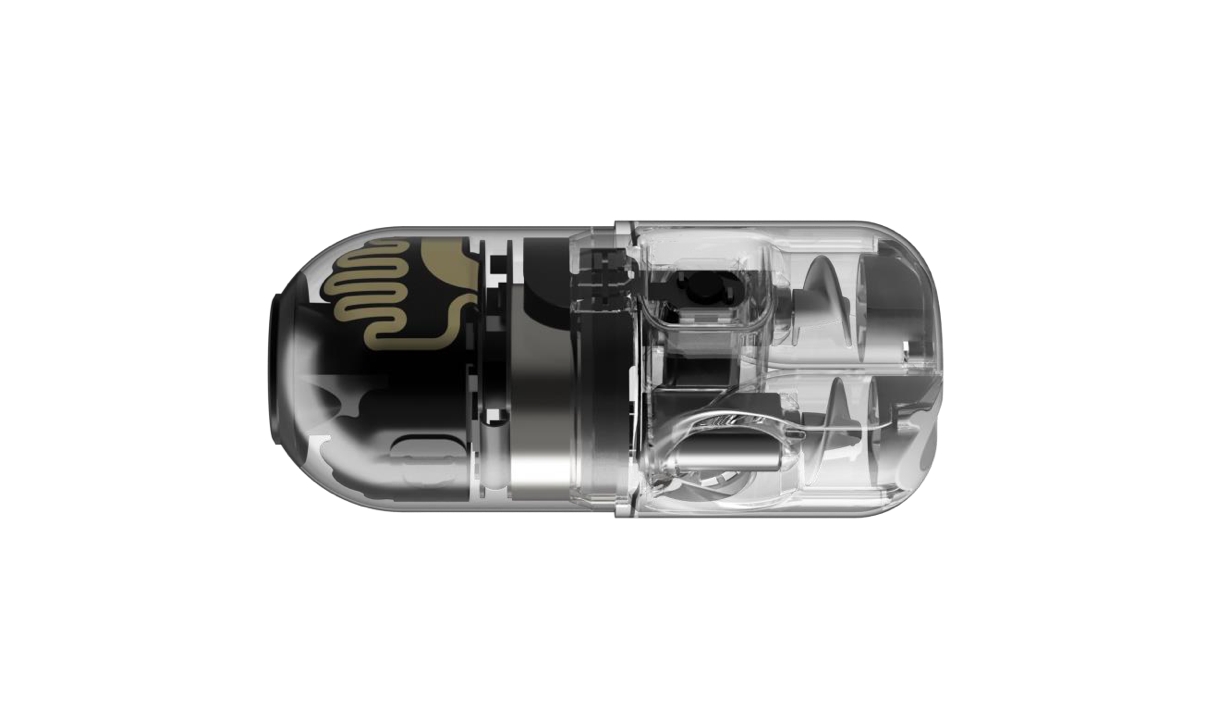
3D printing in the medical field continues to advance. Recently, an American startup has developed a compact, ingestible medical micro-robot. The objective? To replace traditional invasive endoscopies with a remote and painless solution to revolutionize gastric imaging.
A kind of robotic-pill to observe the stomach
As a reminder, the traditional upper digestive endoscopy (or gastroscopy) is used to observe, diagnose, and treat abnormalities of the inner lining of the upper part of the digestive tract, notably the esophagus and the stomach. This technique requires the insertion through the mouth of a flexible tube carrying a camera. While this exam remains a reference today, the constraints are unfortunately numerous: physical discomfort, anesthesia, recovery time, risks of complications, and heavy infrastructures.
To bypass these obstacles—particularly the invasive aspect—the American startup Endiatx has developed an ingestible medical micro-robot named PillBot, with most components originating from 3D printing in SLA resin. In practice, it is a capsule measuring 13 x 30 mm, about the size of a large vitamin pill, as the company explains on its website. Endiatx speaks of “the first living robots inside the body” and notes “to begin” with the stomach, suggesting that the future could bring other areas into consideration.
How PillBot works and its advantages
Unlike the old passive endoscopic capsules that simply transit through the system, the PillBot integrates small motors and propellers (water-jet propulsion). Thus, the device is capable of actively swimming in three dimensions. It also features a high-definition 2.3-megapixel camera offering a 160-degree field of view, a miniature battery for up to thirty minutes of operation, and LED lighting. Moreover, the physician can control the micro-robot’s movements in real time using a standard video game controller. However, the best mode of use appears to be the dedicated app, which receives the video stream directly via a wireless link.
According to Endiatx, the PillBot offers several advantages, starting with the absence of anesthesia since the patient simply swallows it with a large glass of water. In addition, the examination is compatible with telemedicine, i.e., remote consultations. The startup also announces a manufacturing cost of less than one hundred dollars for this disposable micro-robot which, after its mission, exits the body through the natural pathways within 6 to 24 hours.
A device awaiting FDA approval
Although the PillBot could enable ultra-fast screenings for ulcers, lesions, or stomach cancers, it is important to note that it remains at present an experimental medical device. It is therefore not yet available commercially. Endiatx has conducted early clinical trials on humans in New Zealand and collaborates with the Mayo Clinic in the United States. The Food and Drug Administration (FDA) has not yet approved the product, but the process is underway, with a final decision expected at the beginning of 2027.
In the long term, the startup wishes to integrate artificial intelligence to render the PillBot autonomous. However, Endiatx is also working on other projects, such as miniaturized models – like the PillSurgeon – which should be capable of performing micro-surgeries, biopsies, or delivering medications within the body with high precision.
