
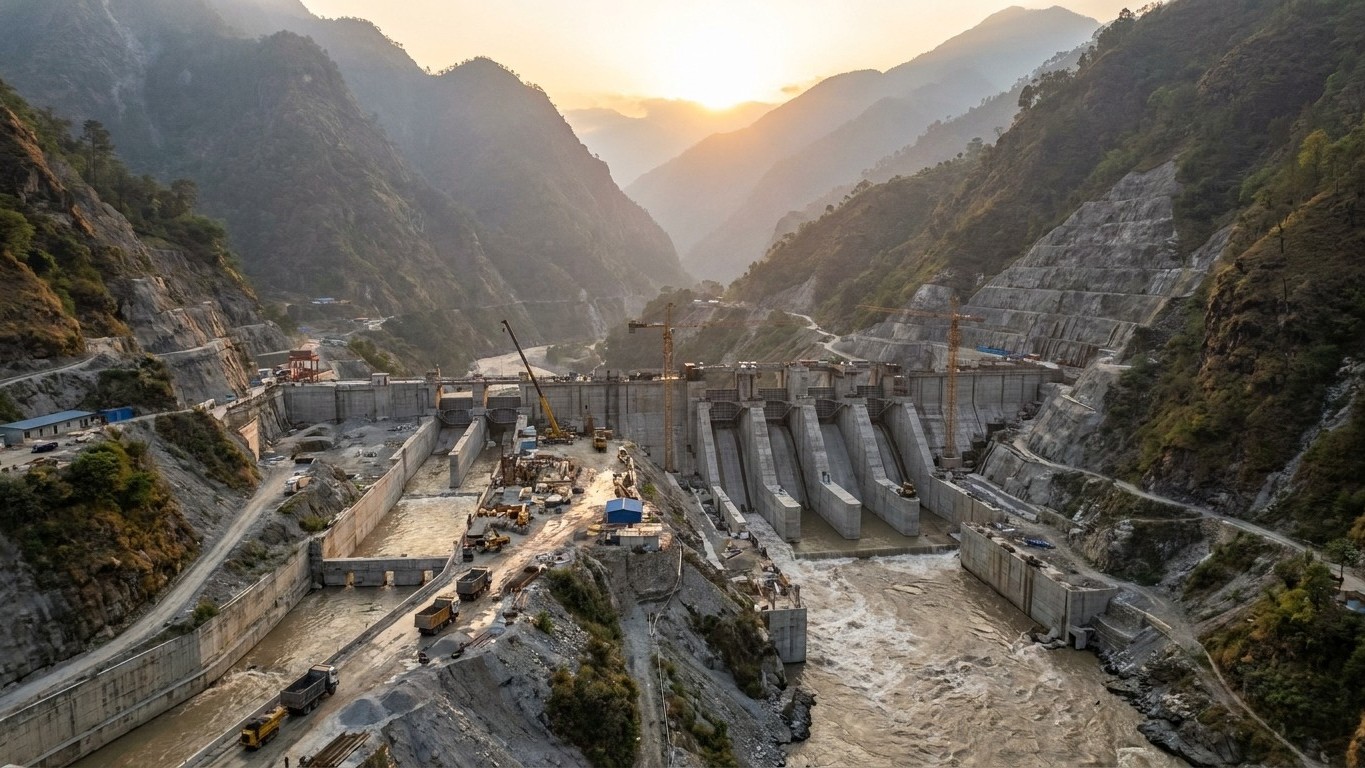
Two thousand meters of drop over fifty kilometers. That is the blunt geography that explains everything. The Yarlung Tsangpo, Tibet’s sacred river, makes a spectacular bend around Namcha Barwa before plunging toward the Indian plains, a natural setup that Chinese engineers have eyed since the 1960s. In December 2024, the Chinese government approved the project, officially launched on July 19, 2025. The Medog Dam is now under construction. And its dimensions are almost inconceivable.
Key takeaways
- A capacity of 60 GW: roughly triple the Three Gorges Dam and the equivalent of France’s entire nuclear fleet
- Four 20-km tunnels will divert the sacred river of Tibet entirely beneath an unstable mountain
- A hydraulic lever affecting India and Bangladesh: 625 million people depend on this river
A Concrete Monster Beneath the Sacred Mountain
With an expected capacity of 60 GW, nearly triple that of the Three Gorges Dam, this infrastructure could reshape the country’s energy production and alter the water balance of a swath of Asia. To grasp the scale: a 60 GW project equals roughly the installed capacity of France’s entire nuclear fleet. In short: a single construction site in a nearly inaccessible Tibetan canyon equals all of France’s nuclear reactors.
The technical trick that makes this possible lies in the site’s peculiar geography. The river climbs 2,000 meters in elevation over a short 50-kilometer stretch. Four 20-kilometer diversion tunnels would be bored through Namcha Barwa to reroute the Yarlung Tsangpo. The water diverted into these tunnels would drive hydro turbines connected to generators before returning to the river’s course. This is not a conventional dam in the classic sense. The project does not require a water-retention dam. This technique creates a steeper gradient for the water, increasing its force and energy potential. Building multiple underground power stations in series allows the same water to be used multiple times, maximizing electricity production.
The flow involved is dizzying: the tunnels would divert the river’s mighty course, carrying 2,000 cubic meters of water per second, the equivalent of three Olympic pools. The project comprises five hydroelectric plants in cascade. Construction is expected to last about ten years, and the project would produce 300 billion kilowatt-hours per year. That is as much as the total electricity generated by France’s nuclear fleet in a single year. This clean, renewable electricity could potentially power up to 300 million Chinese households.
The Price of Ambition
The announced budget stands at 1,000 billion yuan, or about $137 billion, more than four times the total 250-billion-yuan investment for the Three Gorges Dam. The project is fully owned by Power China, the state-owned hydroelectric giant. But money is not the only hurdle.
The site lies in a very deep canyon, in a zone of high seismic activity, unstable and prone to landslides. Chinese experts warn that a large earthquake could threaten the stability of the construction. Not to mention climate change, which is proceeding faster in Tibet than elsewhere, causing rapid glacier melt and multiplying rockfall risks. In 2022, engineers at the Sichuan provincial geological bureau specifically highlighted landslides and mud and rock flows induced by earthquakes as significant threats to the project’s stability.
The canyon itself has been a protected area since 1988. The Yarlung Tsangpo Canyon is the longest and deepest in the world, carved by the river as it traverses the eastern Himalayas in Tibet. With a depth of 6,009 meters at its lowest point and stretching over more than 500 kilometers, it even surpasses the Grand Canyon in the United States. Drilling four 20-kilometer tubes through one of the planet’s most unstable mountains is the concrete obstacle that Power China’s teams must overcome.
A Geopolitically Sensitive Valve 30 Km from the Indian Border
The Yarlung Tsangpo becomes the Brahmaputra in India and then flows into the Jamuna in Bangladesh. That name change encapsulates the tension at the heart of the matter. The Brahmaputra and its tributaries account for more than 30% of India’s water resources, and 94% of those of Bangladesh. 625 million people live in its basin, of whom 80% are farmers who rely heavily on water for their crops. 625 million. That is the combined population of the European Union, the United States, and Mexico.
The fear is that China could use this dam as a valve to curb the river’s flow, or conversely to suddenly increase its discharge, which would be particularly damaging during floods and the monsoon, experts warn. “It’s a time bomb,” warned Pema Khandu, the chief minister of Arunachal Pradesh, through which the Brahmaputra runs. New Delhi is not standing idly by: India plans counter-projects, including a hydroelectric project in the Siang upper district of Arunachal Pradesh, intended to supply 11 gigawatts.
China controls the sources of ten of Asia’s major rivers: the Mekong, the Irrawaddy, the Salween, the Indus, the Ganges, the Brahmaputra, among others. It is, in effect, the water tower of Asia. And it has consistently refused to sign binding treaties on water sharing with downstream neighbors. The Medog project fits into this logic of hydraulic power: producing clean energy to decarbonize an economy still 60% dependent on coal, while solidifying a lever of pressure on two neighboring countries with which relations remain tense.
China’s Energy Transition Against a Backdrop of Tensions
The river’s natural floods would be regulated by the dam, which seeks to homogenize the flow; seasonal fluctuations would disappear. And if floods are no longer widespread but standardized, the fertile deposits on the alluvial plains will be diminished, yet they are crucial for the soil structure and texture. Millions of Indian and Bangladeshi farmers cultivate thanks to the silt laid down each year by the Brahmaputra’s floods. Altering this cycle would directly affect their food security.
On the Tibetan side, the human dimension is equally heavy. The project has faced resistance from various quarters, including environmental groups, downstream countries, and Tibetan rights advocates. Similar hydroelectric developments in Tibet have already sparked protests, notably recent demonstrations against the Kamtok dam project on the Yangtze, which led to over 1,000 arrests.
The construction, planned for ten years, will nonetheless permanently transform this corner of the Himalayas. China plans to sell part of the produced electricity to neighboring countries, a way of presenting regional cooperation that remains essentially a unilateral demonstration of power. The idea of diverting an entire river under a mountain at an altitude of 1,500 meters, in a seismic zone, just 30 kilometers from a disputed border, speaks volumes about the appetite for infrastructure in a China that now builds where others would hesitate to even send a reconnaissance team.
Sources: france24.com | revueconflits.com
