
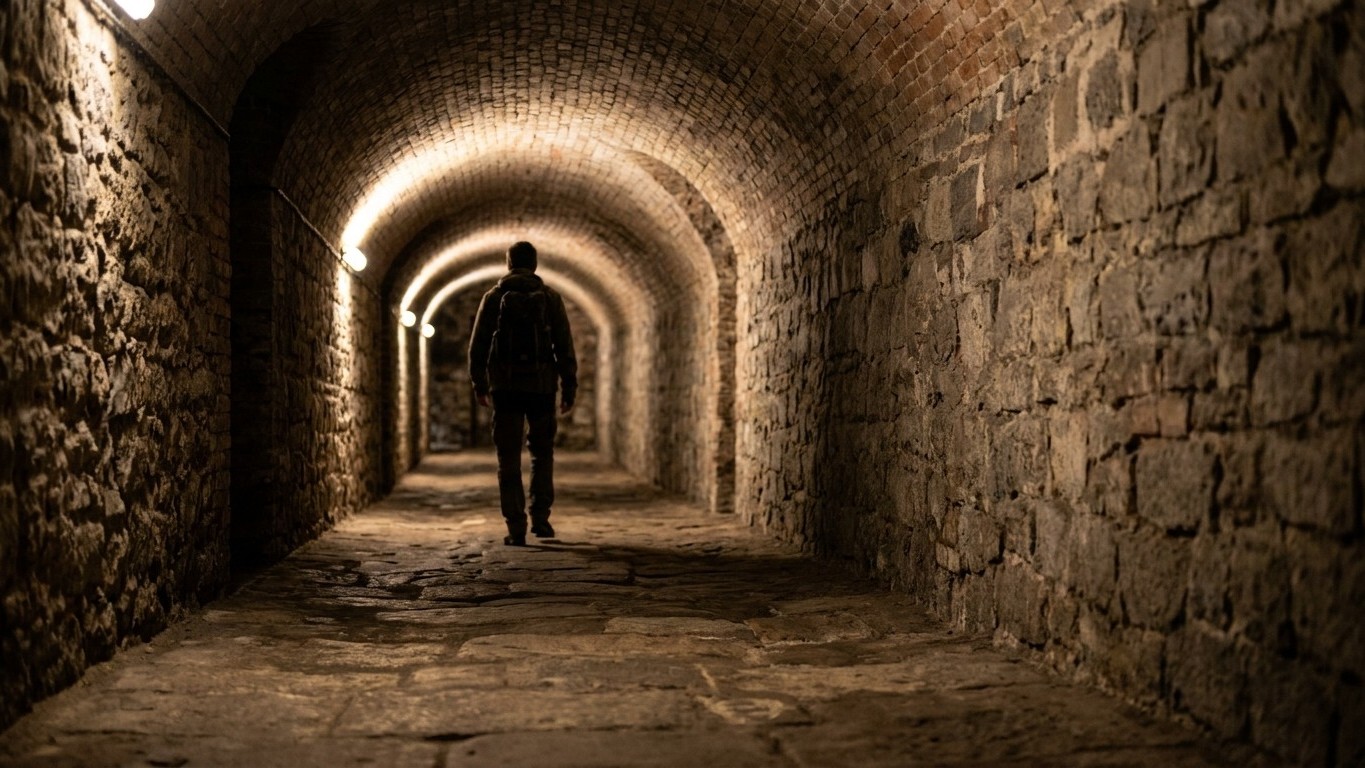
Two hundred years have passed with the question hanging over Liverpool, and still no one has uncovered the answer. Beneath the Edge Hill district lies a network of underground galleries, dug from 1810 onward under the direction of a tobacco trader named Joseph Williamson. The purpose of these tunnels remains unexplained, the subject of endless speculation: a commercial quarry of sandstone, a philanthropic gesture toward the poor, or the personal obsessions of a flamboyant eccentric. Williamson died in 1840 without ever uttering a word of explanation.
Key Points
- A labyrinthine network of tunnels runs beneath Liverpool since 1810, but their true purpose remains unknown
- Joseph Williamson refused any explanation in his lifetime and left no documents to justify the vast underground project
- Three competing theories persist: a philanthropic endeavour, a sandstone operation, or an apocalyptic refuge
From Misery to Edge Hill Sandstone
Joseph Williamson left his native Warrington at the age of eleven to work for a tobacco merchant in Liverpool. Through work, he climbed the ranks, married his boss’s daughter, and eventually bought the business. A meteoric rise, almost romanesque in its pace. In 1805, he acquired a plot on Mason Street in the Edge Hill district, then a broad outcrop of sandstone left in a state of rough abandonment, dotted with the scars of small quarries. There he built houses for himself, for his wife, and for neighbors of similar standing. According to a nineteenth‑century chronicler, James Stonehouse, these constructions were conceived in a manner that was, at the very least, “the strangest description,” with no discernible rational plan.
Then came the turning point. At a moment impossible to date precisely, the workers he employed for his building ventures were ordered to begin digging tunnels in the sandstone beneath the houses. The reasons for this underground network remain shrouded. No notes. No signed plans. Williamson never explained why he was constructing the tunnels. He left no diary or correspondence, and his will contained no guidance regarding any possible use for these galleries. A silence as thick as the walls of sandstone itself.
A Hand-Hewn Labyrinth
Between 1810 and 1840, Williamson employed entire crews to dig, carve, and construct this expansive subterranean network beneath Edge Hill. He personally oversaw design and planning, surrounded by hundreds of local workers, many of whom were unskilled at the outset. The result surpasses comprehension for a project of the early 19th century. Certain spaces reach vaulted ceilings that are breathtaking: the so‑called Banqueting Hall measures about 64 feet long by 27 feet high. By comparison, that would be the equivalent of a nine‑story building cut into living rock. Elsewhere, some tunnels are as narrow as 4 feet in width and 6 feet in height, passages where one must move forward doubled over, not knowing where they are headed.
Under the Edge Hill district sprawls this sprawling network of brick-vaulted tunnels that lead nowhere and seem to serve no obvious purpose. Williamson is even said to have tasked his workers with deliberately pointless chores: moving piles of stones from one place to another for no reason, or digging tunnels only to seal the entry off again. It sounds like a British variant of the Sisyphus myth, financed by a wealthy merchant. Some of these workers later found employment in railway construction, leveraging the skills honed within Williamson’s galleries.
Philanthropist, Mystic, or Stone Extractor?
The prevailing theory holds that Williamson launched these projects for philanthropic reasons, to keep men employed. Liverpool’s population was swelling at the time, and jobs were scarce, especially after the Napoleonic Wars ended in 1816. Some even speculate that he wished to provide work for soldiers returning from the Napoleonic campaigns. Williamson was aware of poverty: he himself noted that misery bred “the concomitant curse of stifled dignity.” Digging tunnels seemed, to him, a better alternative than dole distributions.
Yet the philanthropic explanation does not convince everyone. More recent research conducted by scholars at Edge Hill University suggests Williamson’s motives were not charitable, and that the earthworks were intended to quarry sandstone to supply a growing urban market. A third, more sensational hypothesis leans on apocalyptic fiction: some believe he was driven by religious fervor, preparing for an imminent apocalypse. Others, conversely, view the underground project as a natural extension of sincere devotion: a sanctuary where visitors could feel close to God. A shrine. A world‑ending bunker. Or simply a disguised quarry. All three interpretations coexist, with none prevailing.
The truth may be even harsher still: the chance to know the real reasons behind these tunnels was probably buried with Joseph Williamson. He kept his tunnels “hidden from curious eyes,” refused to show them, and was remarkably reluctant to permit anyone to inspect them. A man who hides something, or a man who simply does not know why he digs. Both portraits are troubling in equal measure.
Buried, Then Resurrected
By the end of the nineteenth century, Liverpool’s city authorities began filling the tunnels with rubble and demolition debris, a process that continued intermittently into the twentieth century. In 1867, a local satirical newspaper already described them as “a great nuisance”: sewers directly connected to them, at times forming a 15‑foot-deep pit of foul water. From a mysterious relic, the tunnels had become a dump.
Gradually backfilled, they remained largely inaccessible until archaeological investigations in 1995. Since then, volunteers have rediscovered and excavated an extensive network of galleries, chambers, and voids across several sites, with some sections now open to the public. Today the tunnels have become a popular tourist draw and even served as a backdrop for a Doctor Who series episode on the BBC. What Williamson had carefully concealed has, ironically, become one of Liverpool’s most visited places. Still without a complete map: no one knows exactly how far the tunnels extend. Volunteers continue digging, and every meter unearthed raises new questions rather than answering them.
Sources: historic-liverpool.co.uk | tripadvisor.com
