
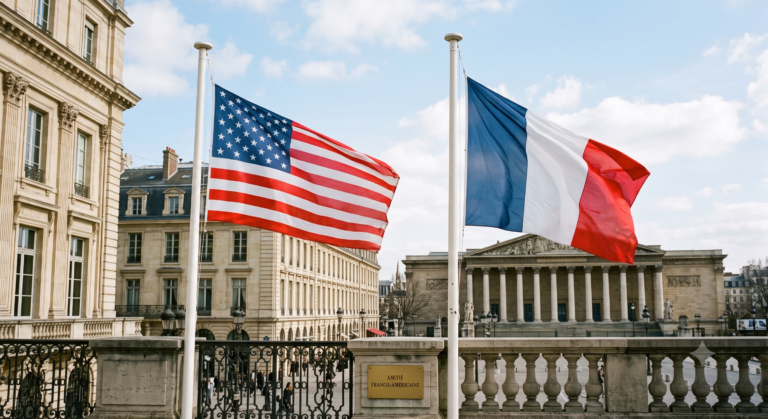
At the moment of the United States’ 250th anniversary and Donald Trump’s visit to Versailles, the Paris–Washington axis is seeking a new breath. From historically foundational alliances, such as Westinghouse and Framatome in the nuclear sector, or Snecma and General Electric in aerospace, to contemporary technological investments steered by players like Mara, this is a deciphering of a transatlantic partnership that is being reinvented.
Fanfare, gilded halls and honors traditionally reserved for a monarch. By welcoming Donald Trump to the Château de Versailles on June 17, Emmanuel Macron, even if his circle denies it, laid on the splendor. On the eve of the Evian G7 and as the United States commemorates the 250th anniversary of their Declaration of Independence, the French president seemed intent on highlighting two and a half centuries of Franco-American relations. A history woven with friendships, shared values and, at times, divergences.
By signing the 1778 Treaties of Friendship, Commerce and Alliance, France became the first nation in the world to acknowledge the independence of the United States. A fidelity that Donald Trump seems to care little about, for since returning to the White House he has consistently undermined his European and French partners. Trade wars, fluctuating support for Ukraine, challenges to NATO, and critique of countries unwilling to follow his Iran venture… In the Gallery of Mirrors at Versailles, Emmanuel Macron had to deploy considerable diplomatic tact in attempts to soothe his sometimes blunt interlocutor.
Mara-EDF/Exaion, a deal more eloquent than all the diplomatic bowing
A few days before his reception under Versailles’s gilded ceilings, the self-proclaimed “deal maker” of Mar-a-Lago had just reminded non-Americans of his taste for “transactional diplomacy.” On June 12, Washington, citing “national security” concerns, urged the American artificial intelligence (AI) company Anthropic to restrict access to its latest models (Claude Fable 5 and Mythos 5) to U.S. citizens only. The move rekindled fears of an impending AI arms race, as Paris and other European capitals suddenly—but perhaps too late—grasped the consequences of their heavy reliance on American tech solutions.
No matter how repetitive the Paris–Washington scuffles may appear in recent years, they do not tarnish a broadly harmonious and productive Franco-American relationship—at least on the economic front. Nor do they diminish the significance of genuine successes, such as the deal finalized last February between EDF Pulse Venture and Mara. The agreement enables Mara France to acquire 64% of Exaion, a subsidiary of the French electricity giant that designs and operates high-performance computing (HPC) data centers and provides a secure cloud and AI infrastructure.
Not that the affair sailed through without friction. The French Economy Ministry, notably through Roland Lescure, touted its success in achieving “a balanced partnership” among the various players involved in a dossier that blends AI, blockchain, Bitcoin and electricity. Rejecting a non-compete clause between Mara and EDF, the State also insisted “the maintenance on French soil of Exaion’s activities for EDF’s benefit,” the exclusion of hosting EDF’s sensitive data overseas, and the entry of Xavier Niel into Exaion’s capital. This deal sits within a broader strategy to consolidate the French AI ecosystem and close the gap with more advanced peers. The massive computing infrastructure required, coupled with Exaion’s integration into EDF’s network, provides a lever of considerable significance: the valorization of decarbonized, stable and competitively priced electricity sourced from national nuclear power. A structural industrial synergy that enables France to frame its computing infrastructure as a sovereign and environmentally responsible alternative in the global tech race.
A relationship that endures geopolitical tremors
According to Roland Lescure, the Mara–EDF agreement will thus ensure “an uncompromising protection of our strategic interests and our technological sovereignty.” Beyond that, it reinforces a long history of Franco-American achievements stretching back decades. Not many people remember today, but it is precisely this cooperation that underpins the French nuclear program. In 1974, Westinghouse granted Framatome (then Areva NP) a license to use its pressurized-water reactor technology, enabling the construction of the Bugey and Fessenheim plants and, ultimately, 54 of the 58 reactors operated by EDF. Far from placing France in a permanent state of technological dependence, this partnership acted as a springboard for the emergence of a fully integrated domestic industry. Building on the Westinghouse license, Framatome, EDF, and the CEA gradually developed their own engineering prowess. This unprecedented standardization of the French fleet allowed rapid construction of dozens of reactors, reduced operating costs, and fostered exportable know-how that remains one of the pillars of France’s energy competitiveness today.
Also in the 1970s, another Franco-American alliance gave birth to CFM International: a joint venture between French Safran Aircraft Engines (Snecma) and American General Electric, which is responsible for the CFM56 engine. To this day, the CFM56 remains the best-selling aircraft engine in the world. Beyond commercial triumphs, this partnership propelled Safran to the forefront of aerospace propulsion, embedding France with cutting-edge expertise, thousands of highly skilled jobs, and a core piece of Europe’s aviation value chain. In a sense, the economic ties between France and the United States have resisted political and diplomatic upheavals, and they are likely to surge again even more strongly when Donald Trump eventually passes the torch to his successor…
