
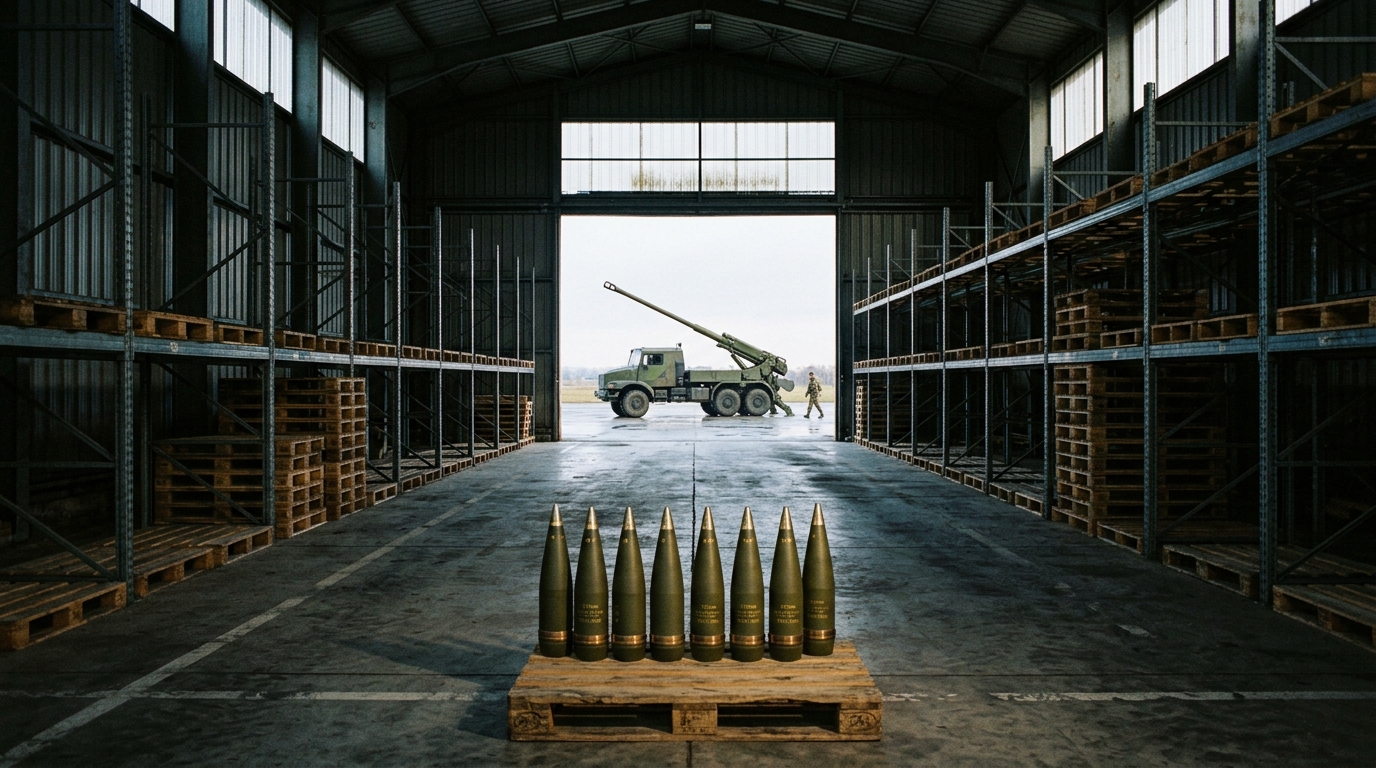
A glance at a world map suffices to be convinced: France possesses one of the most complete defense tools on the European continent. A nuclear arsenal, an aircraft carrier, Rafale fighters, a projection force capable of intervening at the four corners of the globe… on paper, it’s hard to top in Europe. But behind this impressive showcase lies a far more troubling reality, laid bare in a parliamentary report published in 2025. Its conclusion is unequivocal: in the event of a high‑intensity war, France’s ammunition stocks would hold for only three to four days of sustained combat, whereas Russia could endure for several weeks. A gap that prompts questions about our country’s true preparedness for a major and prolonged conflict.
- According to a 2025 parliamentary report, the French Army’s munitions would last only three to four days in a very high-intensity conflict, versus several weeks for Russia.
- France has only 76 Caesar howitzers, whereas at least 215 would be needed for a large-scale conflict, reflecting a lack of a sufficient stockpiling logic.
- The rapporteurs recommend extending the stock-duration benchmark from two to six months to close this strategic gap.
- The alarming findings of the 2025 parliamentary report
- Why the French army is severely short of ammunition
- Comparison with Russia and other military powers
- Possible remedies to close this strategic gap
The alarming findings of the 2025 parliamentary report
It was a rapid briefing mission of the National Assembly, led by deputies Matthieu Bloch and Jean-Louis Thiériot, that laid the issue bare. Published at the end of April 2025, their report devoted to French artillery delivers an uncompromising assessment of the Army’s capabilities in case of high‑intensity engagement. The figure that drew the most attention concerns artillery: according to the rapporteurs, it could sustain only six weeks in a prolonged conflict, due to a lack of ammunition in sufficient quantity. A timeframe that already seems short, but which hides an even more worrying reality for other components of the armed forces.
Because if we broaden the view to the entirety of the armed forces, the picture darkens markedly. A recent publication focusing on the air force revealed that its ammunition stocks would allow for only three days of intensive fighting, a figure that drops to a single day for Meteor missiles, essential to air superiority. By cross-checking all these data, a range of three to four days emerges as the most realistic window for a high‑intensity engagement that would mobilize several branches of the French armed forces at once. An interval that makes one dizzy when one knows that modern conflicts are often decided by endurance, not by sprint.
Why the French army is severely short of ammunition
How can a country endowed with nuclear weapons and a renowned defense industry find itself in this situation? The answer largely lies in a doctrinal shift implemented since the end of the Cold War. For decades, the Army was sized to conduct limited external operations, such as those in Mali or Afghanistan, not to sustain a high‑intensity conflict against a peers’ military power. As a result, stocks dwindled through budget restructurings, and the force structure today is calibrated for episodic missions rather than a prolonged confrontation.
The parliamentary report also highlights a telling figure: France has only 76 Caesar howitzers, whereas at least 215 would be required to face a large‑scale conflict. A gap that alone illustrates the magnitude of the problem. On top of that, the slow pace of the French defense industry in replenishing shell stocks, with current production capacity deemed insufficient to meet a sharp rise in needs, compounds the issue. The rapporteurs sum up the situation with a sharp formula: France has long reasoned along a flow logic, buying munitions as immediate needs arise, rather than a stock logic, which would involve building massive reserves in anticipation of a long and demanding conflict.
La comparaison avec la russie et les autres puissances militaires
It is precisely this comparison that gives the problem its full dimension. While the French Army struggles to hold for a few days, perhaps weeks depending on the component, Russia shows capacities of resistance measured in several weeks of intensive fighting. Moscow’s war economy, though criticized on many fronts, allows it to sustain a substantial flow of ammunition production, enough to feed a front over time. A striking contrast when one considers that France nevertheless allocates a sizable defense budget, yet fails to assemble reserves comparable to those of Moscow.
This gap can be partly explained by different strategic choices. The French Armed Forces have long relied on quality and technology rather than quantity, a prudent approach against asymmetric opponents, but one that reveals its limits in a high‑intensity conflict where the pace of ammunition consumption can reach dizzying levels, as witnessed on the Ukrainian front. That conflict has also served as a wake‑up call for many European staffs, revealing how ill‑suited the post‑Cold War stockpiles have become to the realities on the ground.
Possible remedies to close this strategic gap
In the face of this finding, the rapporteurs do not merely present an alarming diagnosis; they also propose concrete avenues. One of the most striking recommendations is to overhaul completely the reference duration used to calculate the stock level. A more recent Senate report, devoted to the 2026 budget, thus reiterates the proposal to raise this duration from two to six months, a scale change that would force the defense industry to produce and stock substantially more ammunition than today.
Progress is already perceptible in certain segments. The same rapporteurs note a gradual improvement, though still insufficient, regarding the stocks of mortar projectiles, whether 81 or 120 millimeters in caliber. This segment benefits from priority attention, directly linked to the ongoing development of mortar capabilities within the French army. Yet these advances, however encouraging, are not yet enough to close the yawning gap highlighted by the various reports. Increasing production rates, securing supply chains for raw materials, and fundamentally rethinking storage doctrine appear as the priority undertakings for the coming years so that the strength displayed by the French army finally translates into genuine endurance on the ground.
Ultimately, this case perfectly illustrates the gap that can exist between the perceived power of an army and its real capacity to endure over time. France undeniably possesses major assets, from nuclear deterrence to world‑renowned cutting‑edge equipment, but these striking capabilities are only valuable if they can be fed over the long term. The successive parliamentary reports have at least the merit of clearly diagnosing the problem and opening the debate on the means to mobilize. The task now is to turn these findings into concrete actions before a potential high‑intensity conflict comes, alas, to confirm these fears on the ground.
