
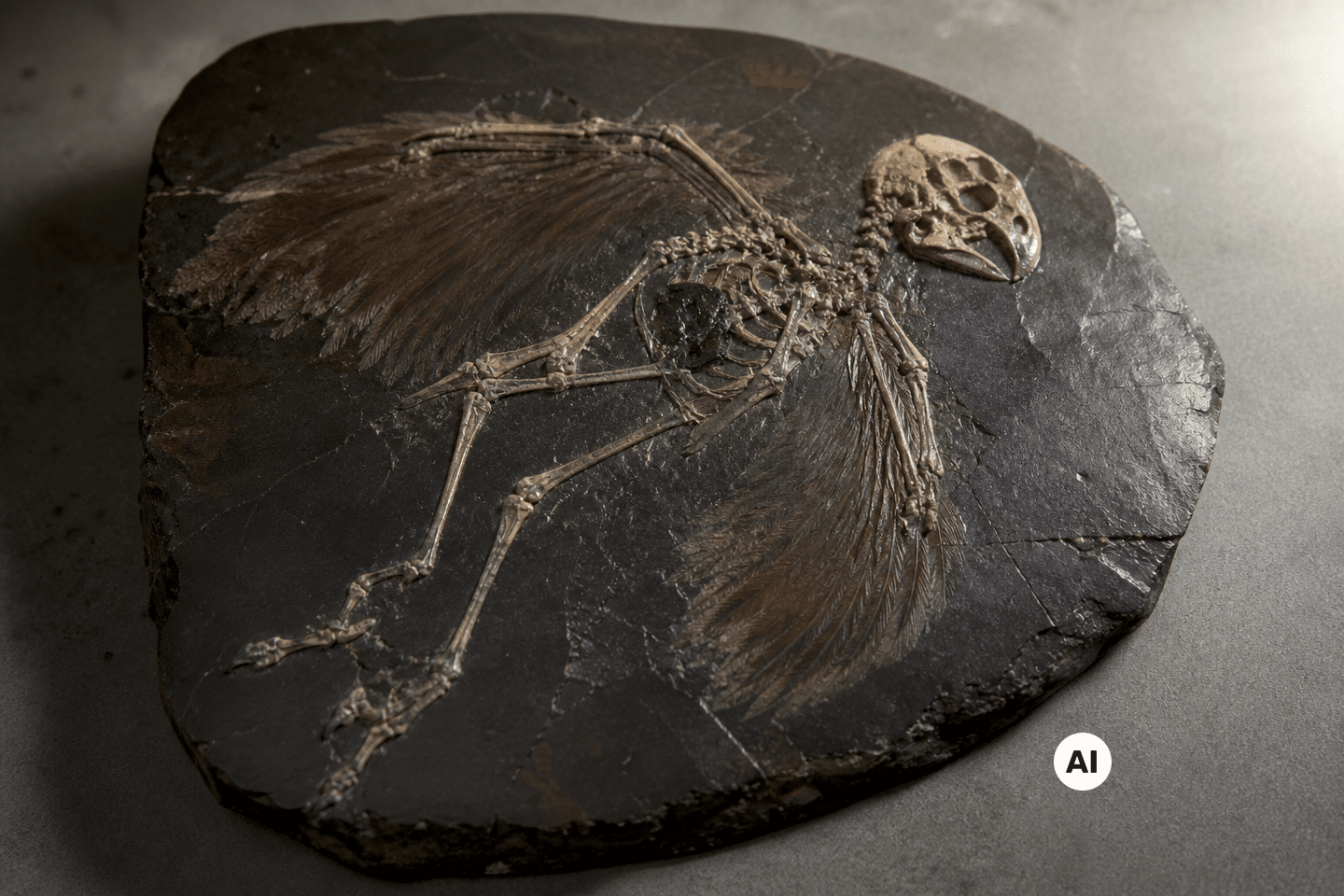
A 47-million-year-old owl has just delivered its last meal, preserved intact in its stomach since the Eocene. This German fossil, with its rare preservation, helps to better understand the period when these birds shifted to a nocturnal life. And the answer does not lie in its gaze, but in its wings.
- A 47-million-year-old owl fossil discovered at Messel still preserves a cockroach in its stomach, the first identifiable insect meal ever found in a fossil bird
- Its feathers, lacking a serrated leading edge and a fringed trailing edge, and its robust humerus show it did not yet possess the silent flight of modern owls
- This fossil places the owl’s shift to nocturnal life between 47 and 34 million years ago, challenging theories linking this change to competition from diurnal raptors and the rise of nocturnal mammals
- A 47-million-year-old meal frozen in stone
- Messel, the site rewriting the history of nocturnal raptors
- Eyes that betray a shift toward darkness
A 47-million-year-old meal frozen in stone
The story begins in the Messel Pit, near Darmstadt, Germany. It is there that the excavation team from the Senckenberg Institute unearthed, in 2025, the skeleton of a small bird. Measuring barely 12 centimeters long, according to Gerald Mayr, a researcher involved in the study published in Current Biology. The animal was given a name that sounds almost like the setup for a crime novel: Masillastrix blattophaga.
The skull is missing, probably dissolved or fragmented over millions of years. But the rest of the body has traversed time in remarkable condition. Sufficient for researchers to recover, still lodged in the fossilized stomach, the bird’s last meal: a cockroach with iridescent blue-green reflections.
This detail is far from anecdotal. It would be the first identifiable insect remains ever found as the last meal of a fossil bird. In other words, no one had yet been able to say as precisely what a species that disappeared tens of millions of years ago had swallowed just before dying.
Proof doesn’t stop there. A few meters from the fossil, at the same dig site, researchers found a cockroach very similar to the one discovered in the stomach. A clue that confirms this prey lived alongside the raptor, in the same environment, at the same moment.
Messel, the site rewriting the history of nocturnal raptors
That level of detail is no accident. The Messel Pit, a UNESCO World Heritage site, is regarded as the richest place in the world for understanding Eocene ecosystems. Fully articulated skeletons, feathers still visible, and, at times like here, preserved stomach contents are found there.
This kind of deposit acts a bit like a time capsule. The deposition conditions, in an ancient oxygen-poor volcanic lake, prevented rapid decay of soft tissues. The result: paleontologists have a snapshot of daily life for an animal, not just a scattered collection of bones.
In the owl fossil record, this level of detail is particularly valuable. The oldest known representative, Ogygoptynx wetmorei, dates back about 60 million years, but it reveals almost nothing about the species’ living habits. Another fossil, discovered in France and about 35 million years old, already shows humerus proportions typical of modern owls. Masillastrix blattophaga thus sits between these two chronological benchmarks, at a pivotal moment.
Eyes that betray a shift toward darkness
The missing skull deprives researchers of an obvious clue: it is impossible to measure the size of the eye sockets or the shape of the facial disk, the signatures usually associated with nocturnal raptors. It is therefore Masillastrix’s wings that had to speak for it.
In modern owls, silent flight relies on very particular feathers. A serrated leading edge, somewhat like a comb, that breaks up air turbulence, and a fringed trailing edge that dampens noise. This is what allows them to swoop on prey without the slightest wingbeat giving away their approach.
None of that is present in the Messel fossil. Its feathers show neither a serrated leading edge nor a fringed trailing edge, and its humerus proves distinctly more robust than that of today’s owls. Wings built for power, not stealth. This combination of clues places the shift toward predominantly nocturnal activity somewhere between the middle and late Eocene, i.e., roughly 47 to 34 million years ago.
This narrow window also upends two classic explanations often offered to justify the owls’ move to night: competition with diurnal raptors and the rise of nocturnal small mammals, their preferred prey. The problem is that these two groups did not diversify significantly until much later, around 20 to 25 million years ago. The timeline does not fit, and researchers will almost certainly have to look elsewhere for the real evolutionary pressures behind this shift to a nocturnal lifestyle.
This tiny 12-centimeter fossil reminds us that evolution sometimes hinges on details that might seem trivial, such as feather texture or bone thickness. Thanks to Messel and its extraordinary preservation, a meal interrupted 47 million years ago now allows us to reconstruct, step by step, the long path that led owls into darkness.
Source : Not a “night owl” yet: An extraordinary bird fossil from the Messel pit (senckenberg.de)
Article prepared with the help of AI · Our method
