
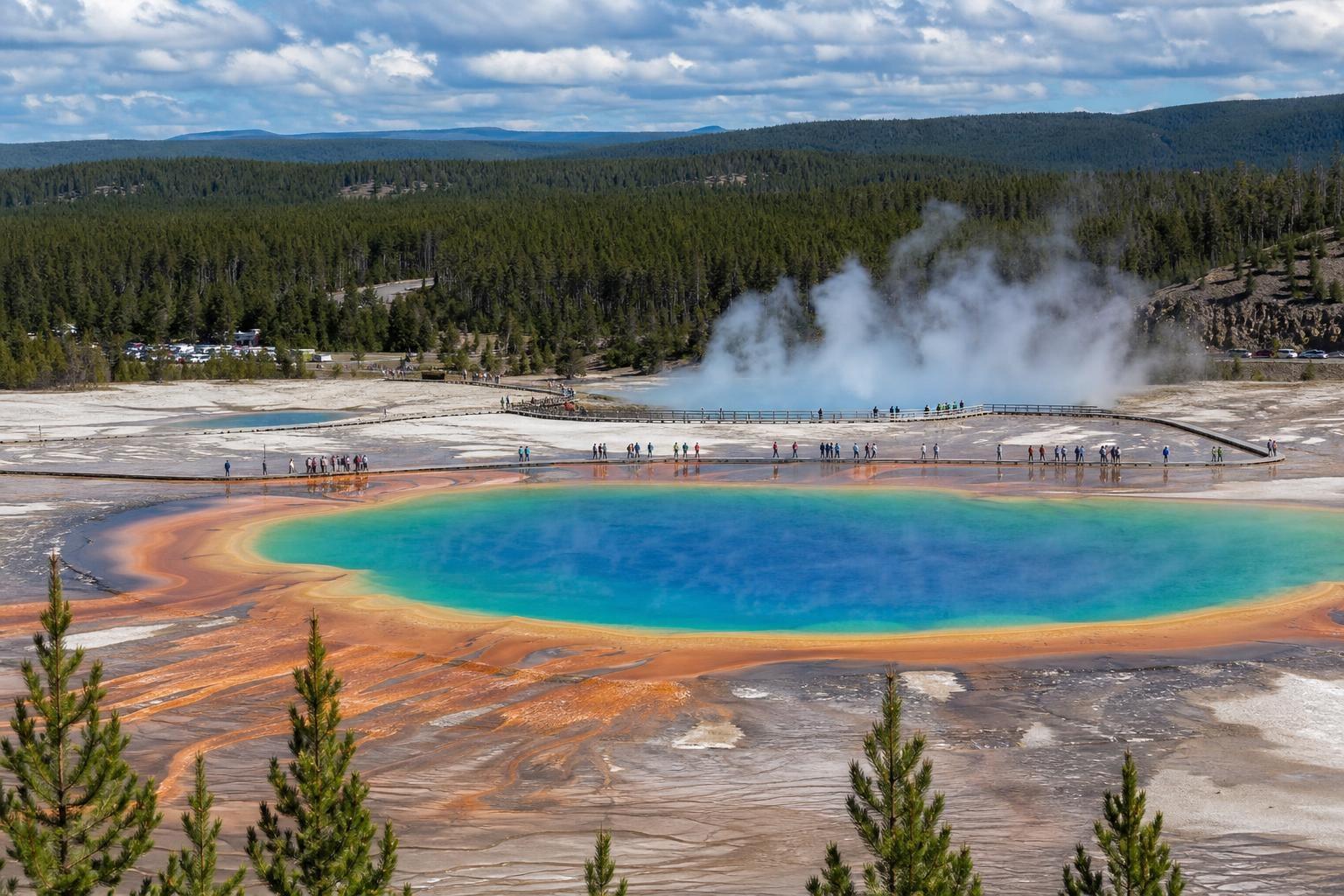
Yellowstone’s underworld is both vaster and more intricate than most people imagine. Beneath the park’s forests and geysers lies a two‑tiered volcanic system with enough molten material to dwarf familiar landscapes—a scale that turns analogy into awe.
In 2015, researchers mapped a deeper, previously unseen reservoir that holds the lion’s share of the system’s melt. Think “magma mush,” not a “boiling lake”: it’s a hot, crystalline sponge with pockets of liquid threaded through a network of cracks.
A hidden staircase under the caldera
The upper reservoir sits within the upper crust, a few miles below the surface, feeding the park’s iconic geysers and hot springs. Deeper down lies a second, larger chamber, imaged only in 2015, that bridges Yellowstone’s heat to the lower crust.
Most of the partial melt tallies in this lower body, making the system broader than earlier estimates. As one scientist quipped, “it’s a plumbing diagram with multiple basements.”
How scientists saw the unseen
No one drilled a hole into this fiery architecture. Instead, researchers used earthquake waves like medical scans, reading how vibrations slow through hot, partially molten rock.
By stitching thousands of seismograms with GPS‑measured uplift, they built a 3‑D portrait of Yellowstone’s interior. “Seismic tomography is our flashlight, and the crust does the talking,” one geophysicist likes to say.
How big is “big”?
Imagine the iconic canyon filled not with water but with a slurry of crystals and melt—and then imagine it many times over. That gives a sense of scale, even though the reservoir is mostly solid framework with melt in veins.
Crucially, the magma is not a single vat waiting to burst. It’s a dynamic mosaic with melt fractions typically well below eruption‑ready thresholds.
What volume doesn’t tell you
A large inventory doesn’t equal an imminent eruption. What matters are melt percentages, connectivity, gas pressures, and the rate at which heat and fluids reorganize.
Volcanoes “breathe” over centuries, pulsing between uplift and subsidence as fluids migrate. Yellowstone is no exception, and most cycles end with quiet degassing, not ash‑choked skies.
What would change before anything big
If the system were shifting toward trouble, multiple, independent alarms would likely sound together for months or years. Scientists watch for patterns that form a coherent story rather than isolated blips.
Key signals they track include:
- Swarms of shallow earthquakes migrating in space and time
- Sustained, rapid ground deformation across broad areas
- Sharp changes in gas output, especially sulfur and CO₂
From hot water to hard lessons
Yellowstone’s surface vents are pressure‑release valves, venting heat that would otherwise stay bottled. Each geyser’s roar tells a subsurface story about boiling, fracture networks, and shifting fluids.
“We learn as much from a quiet year as from a restless one,” researchers often remark. Patience, in this field, is a scientific instrument as vital as any sensor.
Why the second chamber matters
The deeper reservoir connects mantle heat to the upper crust, controlling how magma stalls, cools, and sometimes rises. It’s the staging floor where crystals grow, gases separate, and chemistry evolves.
By clarifying that deeper link, the 2015 imaging unified decades of scattered clues—from crustal thickness to unusual seismic wave speeds.
Rethinking “supervolcano” narratives
Pop‑culture frames Yellowstone as a ticking clock, but geology runs on messy timelines. The record shows many small eruptions, lava flows, and hydrothermal blasts—punctuated by rare, outsized events.
Risk lives in the details: where melt is connected, how gases accumulate, and whether fractures invite ascent. “Volcanoes fail to erupt more often than they succeed,” as the field dryly notes.
Science as stewardship
Continuous monitoring by interagency teams turns raw data into public‑facing advice. The goal is not prediction with a date, but evolving probabilities anchored in many lines of evidence.
When instruments disagree, that friction pushes better models and better questions. In uncertainty, transparency becomes a civic tool.
Standing at the rim of perspective
It helps to remember that Earth’s engines also power life’s comforts—geothermal heat, fertile soils, mineral wealth. The same restless planet that builds risk also builds our habitat.
Yellowstone teaches humility: immense volumes, deep time, and a living system that rarely behaves like a simple clock. Or, as one field note put it, “measure patiently, and the Earth will answer.”
