
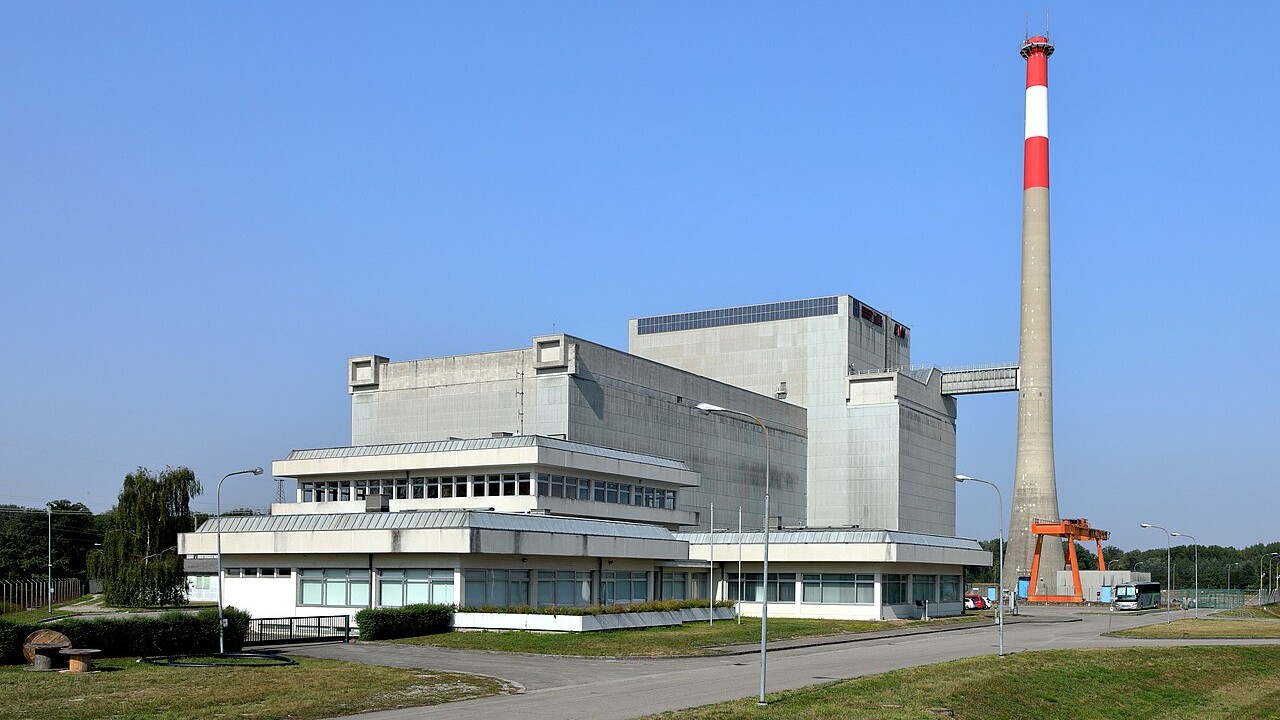
A ventilation stack rising 110 meters, a brand-new concrete edifice, a reactor loaded and ready to start. In Zwentendorf an der Donau, on the banks of the Danube, just a few dozen kilometers from Vienna, this nuclear power plant has stood since 1978. Yet it has never produced a single kilowatt-hour. The country paid, built, completed, then renounced it, by a slender margin of votes.
Key takeaways
- A pivotal referendum decided by only a few thousand votes the fate of a strategic project
- A monumental bill paid in full for an infrastructure never brought online
- An unforeseen conversion that turns failure into a paradoxical asset
A Titanesque Construction Drowned by 30,000 Votes
Everything begins in April 1972. Austria wants to follow its European neighbors into the nuclear venture, and the plan calls for a 730-megawatt Boiling Water Reactor, designed by the German giant Siemens, a technology proven across the Rhine. Zwentendorf was to be only the first step: it was meant to inaugurate a series of plants delivering electricity to six million Austrian households.
Five years of work later, the building is completed. But the chancellor at the time, Bruno Kreisky, chooses to settle the question at the ballot box, submitting the plant’s commissioning to a referendum, once the work is finished. A political wager that goes awry. The vote takes place on November 5, 1978, and the result reads like a thriller: with 64.12% turnout, the “No” wins by only 30,068 votes, i.e., 50.47% to 49.53%. A few thousand ballots are enough to bury a colossal industrial project.
The public sanction immediately becomes a legal brake. Right after the referendum, in December 1978, Austrian lawmakers pass a law banning the use of nuclear energy—Atomsperrgesetz. And the matter does not stop there: after the Chernobyl disaster in 1986, the scope of this law is strengthened in 1999 with the “Law for an Austria without Nuclear Energy,” which is incorporated into the country’s Constitution. Since then, no Austrian party has seriously questioned this renunciation that has become state doctrine.
A Bill That Keeps Running
The exact amount spent on the project is debated depending on the method of conversion, but the scale remains staggering. At the time of the referendum, construction was finished and had already cost 5.2 billion schillings, equivalent to about 1.3 billion euros. Some more recent estimates, adding long-term site maintenance, go further: direct costs including post-construction measures would reach 14 billion Austrian schillings, around 1.017 billion euros at nominal value. Regardless of the figure chosen, one fact stands: Austria financed entirely, down to the last bolt, an infrastructure that it subsequently condemned to inactivity.
From Ghost Plant to Spare-Parts Repository
Pulling down such a concrete behemoth made little economic sense, and letting it languish was even less sensible. The successive owners sought, and found, unexpected uses. Since 2005, the site has become literally a full-scale spare-parts warehouse: the plant contributes to the upkeep of its five German sisters built on the same blueprint, and turbines, pipes, and other parts are sold to replace worn components of the German plants still in service. A reactor that never ran ends up prolonging the life of those that do generate electricity on the other side of the border.
The site has also become a valuable training ground for an entire profession. Zwentendorf serves as a school for German engineers, who come to practise assembly and disassembly at real size, without irradiation risk. It is a paradoxical advantage: having never operated, the installation has never been contaminated. Nuclear technicians from across Europe come to train on full-scale equipment that has never been contaminated, a setup nearly impossible to replicate elsewhere on the continent. Zwentendorf’s failure, by force of circumstance, has thus made it one of Europe’s best open-air simulators.
The setting has also attracted the silver screen. The plant has served as a filming location, notably for Rebecca Zlotowski’s Grand Central, with Tahar Rahim and Léa Seydoux in the lead roles. An intact control room, corridors frozen in the 1970s, gauges and era-appropriate dials: the site offers an industrial authenticity that no studio could artificially recreate. Today, the plant is even open to public tours, inviting those curious to see with their own eyes this frozen relic of Europe’s energy cold war.
The Symbol of the Atom Turned into a Solar Showroom
Perhaps the most ironic twist concerns the roof. In 2005, the energy company EVN bought the site with the aim of turning it into a renewable-energy production site. Four years later, the project came to fruition: in 2009, EVN installed a photovoltaic plant on the site, with an investment of 1.2 million euros. About 1,000 solar panels were installed on the roof, on part of the southeast facade and especially on the land of the former nuclear plant, producing around 180,000 kWh of renewable electricity per year and becoming one of Austria’s most powerful solar farms.
Production remains modest on the scale of a country, but the symbolic reach far outweighs the kilowatt-hours actually fed into the grid. A building designed to embody the power of the atom now serves as a frame for photovoltaic cells, on a site where the telephone line once linked directly to the federal chancellery still sits, intact, on the abandoned dashboard.
Sources: lenergeek.com | sortirdunucleaire.org
