
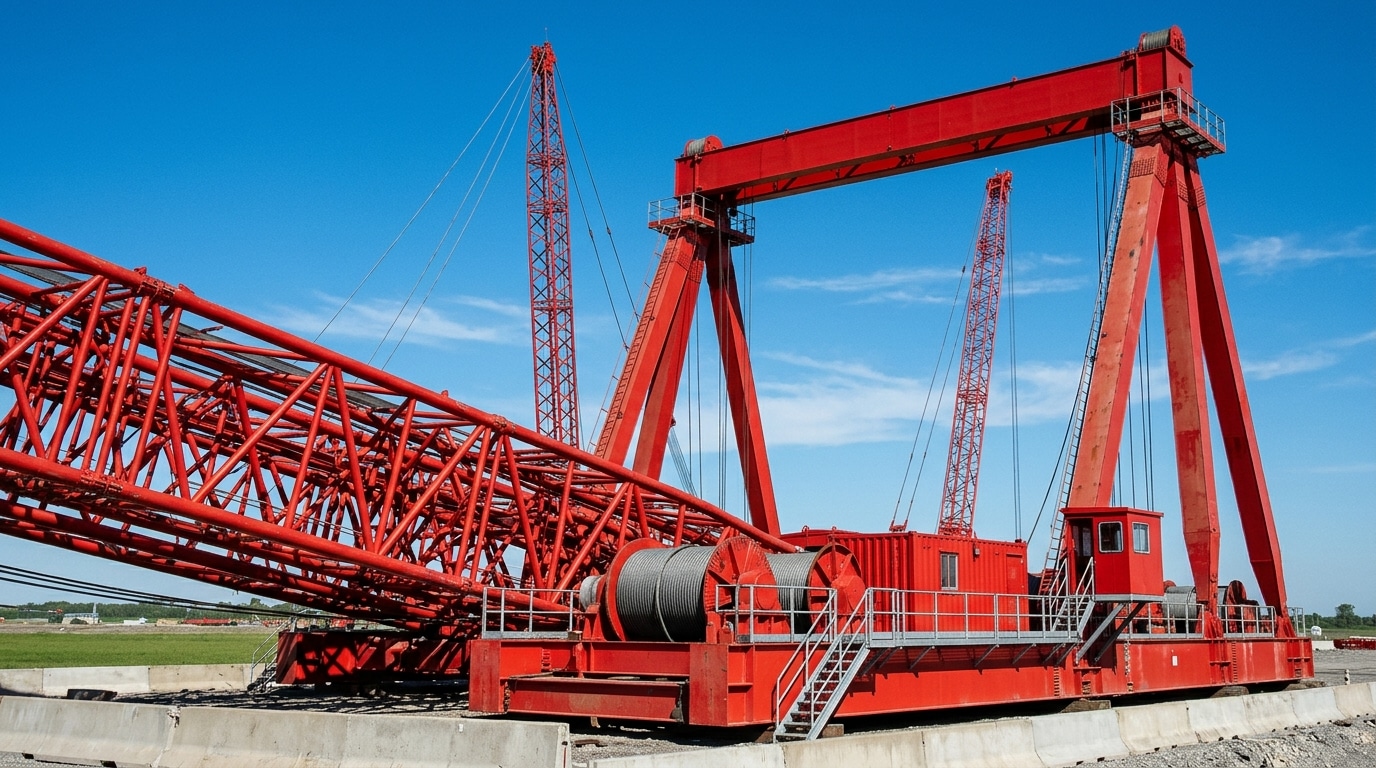
A crane capable of lifting 6,000 tonnes, the equivalent of several Eiffel Towers, yet unable to travel a single meter on its own wheels. That is the paradox signed by Mammoet. The Dutch group has just unveiled the SK6000, a steel behemoth designed for the planet’s most titanical construction sites, starting with nuclear projects.
- The Mammoet SK6000 can lift up to 6,000 tonnes and hoist 3,000 tonnes to a height of 220 meters, but it rests on a fixed circular track rather than wheels or tracks
- The crane runs entirely on electricity and targets especially the next-generation nuclear sites requiring the handling of very heavy prefabricated modules
- By the end of 2025, despite Lloyd’s Register–approved tests, the SK6000 had not yet been deployed on an actual site against its rival the Sarens SGC-250 “Big Carl”
- 6,000 tonnes aloft: the feat that doesn’t sit on wheels
- A circular track rather than tracks: the secret of its stability
- 220 meters tall and zero emissions: Mammoet’s weapon for tomorrow’s nuclear era
6,000 tonnes in the air: the feat that doesn’t rely on wheels
Impossible to discuss the SK6000 without mentioning the numbers that make one’s head spin. This annular crane boasts a maximum lifting capacity of 6,000 tonnes, which Mammoet says makes it the most powerful land-based crane ever built. To put a concrete figure on it, it can lift 3,000 tonnes to a height of 220 meters, roughly the height of the Montparnasse Tower.
But all that power comes at a price. To stay stable under such a load, the SK6000 relies on 4,200 tonnes of ballast, spread across more than 40 shipping containers filled with sand and gravel. The result is ground pressure that can reach up to 30 tonnes per square meter, a figure that alone explains why this crane cannot roll like a conventional site vehicle.
Its main mast peaks at 171 meters, and by adding the fixed jib, the total lifting height climbs to 274 meters. In short, the SK6000 is not designed to move loads across long distances, but to seize up to 2,000 tonnes from a block and deposit them at a distance roughly the length of a football pitch away. It is a tool of precision, not a vehicle.
A circular track rather than tracks: the secret behind its stability
Here is the detail that changes everything, answering the somewhat enigmatic promise of a crane that doesn’t roll. Unlike conventional mobile cranes equipped with tracks or oversized wheels, the SK6000 operates on a circular rail laid directly on the ground. It literally spins on its own axis, like a gigantic industrial carousel, rather than advancing across a site.
This technical choice is hardly incidental. By distributing its colossal weight over a fixed annular structure, Mammoet avoids the mechanical stresses that would come from moving such mass over long distances. The crane stays anchored at a precise point on the site, rotates around its central axis, and can lift and place loads with a stability that tracks would struggle to guarantee at this scale.
Before delivering this machine to job sites around the world, Mammoet wanted to ensure it would live up to its promises. Assembly of the crane began in June 2024 at Westdorpe, Netherlands, with the help of other group cranes, including a 250-ton crawler crane. The subsequent tests lasted three months under the supervision of Lloyd’s Register, with structural tests pushed to 125% of the admissible load for each mast configuration, from 127 to 171 meters.
220 meters tall and zero emissions: Mammoet’s weapon for tomorrow’s nuclear era
Beyond sheer power, the SK6000 stands out for a detail that matters more and more on industrial sites: it runs entirely on electricity. No diesel engine roars to feed this mass of steel, making it a tool tailored to the environmental requirements of today’s major projects, with nuclear at the forefront.
That is precisely where the SK6000 wants to make its mark. Next-generation nuclear plants require handling ever heavier and larger prefabricated modules to speed up construction and limit on-site work. A crane capable of lifting 220 meters high while remaining clean on energy meets that need, whether for reactors, steam generators, or massive industrial structures.
One non-trivial logistical detail remains, since transporting such a mastodon is a logistical puzzle. Once dismantled, the SK6000 fits into about 300 containers, shippable by container ships to any project worldwide. In this field, it faces a well-established competitor, the Sarens SGC-250 nicknamed Big Carl, towering 250 meters and capable of lifting 5,000 tonnes. That machine has already proven itself by completing a 500-ton reactor lift in two days at the Hinkley Point C site in the United Kingdom. Against it, the SK6000 appears to offer a higher theoretical capacity, but as of the end of 2025, it had not yet been deployed on its first real project.
Between technical promises and field testing, the battle of the giants cranes is only just beginning. The SK6000 has demonstrated its power in the lab; it now must prove itself on a real construction site. A first deployment could mark the true start of its career and confirm whether Mammoet has found the tool that will redefine the standards of industrial lifting.
👉 A small gesture for Space Group? Follow us on Google, add us to your bookmarks, and find us on Google News so you don’t miss any discovery.
