
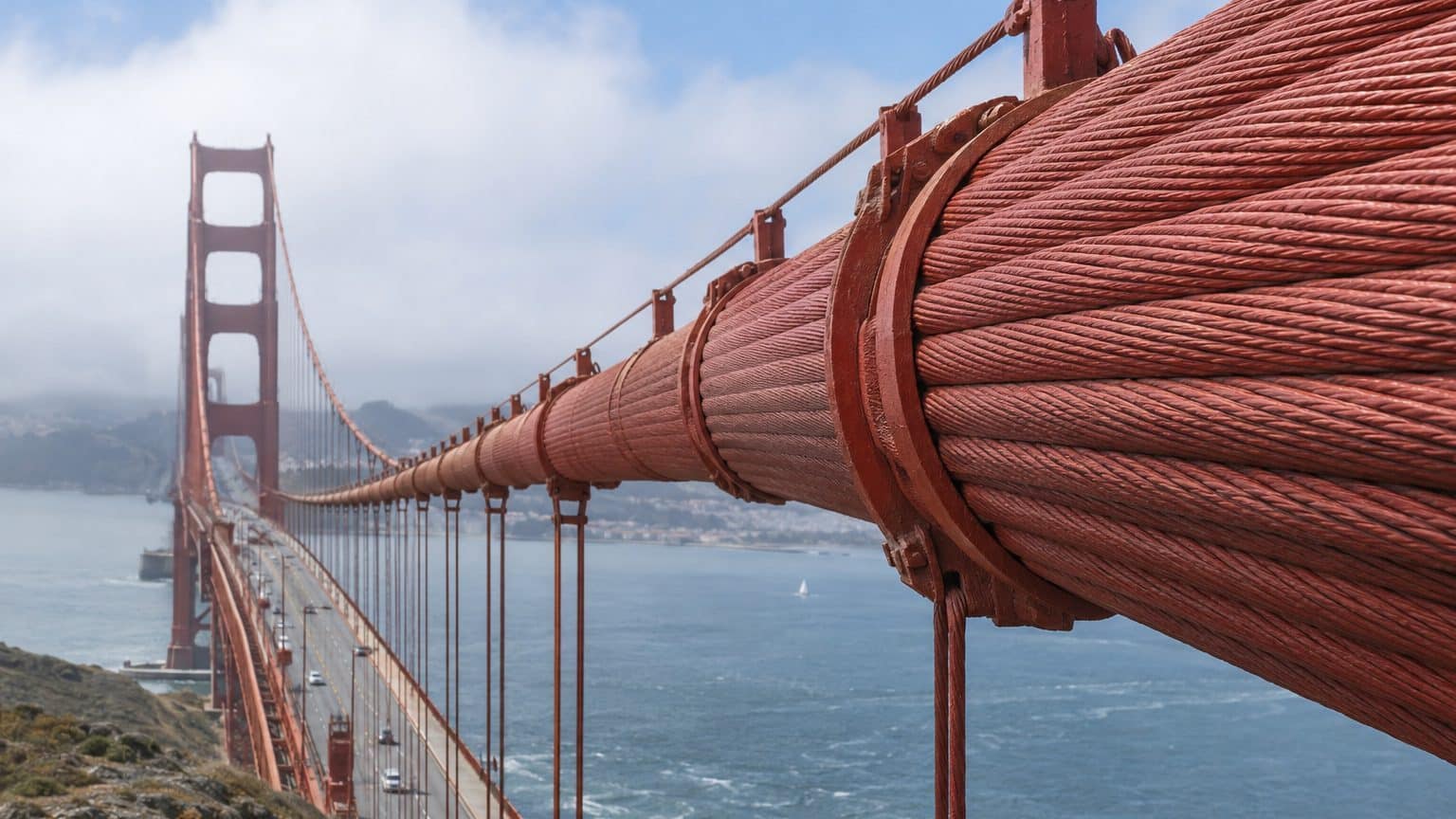
The Golden Gate Bridge in San Francisco does not rest on two enormous bars of steel, but on two bundles of wire. Each of the two main cables contains 27,572 parallel wires, 27,572 galvanized steel wires laid one by one on-site. End to end, the wires of the two cables total 129,000 km (80,000 miles), enough to circle the Earth’s equator more than three times over.
The calculation: 129,000 ÷ 40,075 km of the equator = 3.2 turns.
- Each main cable of the Golden Gate contains 27,572 galvanized steel wires.
- All wires from both cables total 129,000 km, i.e., more than three Earth circumnavigations.
- Winding was completed in 6 months and 9 days, i.e., more than seven months ahead of the contract deadline.
Two Cables, Two Towers, Two Anchor Blocks
Opened on May 27, 1937, the suspension carries its deck on two main cables. They pass over the tops of two towers standing 746 feet (227 m) tall and are anchored at each end in enormous anchor blocks. These cables are not solid bars.
Each measures 7,650 feet (2,332 m) long and 36 3/8 inches (0.92 m) in diameter, including the sheath. The wires making them up have a diameter of 0.192 inch, or 4.88 mm: just under 5 mm, roughly the thickness of a pencil. They are grouped into 61 strands of about 452 wires on average. For the two cables, that amounts to 55,144 wires.
A quick check confirms it: 55,144 wires of 2,332 m each total about 128,600 km. The result is very close to the 129,000 km announced for the whole system.
These cables also had to stay flexible. They needed to bend laterally up to 27 feet (about 8 m) in the winds of the Golden Gate, while carrying the bridge’s structure. At the time of their construction, they were the largest bridge cables ever made.
One Wire at a Time, from Anchor to Anchor
A cable of this size could not be manufactured in factory sections and then joined together; it had to be drawn on site, securely attached to the ground, hence the enormous anchor blocks. The wires came from the Roebling’s Sons company, based in New Jersey. Its method, born in the 1840s, had already been used for the Brooklyn and George Washington bridges.
The wires were laid one by one by a wheel that moved back and forth between anchors, like the shuttle of a loom. This wheel ran along an auxiliary cable, taut with the same curvature as the future bridge cables. Each pass added wires to a strand, reaching 452 wires on average. The wires of a strand were temporarily tied, then adjusted before the final tightening.
A second wheel would meet it in the middle of the bridge.
At the meeting point, the wheels exchanged the wires, then each returned to its side, effectively doubling productivity. The company later devised a system able to pull six wires at once, color-coded to prevent mix-ups. With these six wires, the wheels could lay down as much as 1,000 miles of wire, about 1,600 km, during an eight-hour shift. The contract allotted 14 months to finish the winding.
6 Months and 9 Days to Draw 129,000 km of Wire
The winding began in the autumn of 1935. On May 20, 1936, the flag-adorned wheel pulled the last wire. Official duration: 6 months and 9 days, more than seven months ahead of the contract deadline.
Compared to the schedule, this duration yields an average of about 680 km of wire per day, counting roughly 190 days in the period. This is an arithmetic average, far below the 1,600 km achieved by the best eight-hour shifts.
Tighten, Suspend, Carry
Once the 61 strands were in place, hydraulic jacks tightened the wires to give the cables their round shape. Bolted collars were then installed around each cable. The steel hangers, run over these collars, descend to support the deck.
A quick calculation gives a sense of the result. A wire of 4.88 mm has a cross-section of about 18.7 mm², and 27,572 wires amount to roughly 0.52 m² of steel. The finished cable, with its 0.92 m diameter, has a cross-section of about 0.66 m². Steel thus occupies roughly three quarters of that area, the remainder corresponding to the spaces between wires and the sheath.
The assembly formed by the two cables, the hangers and the fittings weighs 22,200 tons. On each of the two towers, the cables press down with 61,500 US tons, or 56,000 metric tons.
The visitor can judge for themselves on site. A life-size cross-section of a cable, exhibited at the bridge, shows the 27,572 parallel wires pressed tightly against one another. An historical panel installed in 2012 at the south viewpoint tells this winding story.
The last wire preceded the bridge’s opening by one year and seven days.
👉 A small gesture for Space Group? Follow us on Google, add us to your favorites, and find us on Google News so you don’t miss any discoveries.
Sources: home.uchicago.edu | goldengatebridgetoll.com
