
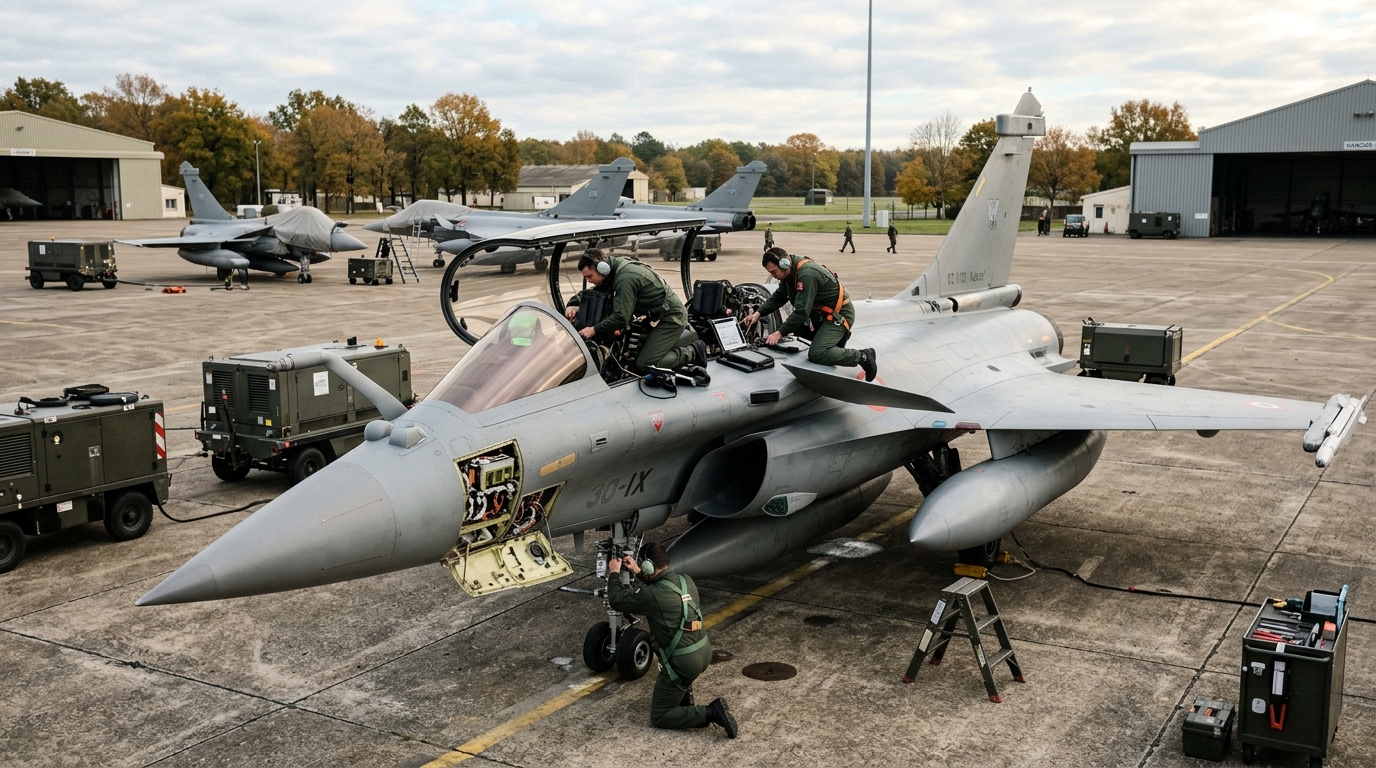
A Rafale lifts off, its pylons unchanged in shape, its silhouette still the one known for years. Yet, since October 2025, the Air and Space Force has rolled out a version that upends everything without turning a single external screw. The F4.2 standard adds satellite connectivity and native cyberwarfare capabilities, designed to thwart modern electromagnetic jamming.
- The F4.2 standard, certified in October 2025 by the DGA, adds national satellite connectivity and cyber capabilities with no visible modification to the aircraft
- This evolution aims to counter electromagnetic jamming by multiplying communication channels, reducing reliance on NATO’s Link 16
- Only Rafales built to the F4 standard will be able to receive the future F5, expected between 2033 and 2035 for about 5 billion euros, intended notably for the Luxeuil-les-Bains base
- The real change of the F4.2 is not visible to the naked eye
- Why electromagnetic jamming forced France to rethink its fighter aircraft
- A digital weapon that changes the very nature of air combat
The real change of the F4.2 is not visible to the naked eye
Early October 2025, the Directorate General of Armaments certified the Rafale’s F4.2 standard. On paper, nothing sets this aircraft apart from its predecessor. No new bump under the fuselage, no extra sensor visible from the tarmac. The change lies elsewhere, in the circuits and software that make the aircraft speak to the rest of the armed forces.
This standard connects each affected Rafale to a national communications network, satellite links included. In other words, the aircraft no longer relies solely on an external system to exchange its tactical data. It can now converse through an infrastructure that France controls end-to-end, which changes everything in terms of operational sovereignty.
To understand the issue, a quick historical detour. Until the F4, Rafales exchanged data via Link 16, a NATO protocol with limited throughput, somewhat like a shared telephone line across an alliance. The problem is that France does not control the evolution of this protocol. The F4 precisely added national channels to this system, a first step toward greater independence.
This F4.2 is in fact only the second stage of a three-tiered rocket. General Stéphane Mille, then Chief of Staff of the Air and Space Force, had clearly stated: deliveries under the 2024-2030 military programming law would be made to the F4 standard, itself broken down into three sub-standards, F4.1, F4.2 and F4.3. F4.1 had already brought the Scorpion helmet sight and the 1,000-kilogram AASM munition, a weapon capable of striking hardened targets at a good distance.
Why electromagnetic jamming forced France to rethink its fighter aircraft
A modern combat aircraft is no longer merely a machine that flies fast and shoots accurately. It is, first and foremost, a node in a network, somewhat like a smartphone that must stay connected even in a storm. And on today’s battlefield, the storm is electromagnetic jamming.
Recent conflicts have shown how military communications can be disrupted, or even completely cut, by electronic warfare systems. An aircraft that can no longer talk to its allies becomes blind and isolated, regardless of the power of its radar or missiles.
This is exactly what the F4.2’s satellite connectivity corrects. By multiplying communication channels, the French armed forces reduce the risk that localized jamming could entirely isolate their aircraft. It’s akin to moving from a single national road to a full highway network, with multiple routes available if one is blocked.
That logic also explains why Rafales do not come straight out of the production line fully transformed. They are delivered to the F3R standard at Dassault in Mérignac, then transported to Mont-de-Marsan for their software transformation and upgrade to the F4 standard — an invisible but crucial phase for the fleet’s future resilience.
A digital weapon that changes the very nature of air combat
Beyond resistance to jamming, the F4 standard carries protections against cyber threats. In practical terms, the aircraft could potentially interact with enemy networks or shield its own systems from digital intrusions, all without relying on external hardware added after the fact. The air battle is no longer fought solely in the skies; it also unfolds in the waves and the data.
This software-driven uplift goes hand in hand with a faster production cadence. Dassault Aviation recently completed the production of the 300th Rafale, with 533 firm orders recorded by France and eight export customers. There remain 233 aircraft to deliver, a figure that underscores the scale of the ongoing program.
Éric Trappier recently outlined the pace of deliveries: 26 Rafales left the production lines in 2025, 28 are planned for this year, with an objective of four aircraft per month by 2029, or five if everything goes as planned. This tempo is driven as much by export demand as by the needs of the French armed forces.
But the F4.2 is only a step. Only aircraft built to the F4 standard will be able to receive the forthcoming F5 standard, an overhaul estimated at nearly 5 billion euros, financed solely by France, expected between 2033 and 2035. This version is scheduled to equip the Luxeuil-le-Bains Air Base, renovated at about 1.5 billion euros, which will eventually host around fifty Rafales as well as the ASN4G hypersonic missile at the heart of French nuclear deterrence.
The F4.2 thus sketches a clear trajectory. France no longer seeks merely the fastest or best-armed aircraft; it is building a system capable of staying connected, protected, and operational even in a data-saturated environment. And when looking at the rest of the program, with the F5 and Luxeuil in sight, it becomes clear that what is happening under the Rafale’s wings today is only a prelude to even deeper transformations to come.
