
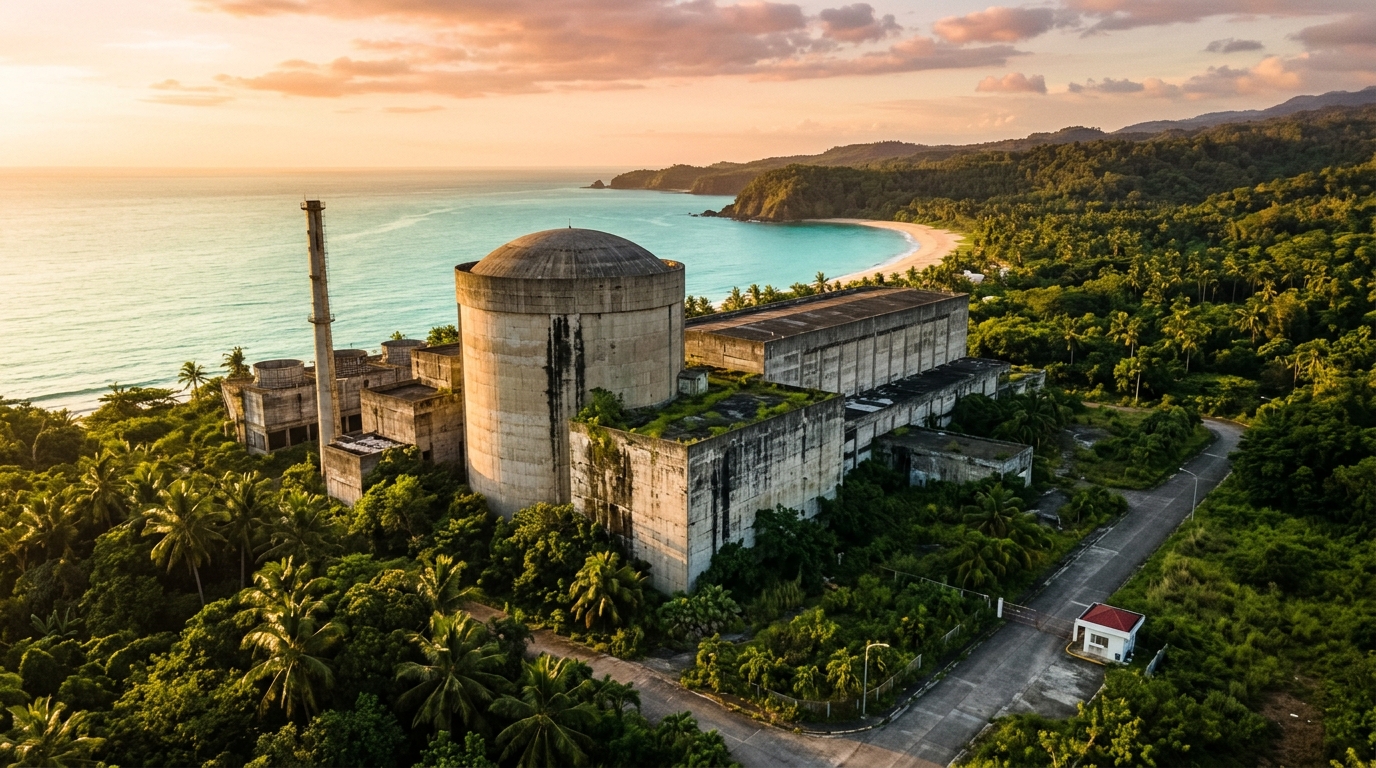
Imagine a titan of a construction site facing the South China Sea, with the power-generation counter still today displaying a single, round figure: zero. Not zero watts by accident, not zero due to a temporary outage, but zero watts since its very first stone. And yet this is precisely what happened with the Bataan Nuclear Power Plant, a 620 MW behemoth signed by Westinghouse, completed in 1984 for the dizzying sum of $2.3 billion. A figure to compare with the initially promised $500 million, i.e. more than four times the original budget. For decades, this facility has haunted the Philippine landscape as a symbol of waste, of dictatorship, and of a missed date with the history of energy. A retelling of the astonishing history of a reactor that never warmed a single bulb.
- The Bataan plant, completed in 1984 for $2.3 billion, was never commissioned in the wake of Chernobyl and the 1986 fall of Marcos
- Philippines took more than twenty years to repay the debt tied to the project, the last payment dating from April 2007
- The initial contract with Westinghouse was marred by corruption allegations, a court ordering the restitution of $50 million misappropriated in 2012
- A plant built during the Marcos dictatorship, already under fire
- Chernobyl changes everything: the brutal decision to abandon the project in 1986
- A colossal debt repaid twenty years later, up to April 2007
- An industrial ghost still maintained, between revival projects and an improbable museum
A plant built during the Marcos dictatorship, already under criticism
It all begins in the mid-1970s, amid a tense international climate. The 1973 oil shock had just battered hydrocarbon-dependent economies, and the Philippines, ruled with an iron hand by Ferdinand Marcos, seeks to secure its energy supply. Civilian nuclear power then appears as an emerging solution, championed by the major industrial powers. It was in this logic that construction of the Bataan plant, on the peninsula of the same name, north of Manila, started in 1976.
But the project soon proved problematic. The 1974 contract with Westinghouse for the reactor’s supply raised corruption suspicions, notably involving intermediary Herminio Disini, close to the Marcos regime. Defects accumulated on a site located in a seismically and volcanically active area, not far from Mount Natib. Costs literally exploded, rising from $500 million to $2.3 billion, a derailment that would weigh heavily on the country’s public finances for more than three decades.
Chernobyl changes everything: the brutal decision to abandon the project in 1986
The plant was completed in 1984, theoretically ready to enter service. But history would decide otherwise. In 1986, two major events collide and seal Bataan’s fate. On one hand, the Chernobyl disaster shakes the entire world and redefines the social acceptability of nuclear power, even in countries that had never experienced a major incident. On the other hand, a popular uprising in the Philippines topples the Marcos regime and brings Corazon Aquino to power.
The new administration, confronted with a double explosive dossier combining nuclear safety concerns and proven corruption, chooses never to put the installation into service. Fears about proximity to active geological faults, combined with the distrust inherited from the Marcos era, seal the reactor’s fate. A court would later order, in 2012, the restitution of $50 million diverted during the initial contract negotiations, evidence that the shadows surrounding this project were far from trivial. The country’s most expensive plant thus becomes, overnight, a totally useless financial sinkhole in energy terms.
A colossal debt repaid twenty years later, up to April 2007
If the plant never produced a single electron, its bill, however, was paid in full to the last cent. According to data from the Philippine Bureau of the Treasury, the government only settled the debt tied to this project in April 2007, more than twenty years after the final abandonment of its operation. The last payment, amounting to $15 million, was confirmed to AFP by a government official at the time. In total, around 21.2 billion pesos, equivalent to about $460 million at current exchange rates, were extracted from Filipino taxpayers to extinguish an initial debt of roughly 1.06 billion pesos.
In other words, generations of Filipinos paid via their taxes the interest on a loan contracted for a plant that never ran a single day. AFP even described Bataan as the country’s greatest white elephant, a pharaonic project turned into a financial burden with no practical use. Few infrastructures worldwide illustrate so bluntly the gap between a project’s initial ambition and its final economic reality.
An industrial ghost still maintained, between revival projects and an improbable museum
Nearly fifty years after the work began, the Bataan plant has not delivered its final verdict. According to Mauro Marcelo, head of nuclear infrastructure at the Ministry of Energy, the site remains largely intact, the reactor included, kept in a state of preservation that continues to cost public money each year, simply for maintenance and monitoring of the facilities. A situation that is at once paradoxical: the Philippines continues to spend to safeguard an industrial tool that they gave up using almost forty years ago.
Regularly, the idea of restarting the facility resurfaces in public debates, driven by those who see avoidable waste in light of the country’s growing energy needs. But former Energy Minister Raphael Lotilla has spoken clearly: given the current standards of the International Atomic Energy Agency, rehabilitating this reactor would cost far more than building a brand-new one. Marcelo also notes that even though the site has been officially on sale for decades, it seems unlikely any buyer will come for a technology stuck in the 1980s. “More recently, in January 2024, the Philippine Supreme Court reduced the damages owed by Herminio Disini’s estate from 1 billion to 100 million pesos,” the article notes, adding yet another episode in a dossier that continues to feed the chronicle.
In the absence of a credible restart, some now imagine a touristic conversion, in the mold of other abandoned nuclear sites that have become unusual attractions around the world. In the meantime, the Bataan plant remains a monument frozen in time, a silent witness to a period when a country’s energy ambitions collided head-on with geopolitics, corruption, and one of the worst nuclear disasters in history. A timely reminder, as several nations rethink their atomic programs, that the success of a nuclear project is never reducible to technical prowess alone.
