
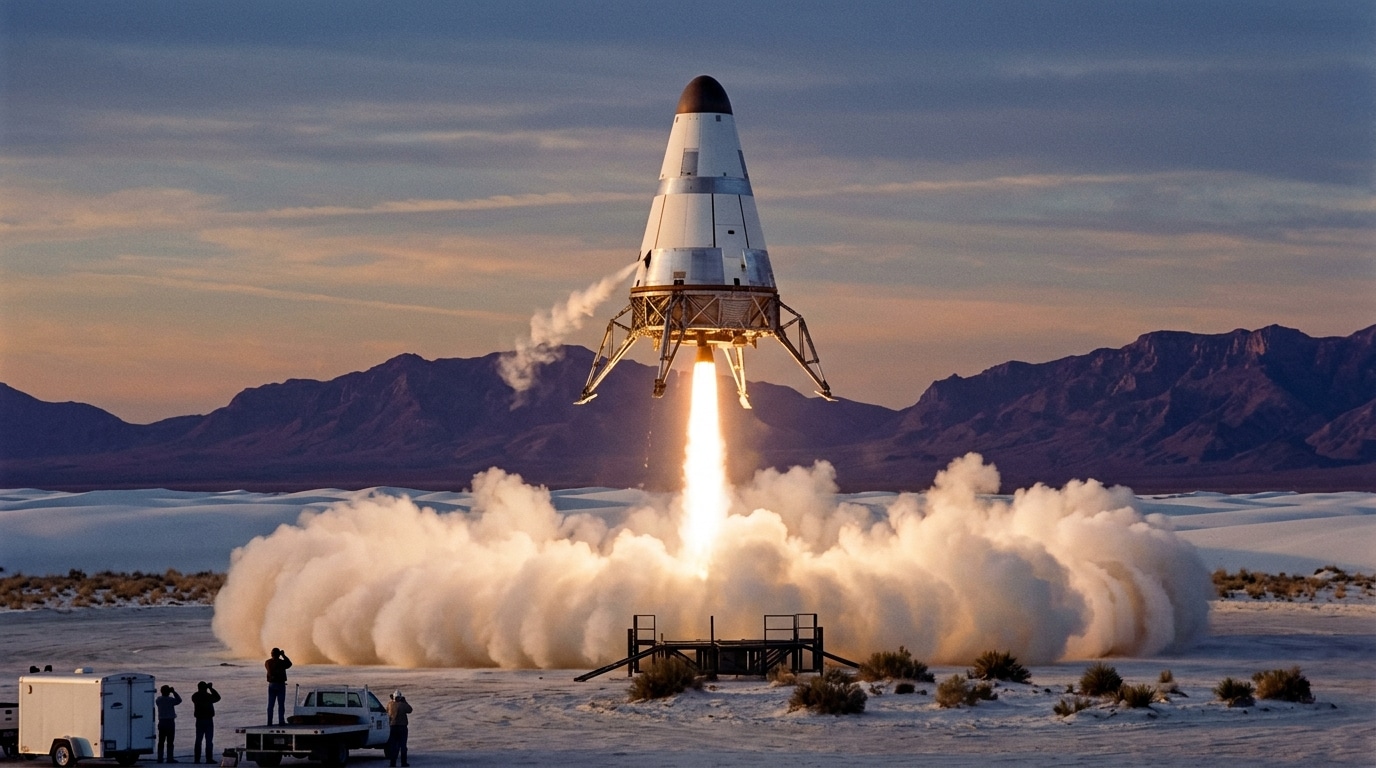
A rocket that lands standing upright on its feet, just like in the best science-fiction films, appeared three decades before the idea came back into vogue thanks to SpaceX: that is what the DC-X had already accomplished at the dawn of the 1990s. Yet a simple helium hose that wasn’t properly connected was enough to turn this success into a blaze and to bury an entire program.
- The DC-X by McDonnell Douglas logged twelve successful flights between 1993 and 1996, proving that a rocket could take off and land vertically on its feet.
- The July 31, 1996 accident was caused by an unconnected helium pressurization line, preventing the deployment of foot number two and causing the vehicle to topple and ignite.
- Lacking the budget to rebuild the craft, the program was abandoned, but the team was inducted into the International Space Hall of Fame in 2013 for having anticipated space-reuse technologies.
- A vertical landing that had become routine for three years
- An overlooked hose, and the rocket collapses in full glory
- The fire that ended the dream of daily launches
A Vertical Landing That Had Become Routine for Three Years
Before SpaceX popularized the idea of rockets returning to Earth to land, a curious cone-shaped craft was already pulling off such a feat in the desert of New Mexico. The DC-X, built by McDonnell Douglas in partnership with the Pentagon’s Strategic Defense Initiative Organization, flew for the first time on August 18, 1993 at White Sands. Fifty-nine seconds of flight, 46 meters of altitude, and most importantly a lateral shift of 350 feet before settling vertically on its tail.
The achievement now looks almost artisanal in hindsight. The mission-control center fit into a single trailer, where seven people followed the flight under the supervision of Pete Conrad, the former Apollo astronaut. Four Pratt & Whitney RL10A-5 engines, operating on liquid oxygen and liquid hydrogen, powered this single-stage craft intended to take off and land like an airplane, without ever shedding any stage.
Between 1993 and 1996, the program logged twelve flights: eight under the McDonnell Douglas banner, then four more under NASA labeled DC-XA. This lighter version carried a graphite-epoxy hydrogen tank and an aluminum-lithium oxygen tank built by the Russian Energia, saving 620 kilograms in empty weight. On June 7 and 8, 1996, the team even demonstrated that it could relaunch the vehicle within twenty-six hours, followed by a 142-second flight reaching an altitude of 3,140 meters. Everything suggested that the reusable rocket, taking off and landing several times a week, was no longer a fantasy.
An Overlooked Hose, and the Rocket Collapses in Full Glory
On July 31, 1996, the DC-XA was about to undertake its fourth flight since its upgrade. Fourteen dozen seconds of flight were planned, aiming for an altitude of roughly 1,250 meters. On paper, nothing about this mission distinguished it from the previous ones. The craft lifted off, climbed, then began its controlled descent to settle on its four feet, as it had done a dozen times before.
Except this time, landing-gear foot number two refused to deploy. Deprived of its fourth point of support, the vehicle tipping over onto its side as it touched the ground. The impact triggered the rupture of the liquid oxygen tank, and the ensuing fire ravaged what remained of the structure. In a matter of moments, three years of testing and progress went up in smoke before the team on the ground.
The ensuing investigation revealed a near-trivial reason for such consequential results: a helium pressurization line, intended to power the deployment mechanism of that foot, had simply not been connected. On July 31, 1996 at White Sands, the DC-XA landed on three feet instead of four, due to a forgotten hose during flight preparations. The rocket toppled, then burned.
The Fire That Ended the Dream of Daily Launches
Gary Payton, who led the Reusable Launch Vehicle program at the time, was unequivocal after the accident: the budget did not allow rebuilding the device, nicknamed Clipper Graham in honor of a general who defended the project. A single unconnected hose thus closed a program meant to pave the way for daily launches—as simple and routine as a commercial airliner flight.
Yet this brutal ending did not erase the DC-X’s contribution to space history. The team was inducted into the International Space Hall of Fame on August 17, 2013, belated but well deserved recognition for engineers who had proven, far ahead of their peers, that a rocket could lift off and return to land on its own feet.
Today, a few remnants of the program rest at the New Mexico Museum of Space History: an RL10 engine, a spare landing leg, and the thrust structure of the vehicle. Pieces of metal that tell, better than any words, the story of an idea that arrived too early, yet not too early to inspire engineers who would, years later, succeed where the DC-X had barely failed.
With hindsight, the July 31, 1996 accident resembles those absurd details that alter the course of a technological story. A helium hose, a few centimeters of unconnected plumbing, and an entire pioneering program goes up in flames. But the principles demonstrated by the DC-X never truly disappeared: they simply waited for their moment, until other engineers picked up the torch and finally made vertical landing a space routine a reality.
👉 A small gesture for Space Group? Follow us on Google, add us to your bookmarks, and find us on Google News so you don’t miss any discoveries.
