
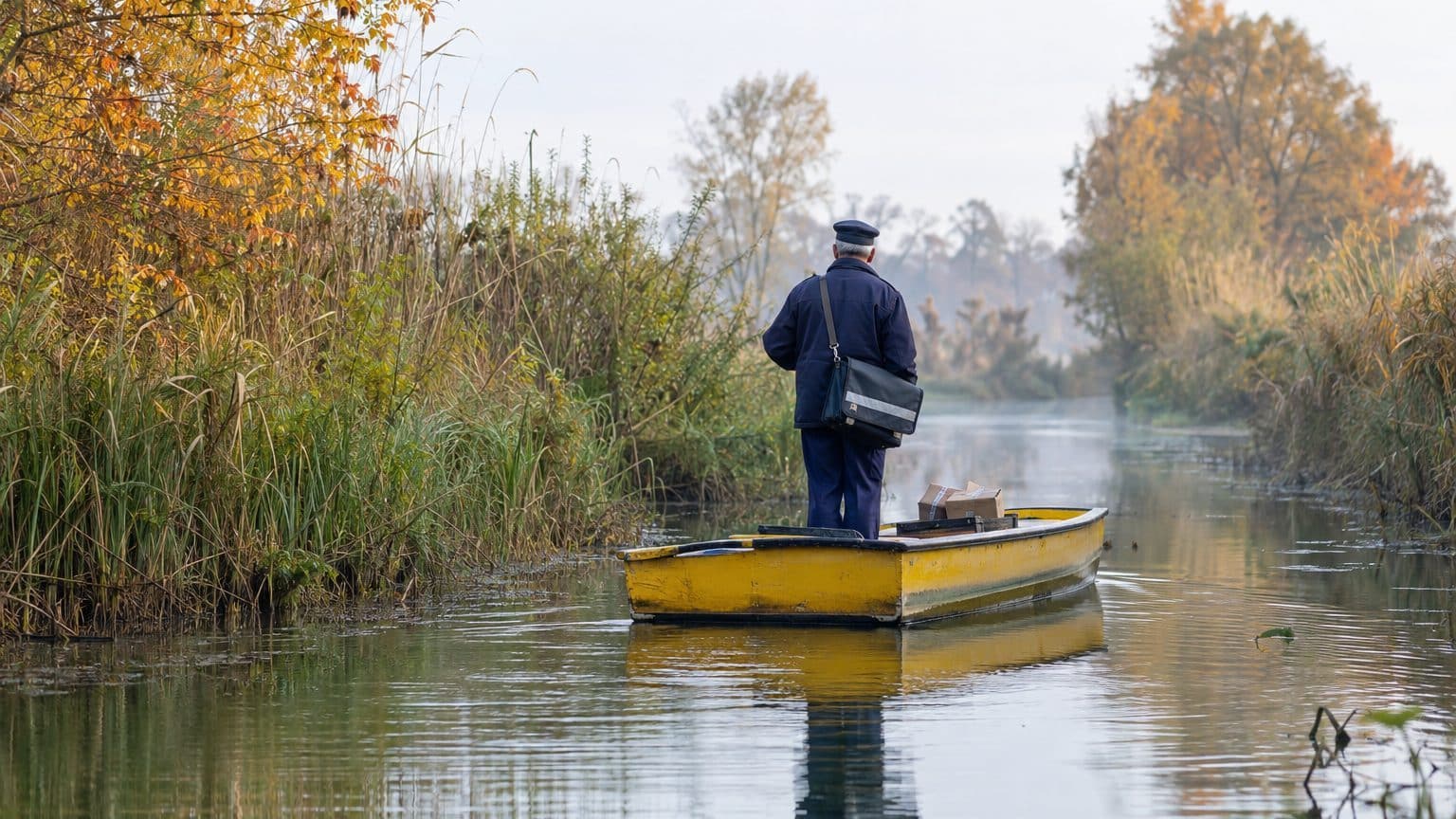
Only one postal worker in France launches a boat to deliver letters and parcels, and he operates near Saint-Omer. His loop spans 15 to 16 km, completed at 6 km/h, the regulatory speed on these canals, and serves around fifty residents. His vehicle: a wooden yellow-painted boat, which no other mail carrier in the country uses.
It is the only La Poste route that takes place on water.
- The Saint-Omer mail carrier is the only La Poste employee delivering by boat in France.
- His route covers 15 to 16 km of canals and serves around fifty addresses.
- The Audomarois marsh was dug by its inhabitants and remains below the level of high tide.
A morning on land, then two hours on the water
The day, however, begins on solid ground. According to Le Parisien, in its July 30, 2026 edition, the postman first delivers parcels from 8:30 a.m. to 11 a.m., like any colleague. He then departs in his yellow boat for the waterborne portion of the route. This leg can involve up to 2 hours and 20 minutes of deliveries. The feature is titled “I’m Right at Home in My Marsh.”
At the nautical stop, the yellow boat blends in with tourist craft. Its paint makes it stand out, according to France Bleu, which describes it as a traditional flat-bottom scow.
6 km/h is the pace of a hurried walker. Along these 15–16 km of canals, the houses served are largely inaccessible by road, reports France Bleu. The same report mentions around fifty houses and businesses, evidence that the route serves more than just private homes.
Outside the holiday season, the boat carries only two or three parcels per day, according to the report. A mail carrier on the route says he has never crossed paths with another courier in the marsh in ten years.
“People wait for us as if we were in the city center,” says this carrier. Even in the rain, he finds the marsh setting less burdensome than a cycle route. His only real danger, he adds, while dropping a TV guide into a mailbox, is falling into the water.
Fifty addresses spread over 15–16 km translates to about one mailbox every 300 meters, roughly speaking. An approximate calculation, which assumes one box per address, but which underscores the pace quite vividly.
A marsh under high tide, dug by its inhabitants
The Audomarois marsh spans 3,726 hectares across 15 municipalities in Pas-de-Calais and Nord, roughly the size of about 5,000 football pitches. Its altitude is 0 meters. It lies below the high tide level and stays dry only thanks to its locks.
Nothing natural about it. The inhabitants themselves dug ditches and canals to raise their lands and extract peat. Today there are 400 km of ditches, plus 160 km of drainage rivers. In total, 560 km of waterways for an area that would fit inside a square of roughly 6 km on each side.
The antiquity of the project varies by source. La Poste mentions a marsh dug by humans in the 13th century, while the Maison du Marais traces its shaping back to the 7th century, by the monks of Saint-Bertin.
Approximately 13,000 plots were shared among 5,000 owners in 2008.
The landscape is labyrinthine: reed beds, tall grasses, peat forests, meadows, ditches and rivers. Grey herons, kingfishers and swans have their habits there, according to the Maison du Marais. The site carries multiple protections, including Natura 2000 and the designation of national nature reserve, according to Wikipedia.
When everyone traveled by bacôve
Until the 1970s, everyone moved around by bacôve, a large wooden flat-bottom boat, mail carrier included. The boat was therefore a daily tool well before it became an attraction. The current route extends this use more than it invents a curiosity. A 1973 archive mentions as much as 3,600 km traveled annually on the canals.
Three thousand six hundred kilometers is more than four times the distance from Paris to Marseille, within a marsh of 37 km².
The marsh is not merely a postcard backdrop: it is the only marsh of this size still cultivated for vegetables in France. About fifty kinds of vegetables are grown here, including cauliflower, cultivated around 1751, and endive, around 1920. The first has roughly 275 years of cultivation behind it, the second more than a century. The Maison du Marais, which offers guided visits, notes these market gardeners who still grow vegetables and cauliflower.
The site has been a UNESCO Biosphere Reserve since 2013 and a Ramsar wetland since 2008. This Ramsar area covers around 22,300 hectares, about six times the marsh proper, Saint-Omer city included.
A postman, and much more than a mail carrier
In a profile published by La Poste, the postman then, 24 years old, recounted that he had never steered a boat before his management offered him the route. He accepted the challenge. He describes the role as a social link, and says he is often among the first people informed of a birth, a wedding, or a death. Returning to a traditional mail route would feel difficult to him, he says.
La Poste classifies this route among atypical but essential distributions. In isolated areas, mail sometimes takes unusual forms, the group notes.
To see the marsh from the inside, the Maison du Marais offers guided bacôve excursions, with an eco-guide, from April to late October depending on the weather. Departures take place a few steps from the center of Saint-Omer, with a chance, according to the site, of meeting the postman along the way. The excursion lasts about 45 minutes, with a maximum of 12 people per boat.
Sources: francebleu.fr | lapostegroupe.com
