
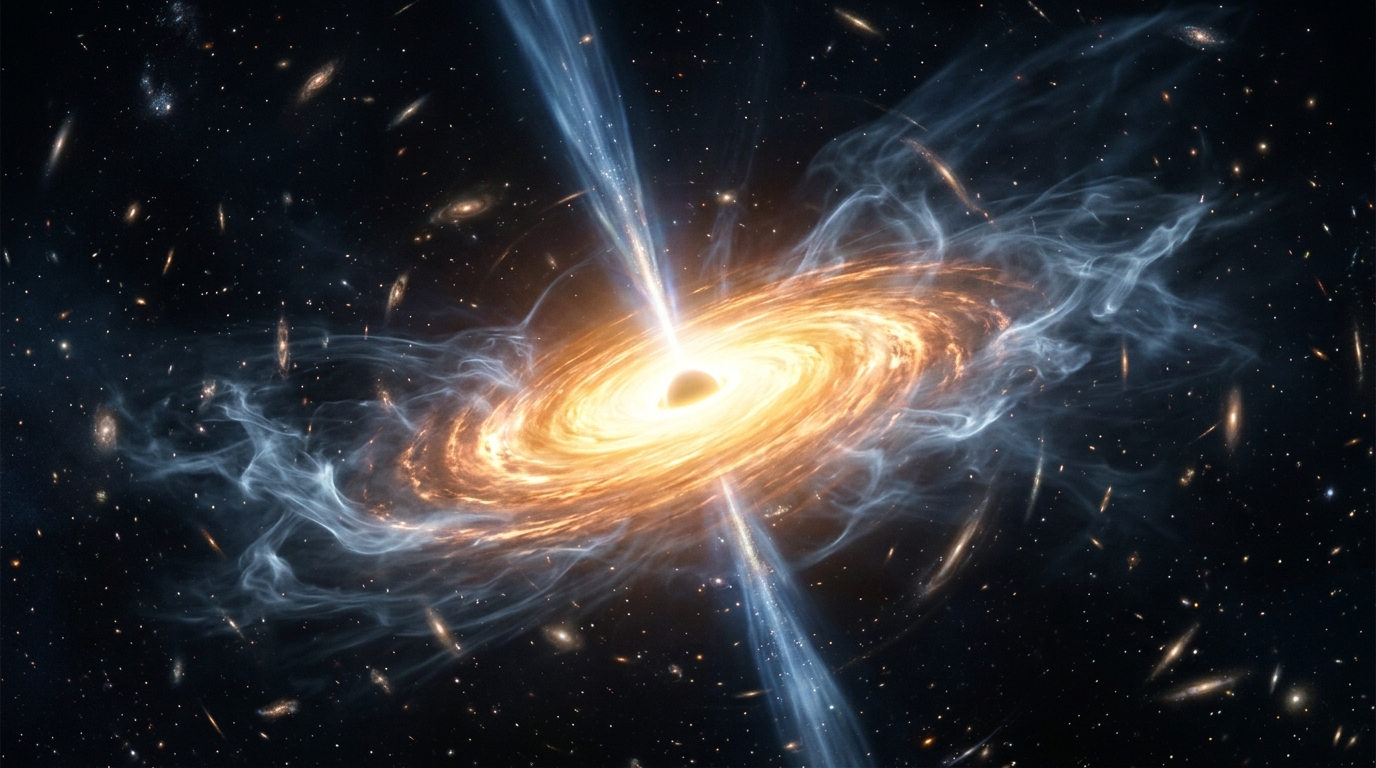
Imagine filling a bathtub, then multiplying that quantity of water by a number so colossal that it defies imagining. That is a rough approximation of what happened when astronomers pointed their instruments at a tiny, distant point in the sky somewhere in the Lynx constellation. What they found defies belief: a reservoir of water vapor so immense it could fill Earth’s oceans 140 trillion times. A discovery that, more than ten years after it was announced, continues to astonish as it invites questions about water’s place in the history of the universe.
- In 2011, astronomers detected around the quasar APM 08279+5255 a reservoir of water vapor using the Z-Spec telescope and the Plateau de Bure Interferometer, aided by a gravitational lens magnifying the quasar’s light.
- This quasar, powered by a black hole about 20 billion solar masses in size, is observed as it appeared a few hundred million years after the Big Bang, with the detected water vapor showing a density 10 to 100 times higher than the cosmic average.
- This discovery proves that water existed in the primordial universe, and similar reservoirs have since been identified elsewhere, such as in the Orion Nebula or around the star PDS70.
- A Quasar at the Edge of the Observable Universe
- How to Detect Water at 12 Billion Light-Years
- 140 Trillion Oceans: Making Sense of the Incomprehensible
- What This Discovery Changes in Our View of the Universe
A Quasar at the Edge of the Observable Universe
The hero of this story bears a notably unpoetic name: APM 08279+5255. It is a quasar, meaning the extremely active core of a distant galaxy, powered by a supermassive black hole whose mass is estimated at roughly 20 billion solar masses. To grasp its power, the quasar radiates energy equivalent to a thousand billion suns, making it one of the most intense energy sources ever observed in the cosmos.
Its distance is equally dizzying: the light reaching us from this object took about 12 billion years to arrive. In other words, by observing APM 08279+5255, astronomers are seeing the quasar as it existed a few hundred million years after the Big Bang. It is as if one opened a time capsule showing the universe in its infancy, at a moment when galaxies were just beginning to take shape.
How to Detect Water at 12 Billion Light-Years
One might reasonably wonder how any trace of water could be discerned at such a staggering distance. The answer lies in a combination of cutting-edge technique and a fortunate cosmic arrangement. In 2011, astronomers fused data from the Z-Spec instrument mounted on Mauna Kea in Hawaii with observations from the Plateau de Bure Interferometer in the French Alps. Together, these instruments picked up the spectral fingerprint of water vapor—a chemical signature that molecules imprint on the light that passes through them.
An unexpected ally aided the effort as well: a foreground galaxy lying between APM 08279+5255 and Earth acts as a genuine gravitational lens. It bends and magnifies the quasar’s light, producing a far sharper image than would have been possible otherwise. Without this natural magnification, such a discovery would likely have been out of reach with the technology available at the time.
140 Trillion Oceans: Making Sense of the Incomprehensible
The magnitude of the figure is still hard to picture, even for those used to astronomical scales. This water vapor is spread over hundreds of light-years around the central black hole, with a density 10 to 100 times higher than the average found elsewhere in the universe. Its temperature sits around -63 degrees Celsius, which, by human standards, seems freezing, yet it is in fact warmer than the typical temperatures of the molecular clouds that pervade many galaxies.
The environment surrounding this colossal reservoir is far from tranquil. Additional observations with the space telescope Chandra revealed gusts of gas blowing at speeds up to 40% of the speed of light. These cosmic gusts, driven by the black hole’s ferocious activity, actively sculpt the surrounding material, much like a storm reshaping a landscape at an astonishing pace.
What This Discovery Changes in Our View of the Universe
Far from merely a curiosité, this discovery opened a new way of thinking about the presence of water in the cosmos. It demonstrates that the basic building blocks of life, as we know them, were already in place in the primordial universe long before our solar system formed. Since this announcement, other reservoirs of water vapor have been detected, notably in the Orion Nebula, a much closer region, and around the protoplanetary disk of the star PDS70, a system in the process of forming new worlds.
These successive observations suggest that water is not a peculiarity confined to our corner of the galaxy, but a common ingredient far more widespread than initially imagined, present both in the farthest reaches of time and in our immediate cosmic neighborhood. This continuity—from the oldest quasar to young, forming stellar systems—forms a compelling thread linking the origins of the universe to the potential emergence of habitable worlds.
This exploration of cosmic water reminds us that our planet, with its oceans that sometimes feel vast, is ultimately but a drop on the scale of the universe. Yet one question continues to stir the scientific community: if water existed so early after the Big Bang, how many other reservoirs like this remain to be discovered somewhere deep in the sky, in regions we have yet to peer into?
