
173 years. It is the age of the law that Indian and Japanese physicists have just undermined in a carbon sheet one atom thick in spectacular fashion. The Wiedemann-Franz law, formulated in 1853 and taught in physics curricula around the world, rests on a principle of apparent solidity: in a metal, the ability to conduct heat and the ability to conduct electricity are proportional. When one rises, the other rises. Always. Until now.
Published in Nature Physics, the work from a team at the Indian Institute of Science (IISc) in Bangalore, in collaboration with Japan’s National Institute for Materials Science, documents a deviation of more than 200-fold from this law in ultra-pure graphene samples cooled to low temperatures. Instead of evolving in the same direction, the two properties moved in opposite directions: as electrical conductivity increased, thermal conductivity fell, and vice versa. An inverse relationship where classical physics would not even permit such a hypothesis.
What the Wiedemann-Franz law says (and what it cannot explain)
The Wiedemann-Franz law establishes a proportional relationship between a metal’s electrical conductivity and its thermal conductivity, with a proportionality constant independent of the material. It was established experimentally in 1853, during the pre-quantum era. For more than 170 years, it held for ordinary metals, even though a first violation had been observed in graphene in 2016. In copper, aluminum, silver, gold: no known metal has ever managed to break free from it so spectacularly.
The underlying mechanism is intuitive: in an ordinary metal, the same electrons carry both electrical charges and thermal energy. These two fluxes share therefore the same “highway” and the same limitations. Disassociate the two, and you break the model. That is precisely what graphene did. This divergence shows that energy and charge flow through distinct channels in this exotic state.
The detail that makes the result even more destabilizing: this decoupling is not random. The two types of conduction rely on a universal constant independent of the material, equal to the conductance quantum, a fundamental value tied to the movement of electrons. This isn’t chaos. It’s a different order, governed by rules that classical physics simply cannot describe.
The Dirac fluid, this electron plasma that resembles the Big Bang
At the experiment’s critical point, electrons stop behaving like individual particles. Instead, they move collectively, flowing like a liquid. This fluid-like regime resembles water, but with a much lower resistance to flow.
This regime is observed at what physicists call the “Dirac point,” a precise electronic tipping point reached by adjusting the number of electrons in the material, where graphene is neither a metal nor an insulator. That is where the magic happens. “At the Dirac point, electrons do not behave as individual particles but flow like a fluid,” explains Aniket Majumdar, a PhD student at IISc and the study’s lead author. The ratio between thermal and electrical conductivity exceeds the Wiedemann-Franz value by more than 200-fold.
The comparison researchers use to describe this state is dizzying: this Dirac fluid is “an exotic state of matter that mimics the quark-gluon plasma, a soup of highly energetic subatomic particles observed in CERN’s particle accelerators.” The quark-gluon plasma normally exists only under extreme conditions: collisions of heavy ions at temperatures billions of times hotter than the Sun, recreating the universe’s state microseconds after the Big Bang. The team measured the Dirac fluid’s viscosity and found it minimal, as close as possible to a perfect fluid. Here, the same regime appears in a carbon sheet resting on a laboratory table.
Clean, exceptionally clean: the experimental key
Achieving this result is far from obvious. When graphene contains impurities, electrons begin to interact with them rather than with each other, suppressing and weakening electron-electron interactions, and with them, the emergence of the Dirac fluid. The entire challenge lay in fabricating samples of exceptional purity.
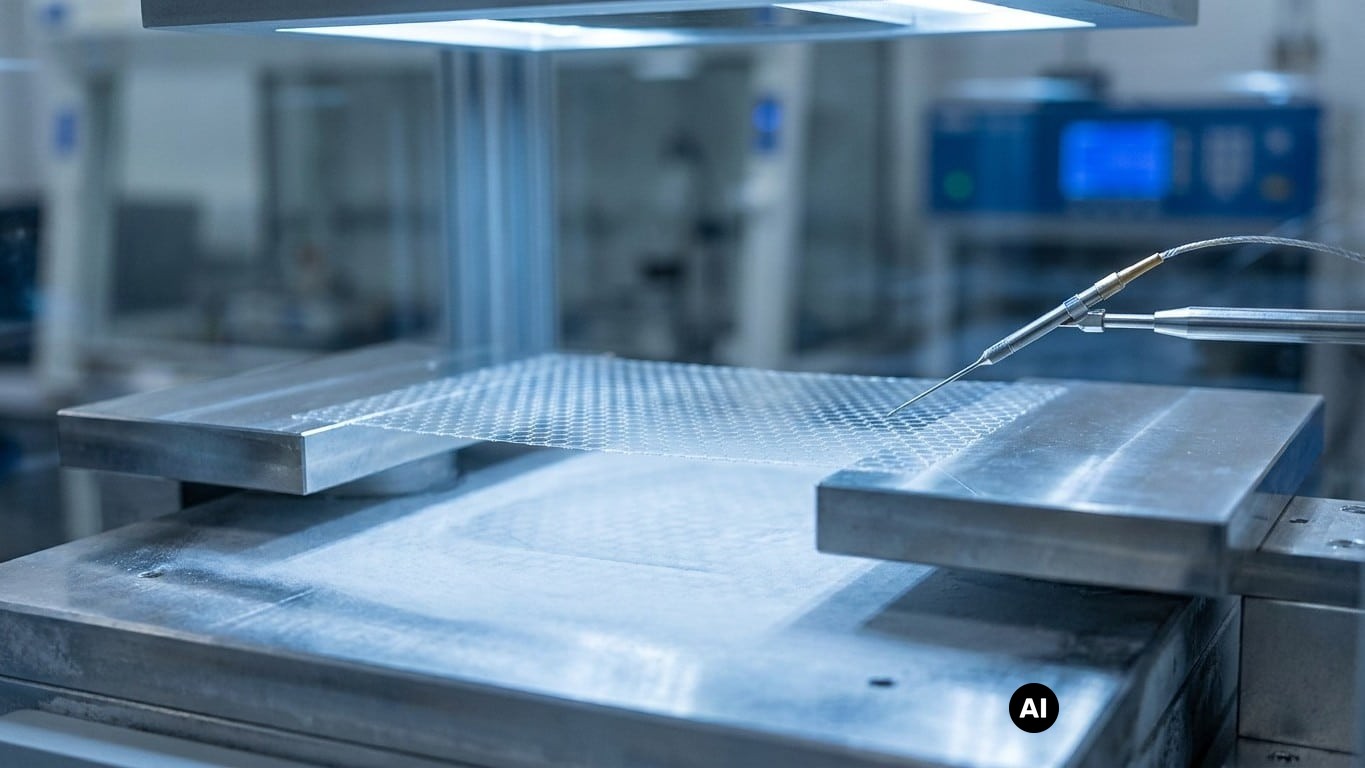
Scientists at IISc and the National Institute for Materials Science in Japan designed ultra-clean graphene devices encapsulated in hexagonal boron nitride, and monitored how charges and heat flow near the Dirac point. Encapsulation in hexagonal boron nitride is the technique that protects graphene from external contamination, the key to the purity required to observe the effect. Electrical conductivity converged to a fixed value, independent of device details, confirming a universal constant of the Dirac fluid predicted theoretically for a long time.
This experimental confirmation of a prediction formulated two decades ago without ever being verified in the lab represents a scientific victory in its own right. “We combined measurements of electrical and thermal conductivity to demonstrate the critical quantum conductivity scale in monolayer graphene, an effect predicted nearly twenty years ago but not experimentally verified until now,” notes Professor Arindam Ghosh.
What this opens up concretely
The presence of a Dirac fluid in graphene could enable the development of highly sensitive quantum sensors, capable of amplifying extremely weak electrical signals and detecting minute magnetic fields. This class of detector is of particular interest to neuroscience (high-resolution brain imaging), quantum magnetometry-based navigation, and ultra-weak RF signal detection.
The discoveries position graphene as an ideal and affordable platform for exploring concepts from high-energy physics and astrophysics, such as black-hole thermodynamics and the entropy of entanglement, within a laboratory setting. In other words: phenomena that once required the Large Hadron Collider or theoretical simulations on supercomputers might tomorrow be reproduced on a graphene sample spanning a few square micrometers, at a fraction of the cost. This scaling bridge between high-energy physics and condensed-matter physics may be the most enduring consequence of this experiment.
Sources: science.org | On the Wiedemann–Franz law violation in Graphene and quark-gluon plasma systems (arxiv.org)
Article prepared with the help of AI · Our method
