
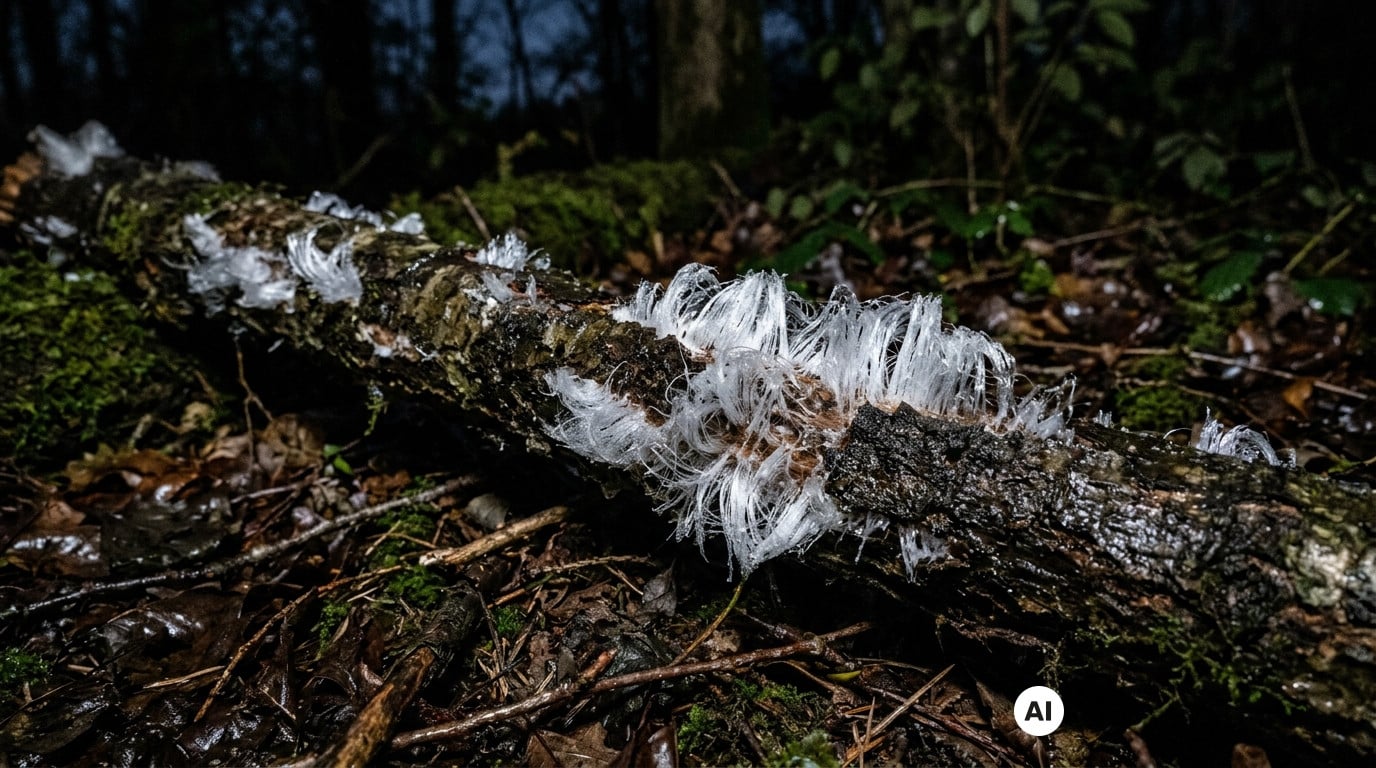
Observing this phenomenon requires a bit of patience and good timing. During a morning walk in the forest, certain dead trees don’t just lie still—they wear strange white filaments, as fine as hair or cotton candy. This discreet spectacle, which can remain stable for hours near 0 °C, has intrigued walkers for a long time. One might think frost or a simple climatic curiosity, but the reality is far more surprising: an invisible fungus would be responsible for this unusually delicate form.
An icy phenomenon that intrigues forest walkers
This phenomenon goes by a name that evokes its appearance: ice hairs. It manifests only under very specific conditions. The “sensitive period” occurs during humid nights when the temperature dips slightly below 0 °C. No need for extreme cold—a touch below freezing is enough. It is noticed on certain dead hardwoods, where fine white filaments form on the surface, giving the impression of a silky mane laid across a branch. The filaments are astonishingly slender, measuring about 0.01 millimeters in diameter. A good tip for winter walkers is to observe them before any rise in temperature melts this ephemeral formation.
An invisible fungus sculpts these unusually delicate ice filaments
For a long time, the exact origin of this remarkably regular form remained a mystery. A study published in 2015 in the Biogeosciences journal, conducted by a German-Swiss team comprising physicist Christian Mätzler, chemist Diana Hofmann, and biologist Gisela Preuß, identified the culprit: a fungus named Exidiopsis effusa.
It was found on all wood samples displaying hair ice studied by the researchers, and it was the sole fungus present in more than half of the cases. A detail confirms its central role: without fungal activity, the ice forms only a simple crust, without any notable relief. It is precisely its presence that transforms ordinary ice into these delicate filaments, recognizable above all others.
The sap of dead wood quietly nourishes the formation of these frozen threads
The physical mechanism behind this phenomenon was studied by Christian Mätzler on samples taken in Moosseedorf, Switzerland. It involves a process called ice segregation: a front of ice forms at the surface of the wood and creates a suction-like effect, drawing water contained in the wood’s pores toward this front.
The shape of the filaments is not random; it is determined by the orientation of the wood’s ray surfaces, those structures that traverse the trunk. Notably, the amount of ice produced remains the same whether the fungus is present or not. Only the form changes radically: on one side, a compact crust with no relief; on the other, these fine ice hairs that can stay stable for hours as long as the temperature remains near 0 °C.
A century-old enigma finally solved by modern science
This link between the fungus and ice formation is not entirely new. As early as 1918, researcher Alfred Wegener proposed the idea of a connection between a mycelium observed on wood and the appearance of these filaments. This intuition was later confirmed by Gerhart Wagner, a retired Swiss professor, who demonstrated that treatments with fungicides or hot water were sufficient to prevent the formation of hair ice.
To go further, Gisela Preuß analyzed samples collected between 2012 and 2014 in forests near Brachbach, Germany, identifying eleven different species of fungi on the examined wood. The researchers’ central hypothesis is that Exidiopsis effusa acts as an inhibitor of recrystallization. In other words, it prevents the fine ice filaments from fusing together to form a coarser structure, somewhat like an invisible conductor keeping each filament separate.
Article prepared with the help of AI · Our method
