
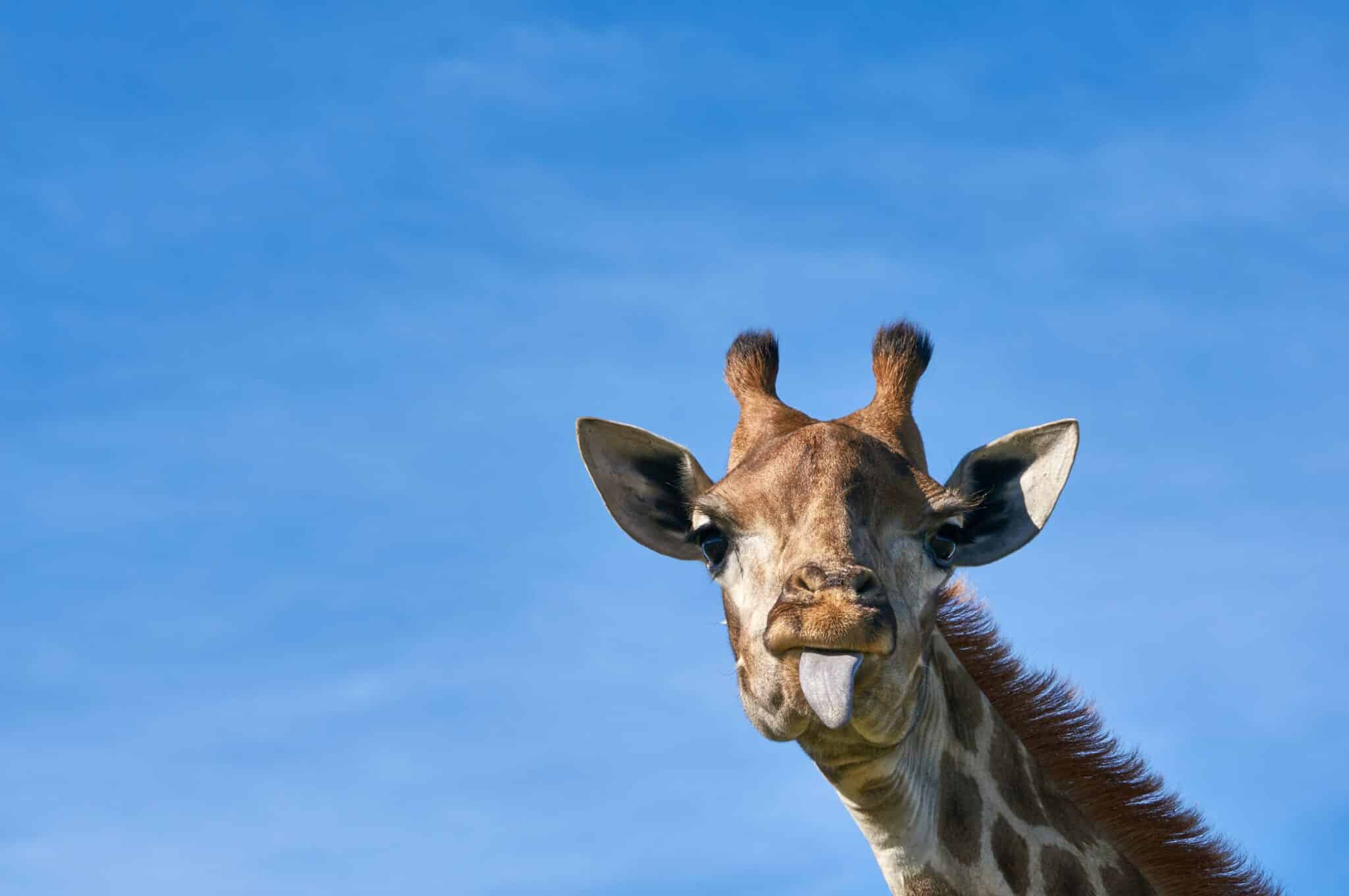
If you have ever been fortunate enough to watch a giraffe during a meal, a single anatomical detail may have caught your attention: as it stretches to reach the highest leaves on the savannah, its tongue is not pink but a deep violet, tending toward black. Far from being a mere aesthetic oddity, this distinctive pigmentation is, in reality, an evolutionary masterpiece. Faced with a merciless African sun and hostile vegetation, this oversized organ has acquired a true chemical and physical armor.
What you will learn
-
The impressive mechanics of this half-meter-long prehensile organ.
-
The chemical secret that turns this tongue into a full UV-screen.
-
Why other animals, from tropical forests to the icy plains, share this peculiar trait.
A precision tool armored against thorns
The four major giraffe species roaming the African continent share a particularly demanding feeding routine. To sustain their towering frames, these herbivores devote up to half of their day to grazing the treetops. The menu includes mimosa trees, wild apricot trees, and, above all, formidable acacias.
To tear off the tender leaves without tearing its mouth on the trees’ sharp thorns, the giraffe has developed an exceptional tool. Its tongue, extraordinarily agile, measures between 45 and 50 centimeters in length. It acts like a true hand, able to slip between the foliage. To crown it all, its surface is lined with thickened papillae that form a natural cuirass, rendering the animal resistant to scratches.
The secret of the biological “solar cream”
Yet it is the color of this tongue that fascinates biologists. With twelve hours a day spent with mouth wide open toward the African sky, the giraffe’s tongue is constantly exposed to ultraviolet rays. A conventional muscle tissue would suffer burns and destructive sunspots in only a few hours.
To counter this threat, nature has saturated this organ with melanin, more specifically eumelanin, a dark pigment that absorbs radiation. It is this extreme concentration that gives it its purplish to black hue. This pigment shield acts as a permanent full-screen barrier, preventing sun-related cellular damage. Conversely, rare giraffes afflicted with albinism or leucism (lacking this pigment) are deprived of this vital protection.
An evolutionary showcase that has spread beyond
This clever adaptation is not exclusive to giraffes. Scientists have studied the okapi, the giraffe’s closest living relative. Although this animal hides beneath the dense canopy of the Democratic Republic of Congo’s forests, it too possesses a violet tongue. The explanation lies in its habits: the okapi frequently feeds in clearings where the sun hits directly, justifying the retention of this UV shield.
This thermal and protective logic even reaches the opposite side of the globe. Under the polar circle, white bear cubs are born with a pink tongue that darkens with age to become violet. Just like their skin (which is black beneath their white fur), this dark hue helps them absorb the sun’s vital heat while shielding them from the reflective glare of the snow.
