
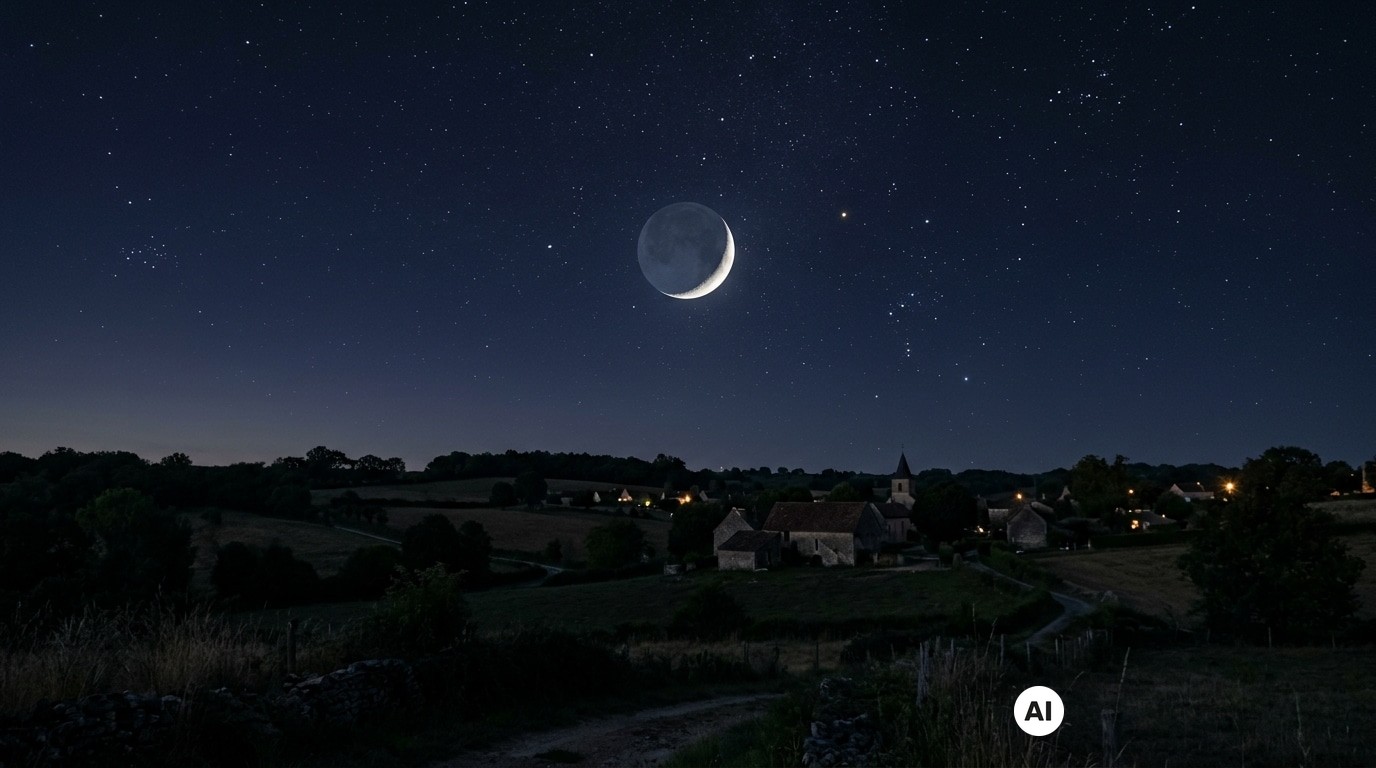
And what if we flipped the perspective for a moment: it isn’t only the Moon that brightens our evenings, it is also the Earth that illuminates the Moon. On the coming evenings, as you gaze toward a slim lunar crescent, many will think they are seeing only a pale fragment of our satellite plunged into darkness for the rest of the night. Yet, if you look a little closer, you can often glimpse the entire lunar disk, with a bright portion forming a crescent and another, duller part bathed in a grayish, gentle light. This quiet halo is nothing mysterious nor ominous. It is a clearly identified optical phenomenon, one that scientists even observe from the ground to better understand our own climate.
This bluish halo on the Moon is not a mystery, but a cosmic mirrors game
There is no need to hunt for a complicated explanation: what we observe is neither an eclipse, nor the famous far side of the Moon, nor a sign of rain. This phenomenon has a precise name, earthshine. It corresponds to the faint illumination of the Moon’s dark side by sunlight initially reflected by the Earth. In other words, the light’s journey goes like this: it leaves the Sun, bounces off the Earth, reaches the Moon, and then arrives at our eyes. In a way, we illuminate our satellite, just as it illuminates some of our nights. The light that reveals the entire lunar disk has indeed made a journey before reaching us.
Why does the Earth reflect enough light to illuminate its satellite
This phenomenon isn’t new. NASA recalls that Leonardo da Vinci had already understood the mechanism more than 500 years ago, noting that the Earth, seen from space, would act as a vast mirror returning sunlight. It would take until the early twentieth century for the French astronomer André-Louis Danjon to carry out the first quantitative observations of this earthshine. Concretely, our planet reflects a portion of the solar rays that reach it. This ability to bounce light back has a scientific name, albedo. It is this light, reflected by the Earth, that then lightly brushes the dark face of the Moon, making it faintly visible from where we stand, especially in the days just before and after the new Moon.
Astronomers scrutinize this terrestrial reflection to better understand our climate
What makes earthshine particularly interesting is that it isn’t only useful for amateur observation. Researchers from the New Jersey Institute of Technology and the California Institute of Technology published in 2001, in Geophysical Research Letters, a study that uses this method to measure Earth’s albedo from the ground, complementing satellite data. Their measurements, taken at the Big Bear Solar Observatory with a six-inch refracting telescope and CCD sensors, covered roughly 200 nights of observation over two years, plus 70 preceding nights. The result: an Earth albedo estimated at 0.297, with a margin of error of 0.005, and seasonal variations that could reach 20%. The researchers also noted a decline index of 2.5% in this albedo over the five years prior to the study. Philip R. Goode, director of the Big Bear Observatory, emphasizes that this net radiative balance plays a significant role for the climate, a drop of barely 1% in reflectance already capable of meaningful consequences for warming. This type of observation, described as a promising path by the researcher Steven E. Koonin in 1991, thus offers a simple and accessible window into the planet’s energy balance.
The next time you glimpse this crescent Moon accompanied by its ghostly disk, take a moment to observe this subtle play of light. Behind this almost ordinary image lies a rigorously studied phenomenon, capable of teaching us a great deal about our climate. A good reason to look up at the sky in the coming evenings, not to forecast rain, but to admire a little of our own light returning to us.
Source: APOD: 2025 April 3 – The Da Vinci Glow – NASA Science (science.nasa.gov)
Article prepared with the help of AI · Our method
