
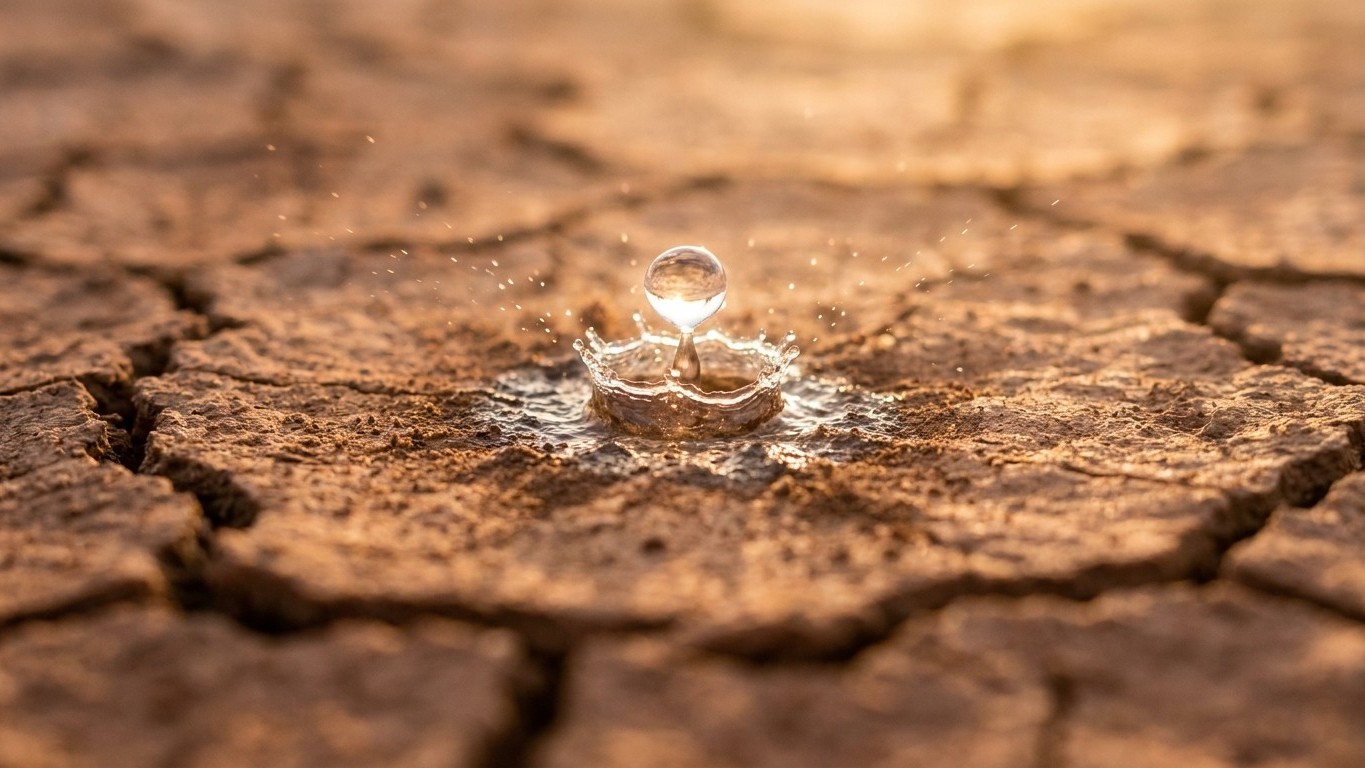
That distinctive scent rising from asphalt or a garden just before a shower has nothing to do with the rain itself. It originates in the soil, hurled into the air by a mechanism that stayed mysterious for decades: microscopic air pockets trapped at the moment of each droplet’s impact, surfacing and bursting, ejecting molecules crafted by bacteria. It bursts forth from these tiny trapped air bubbles within the soil, carried toward our nostrils the very instant the first drops strike dry ground. Rainwater, by contrast, carries no aroma at all.
Key takeaways
- Microscopic air bubbles explode upon droplet impact and catapult millions of invisible particles
- Geosmin, produced by a bacterium millions of years old, is detectable at incredibly low concentrations
- Our noses catch this scent well before the sky darkens: why such extreme sensitivity?
Slow-motion bubbles reveal the mystery
For a long time, no one had truly watched what happened at the microscopic scale the moment of impact. In 2015, two MIT engineers, Cullen Buie and Youngsoo Joung, changed that by filming rain droplets striking porous surfaces at thousands of frames per second. They observed that when a raindrop hits a porous surface, it traps tiny air bubbles at the contact point, which then rise through the droplet like bubbles in a champagne glass, until they burst on the surface, spraying a fine shower of aerosols. The experimental protocol was far from anecdotal: the studies encompassed roughly 600 experiments across 28 different surfaces, including synthetic materials and soil samples.
What this slow-motion footage reveals is almost theatrical. Each bubble that bursts propels a multitude of microscopic droplets, loaded with whatever the soil had accumulated during the dry spell. A simple raindrop striking a porous surface traps microscopic air pockets against the substrate, which journey upward through the droplet and burst at the surface, sometimes projecting hundreds of aerosols upward. Under optimal conditions, everything plays out in mere microseconds: under ideal circumstances, hundreds of aerosol droplets can form in just a few microseconds.
Geosmin, signature of an ancient bacterium
What exactly do these aerosols contain? The answer hinges on one word, a bit of a mouthful: geosmin, a compound produced by soil-dwelling microorganisms, predominantly of the genus Streptomyces. This earth-smelling molecule is generated by soil microbes, including Streptomyces bacteria, and the human nose detects it at incredibly low concentrations. This is no small detail: these bacteria have been producing the molecule for millions of years, long before humanity existed to smell it.
The biological mechanism behind this production is nearly a survival strategy. During dry spells, the activity of these bacteria slows, only to surge again with the return of moisture. Just before a rain event, the air and soil both become more humid, and the activity of actinobacteria accelerates, yielding more geosmin. Some studies even suggest a link to sporulation: under drought, these microorganisms manufacture dehydrationally resistant spores, with geosmin being a byproduct of this preservation process.
Our sensitivity to this molecule borders on the absurd. The detection threshold lies at a few parts per billion, a level that places our sense of smell well ahead of that of some predators renowned for their sniffing abilities. The human nose can typically detect geosmin at about 5–10 parts per billion, equivalent to a single drop of water in an Olympic-sized pool. In other words, we perceive this scent long before the sky fully gathers and threatens rain.
Why does a fine rain smell stronger than a downpour
Here is a paradox that every gardener has noted and may have trouble explaining: a light mist sometimes perfumes the air more than a heavy downpour. The reason lies in the very physics of impact. The rate at which aerosols are generated depends on the speed of the droplet at impact and on the properties of the surface it strikes, and a heavy rain, moving faster, strikes many surfaces too quickly to generate the bubbles. The slower the droplet falls, the more time it has to trap air and create these fragile bubbles before everything collapses.
The condition of the soil matters as much as the droplet speed. A ground saturated with water for days will produce almost nothing, whereas a dry, porous soil releases a real fragrance burst with the first drops. The intensity of petrichor depends on porosity and soil moisture: a compact, clay-rich surface saturated with water will barely release any scent, while a dry, sandy path unleashes a true olfactory firework from the very first droplets. This is also why the scent of a summer rain after three weeks of heat stays vividly etched in many people’s memory.
A phenomenon that goes far beyond fragrance
This aerosolization mechanism is not content with spreading a pleasant aroma: it literally carries living microorganisms into the atmosphere. MIT researchers continued their work to assess this dimension, which is less poetic but no less real. When droplets fall at speeds close to a light rain, under tropical-like temperatures, the droplets release a cloud of aerosols, each capable of carrying thousands of bacteria, remaining alive for more than an hour after impact. This is an area of interest to both climatologists and epidemiologists, since the same mechanism could explain how certain soil pathogens are carried by the wind over long distances.
The next time a shower catches a sun-hot sidewalk off guard, you can close your eyes for a moment and sense, in that waft of damp earth, the echo of a process that has been evolving for millions of years. Petrichor has never been a reliable indicator of an imminent or stronger rainfall, but it remains one of the rare sensory experiences where soil biology can be felt literally in our lungs.
Sources: alertes-meteo.com | omni-vision.fr
