
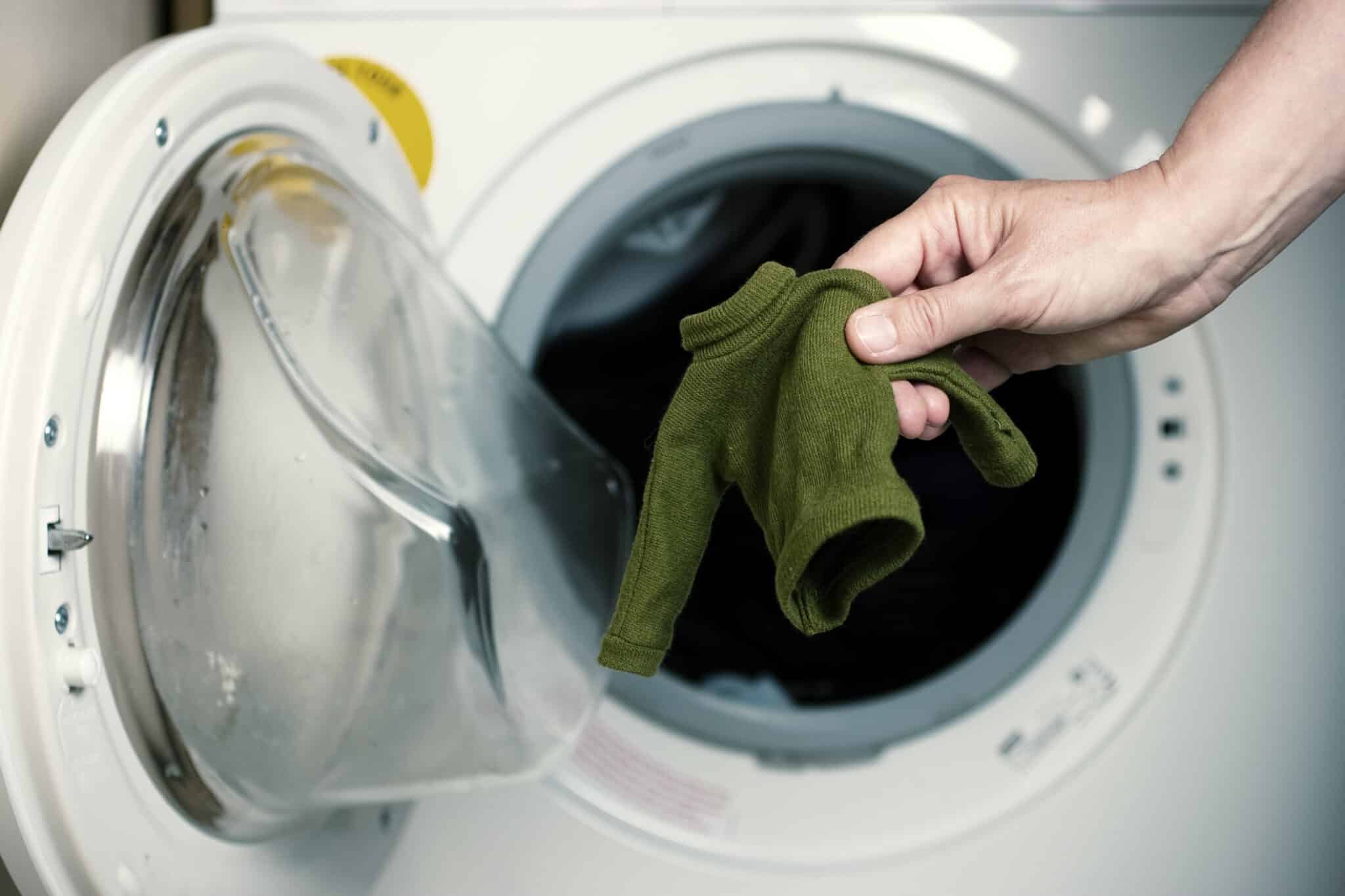
Who has never pulled a sweater or a shirt from the washing machine only to discover, with horror, that it had shrunk by one or two sizes? Behind this small domestic drama lies a complex scientific mechanism. Understanding what happens within textile fibers not only helps prevent such mishaps, but also, in some cases, allows repairing the damage.
The Hidden Memory of Fibers
In the case of plant-based fabrics – cotton, flax, or hemp – the culprit is what researchers call the “fiber memory.” Before being spun into regular threads and then turned into garments, these natural fibers are irregular and crumpled. They consist of long chains of cellulose molecules, naturally coiled and disordered.
During textile production, they are straightened and put under tension to achieve a smooth, uniform fabric. But this is only a provisional state: when exposed to heat, moisture, and the agitation of a machine wash, they tend to revert to their original, less taut and shorter form. This is how your T-shirt or blouse can shrink.
When Heat and Water Team Up Against Your Clothes
At the heart of the process, everything hinges on energy and molecular bonds. Hot water increases the movement of the fibers: the hydrogen bonds, which hold cellulose molecules in place, break more easily. Moreover, cellulose is hydrophilic: it draws in water, swells, and becomes more pliable.
Add to that the tumbling action of the washing machine drum, and you get an ideal cocktail for the fibers to relax and retract. The result: a garment that is shorter and tighter, no longer fitting you as it did before.
The Wool’s Special Case
Wool, on the other hand, doesn’t behave like cotton. It is an animal fiber made of keratin, the same protein as human hair. Its surface is covered with tiny scales that, under normal conditions, overlap like shingles.
Under the influence of washing, these scales open, catch onto one another, and tangle. This is called felting: the fibers clump together, the fabric densifies, and the sweater transforms into a miniature, rigid version of itself. Unlike plant fibers, this process is even harder to reverse.
Can a Shrunk Garment Be Repaired?
Bad news: you cannot completely “undo” shrinking, especially when it has already tightened significantly. Good news: certain techniques can recover part of the lost size, enough for the garment to become wearable again.
One of the most recommended methods by specialists is to soak the garment in warm water with a tablespoon of conditioner or baby shampoo per liter. Then, gently stretch it, without forcing, to restore its shape, and let it air dry flat, possibly pinning it to maintain a slight tension.
Why Does Conditioner Work?
The effectiveness of this technique rests on the chemistry of conditioners. They contain cationic surfactants—molecules that reduce the tension between water and fibers, while attaching to them to make them smoother and more slippery. In other words, they lubricate the fibers, reduce friction, and facilitate their softening.
Thus, the fabric’s loops loosen more easily, enabling the garment to be reshaped before it dries and sets its form again.
Prevention Rather Than Cure
If these tips can salvage a garment accidentally shrunk, the best remedy remains prevention. Read labels carefully, avoid wash cycles that are too hot, prefer air-drying to the tumble dryer: these habits extend the life of your clothes.
Next time you slide your favorite clothes into the machine, remember: behind every fiber lies a memory and a chemistry ready to wake up. And they don’t always have your best interests at heart.
