
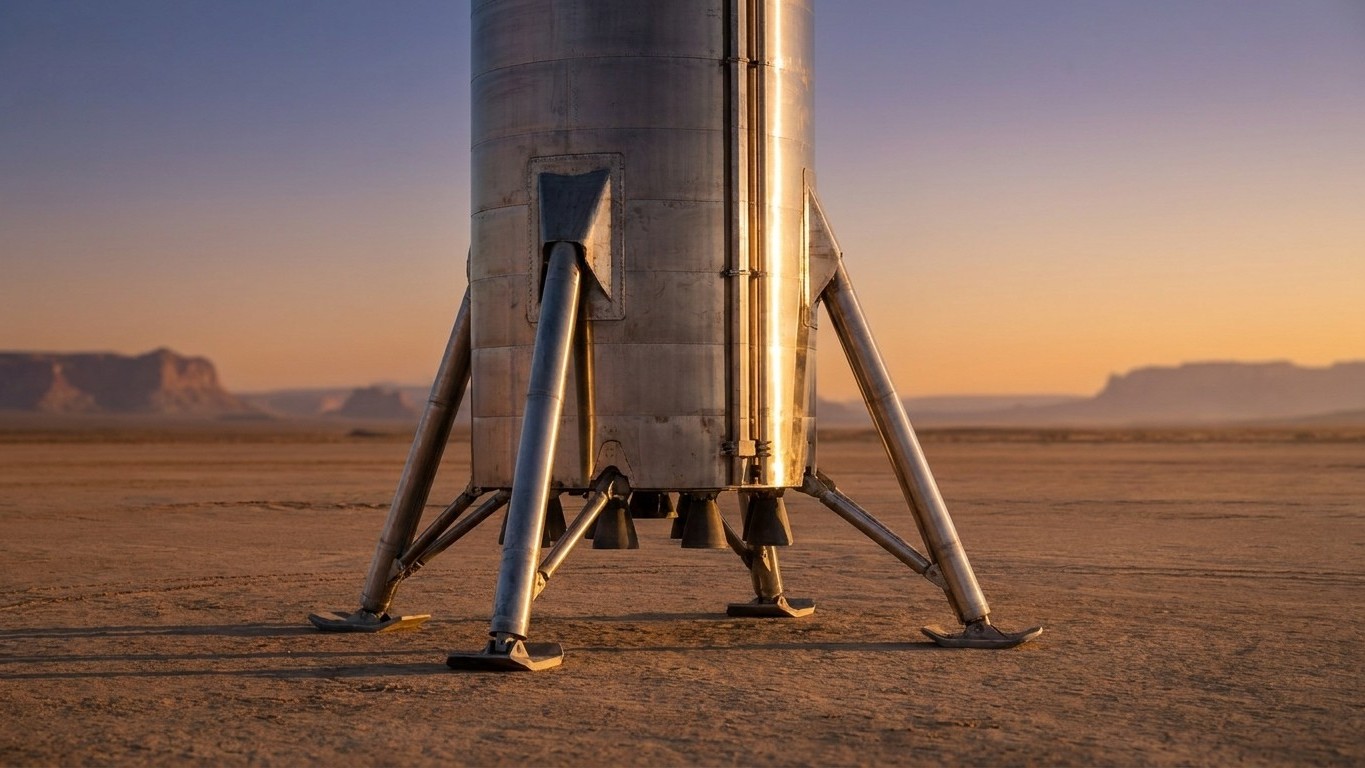
On August 18, 2026 at 23:35 UTC (7:35 a.m. the following day in Beijing), a 66-meter stainless steel cylinder peeled away from the Gobi Desert, released its payload into orbit, and then gently returned on its four metallic legs to a launch pad about 390 kilometers from its launch site. The 66-meter vehicle leveraged its nine Tianque-12A engines for a clean ascent, stage separation, and a precise recovery on landing legs roughly 390 km from the pad. A year after exploding during a landing attempt, the first stage of the Chinese launcher Zhuque-3, developed by private company LandSpace, stood upright on the pad. Intact.
Key takeaways
- A private Chinese launcher exploded a year ago while attempting a landing—what really happened on board?
- Three decisive technical adjustments transformed a spectacular fiasco into a resounding success
- Could this success challenge the technological dominance of another spacefaring power?
A landing that erases the December 2025 failure
Backtracking. In December 2025, the Zhuque-3 rocket carried out its inaugural flight. The upper stage reached orbit without issue—a rare feat for a first flight. But the first stage did not survive its Earth return attempt: LandSpace’s Zhuque-3 test flight ended in a blazing explosion after achieving orbit. A spectacular fiasco, filmed and broadcast, that could have discouraged any team.
LandSpace chose to draw lessons from the episode. In its post-mission briefing, the company detailed the fixes applied to the vehicle. The technical changes made after the initial landing-attempt failure included reducing the number of engines used during the braking burn, which simplified the system and improved reliability, adding a “predicted landing point” to the onboard autonomous safety-control system, and enhanced thermal protection to withstand the extreme heat of atmospheric reentry. Three adjustments, three faults corrected. Nothing revolutionary on paper, but evidently sufficient to turn an afterburner into a success.
How the stage regained vertical orientation
The flight path followed a choreography now familiar to observers of New Space, albeit new to China’s private-sector scene. About 137 seconds after liftoff, the rocket stages separated. The first stage then entered its preplanned descent phase and executed a sequence of key maneuvers, including high-altitude attitude control, propulsion-based deceleration during reentry, and a controlled landing on its deployable legs. Specifically, the methane–liquid oxygen engines re-fired mid-fall to slow the descent, just as SpaceX’s Falcon 9 has done since 2015.
The landing site is far from incidental: the launcher began its descent toward a dedicated landing pad in Minqin County, in Gansu Province, a desert region chosen to absorb misfires without endangering lives. A providential safety zone, given that the first attempt ended in a ball of fire.
China joins a very exclusive club
This success places LandSpace in a select cadre of builders capable of propulsively recovering an orbital stage. The rocket joins Falcon 9, New Glenn, and Long March 10B among the four only partially reusable orbital launchers to have demonstrated flight-proven recoveries. For a decade, this know-how remained the exclusive domain of SpaceX. For ten years, this capability belonged solely to SpaceX; now several providers achieve it every few months. The Californian monopoly is eroding, and China is contributing in its own way.
What distinguishes Zhuque-3 is its method. A month earlier, in July 2026, the state-owned Longue Marche 10B had already achieved a first-stage recovery, but with a very different system: the Long March 10B benefited from assist for Earth return, landing softly in a device resembling a net rigged on a ship at sea, while Zhuque-3 touched down on land and stayed upright thanks to a landing-leg arrangement, much like the Falcon 9. Two philosophies, two equivalent outcomes, but LandSpace adds an extra symbol: the first earth-landing recovery on land with legs for a Chinese operator. The company’s release did not miss the point, calling the event the “first successful recovery attempt of an orbital launcher stage using landing legs, and the first land-based stage recovery in China.”
Another Chinese project in progress is the state-backed Longue Marche 12A, also methane-oxygen powered. It had attempted its own recovery in December 2025, without success: its inaugural flight occurred in December 2025 and likewise failed to land, though its miss was larger than in Zhuque-3’s first attempt. The internal Chinese competition, between private players and state champions, promises to be as heated as the international rivalry.
Why this technical detail shifts the economic equation
Recovering a stage only matters if it can be reused multiple times without rebuilding it for each mission. That is where the real battleground lies. Industry experts cited by Xinhua summarize the challenge: the successful validation of Zhuque-3’s technical approach, combining methane–oxygen propulsion, stainless-steel structure, and vertical landings with recovery, will help accelerate the deployment of China’s low-Earth orbit satellite constellation. The logic is straightforward: amortizing a launcher’s cost over ten or twenty flights, rather than a single mission, mechanically cuts the price per kilogram in orbit.
One major unknown remains, acknowledged by LandSpace itself: the recovered stage must now undergo close scrutiny by engineers. Inspections and evaluations of its engines, its structure, its propellant tanks, its landing mechanisms, and other components will need to be conducted. Remaining lifespans, maintenance costs, and the reuse cycle will directly determine the real economic advantage of the operation. Standing upright in the Gobi Desert was the spectacular milestone. Successful airborne reuse of the same stage without disassembly will be the true test of industrial maturity, a benchmark the world will watch closely at Zhuque-3’s next launch.
Sources: spacenews.com | spacelaunchlive.com
