
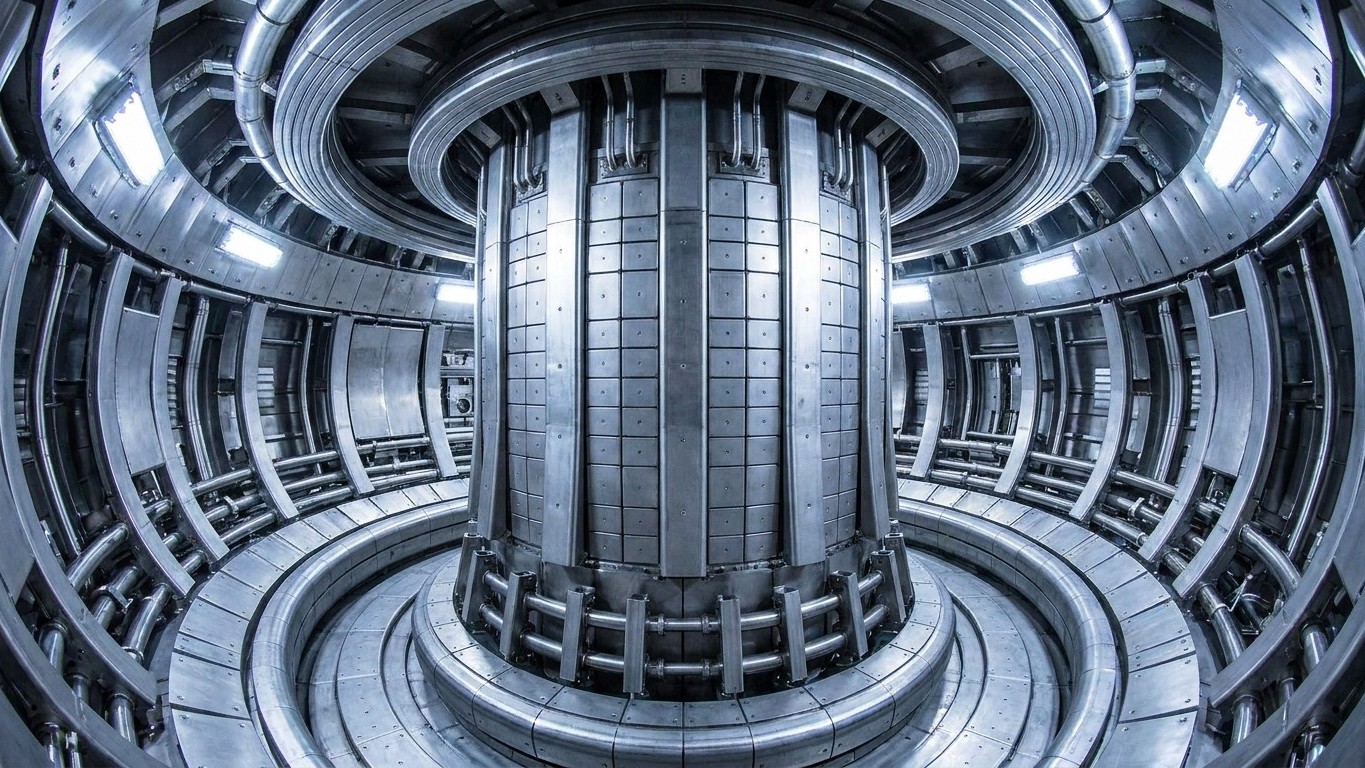
A reactor built in Cadarache, in the Bouches-du-Rhône, with the explicit aim of never lighting a single lamp. It sounds absurd, and yet this is exactly the wager of ITER: the largest fusion machine ever assembled will have neither turbine, nor alternator, nor any connection to the French grid. An intentional absence, accepted from the start, that continues to perplex many people who instinctively associate “reactor” with “electricity production.”
Key takeaways
- A giant reactor designed to never light a bulb: how is that justified?
- The timetable slips by nine years, with costs exploding: the real reasons behind this derailment
- ITER is only a stepping stone: discover the DEMO project that aims to actually produce electricity
A reactor without a turbine, and it’s not a detail
Because of its experimental purpose, ITER is not connected to turbo-alternators and will not produce electricity. In practical terms, the heat generated by the fusion of deuterium and tritium will never be used to turn any generator. The project, which brings together thirty-five countries around a colossal site, aims for a goal that, on paper, is modest but in practice is extremely complex: to produce 500 megawatts of fusion power from 50 megawatts injected to heat the plasma. A tenfold ratio, in other words, between energy invested and energy recovered as fusion, which would already constitute an unprecedented physical achievement.
ITER, despite its gigantism, will never generate electricity. It is not a power plant but a demonstration machine intended to prove the physical and technical feasibility of fusion at the necessary scale. The Cadarache tokamak is designed as a full-scale laboratory, not as a production tool. Every euro invested here serves to answer a precise scientific question: can a plasma be maintained stably at temperatures exceeding 150 million degrees long enough to validate the technologies that will one day equip real power plants?
The schedule keeps slipping, again and again
The answer to that question has fallen behind. Much behind. In July 2024, the ITER Organization’s director-general, Pietro Barabaschi, presented to the project council a new roadmap, validated at the council’s 34th meeting at the end of June. Initially planned for 2025, ITER’s first plasma generations have been postponed. According to the new roadmap submitted to the council, the start of the reactor’s first fusion operations must now be awaited until at least 2034. Nine years of delay on a deadline that had for years been presented as imminent.
The schedule does not stop there. The first plasmas will be based solely on deuterium. Subsequently, the reactor’s full potential in magnetic energy is not planned until 2036. In the end, the deuterium-tritium fusion operations are expected for 2039. This final stage, when the reactor will actually combine the two hydrogen isotopes intended for the industrial reaction, was originally hoped for in 2035. It therefore slips by four more years.
The financial slide follows the same trajectory. Barabaschi noted that he had requested an additional five billion euros from the Board, which accepted the new schedule but has yet to decide on the funding. This amount adds to a bill that is already significant. Until now, through successive financial reassessments, the budget hovered around 20 billion euros. The project, launched with a much more modest initial estimate, has thus seen its cost multiply several times over two decades, a phenomenon that large international scientific projects routinely experience, but rarely on this scale.
The reasons for this drifters are not due to a simple lack of foresight. Project managers justify the delay by several cumulative factors: defects detected on certain vacuum-chamber parts and on the thermal shields, the need to repair them before assembly, and the impact of the Covid-19 pandemic on global supply chains. An additional technical choice was also made during this revision: tungsten will replace beryllium for the plasma-facing walls, due to its much higher melting temperature. A material change that, in itself, illustrates the difficulty of locking in such an experimental design over decades without needing to revise it mid-course.
Why generating electricity isn’t even the objective
That is the point that often escapes the general public: ITER was never meant to power a household, not even a streetlamp on the site. ITER will not be a prototype of an industrial reactor for electricity production. Its role is to provide a proof of principle that such a reactor is possible. This mission belongs to a separate project, still largely theoretical: DEMO. This role will belong to DEMO (from the English DEMOnstration Power Plant), the first true prototype reactor for electricity commercialization planned at best around 2050.
DEMO will build on ITER’s achievements to cross the milestone that Cadarache will never cross: converting fusion heat into electric power. The steam from the heat exchanger will drive turbines and generators to produce electric current. A classic circuit, similar to that of a conventional thermal plant, but powered by a radically different heat source. Demo is the successor, around 2040-2050, to ITER’s experimental fusion reactor, and it represents the next step toward exploiting fusion energy through magnetic confinement.
The DEMO schedule remains uncertain, directly dependent on the results ITER will yield from 2034 onward. Some estimates had construction starting as early as 2030, but that milestone was also deemed difficult to meet. What stands out, subtly, is the timeline of this field: from the first theoretical concept of controlled fusion to a potential commercial plant, almost a century will have passed. A reminder to temper the loud promises of some private start-ups that, themselves, promise commercial fusion within just a few years.
Sources: usinenouvelle.com | sfen.org
