
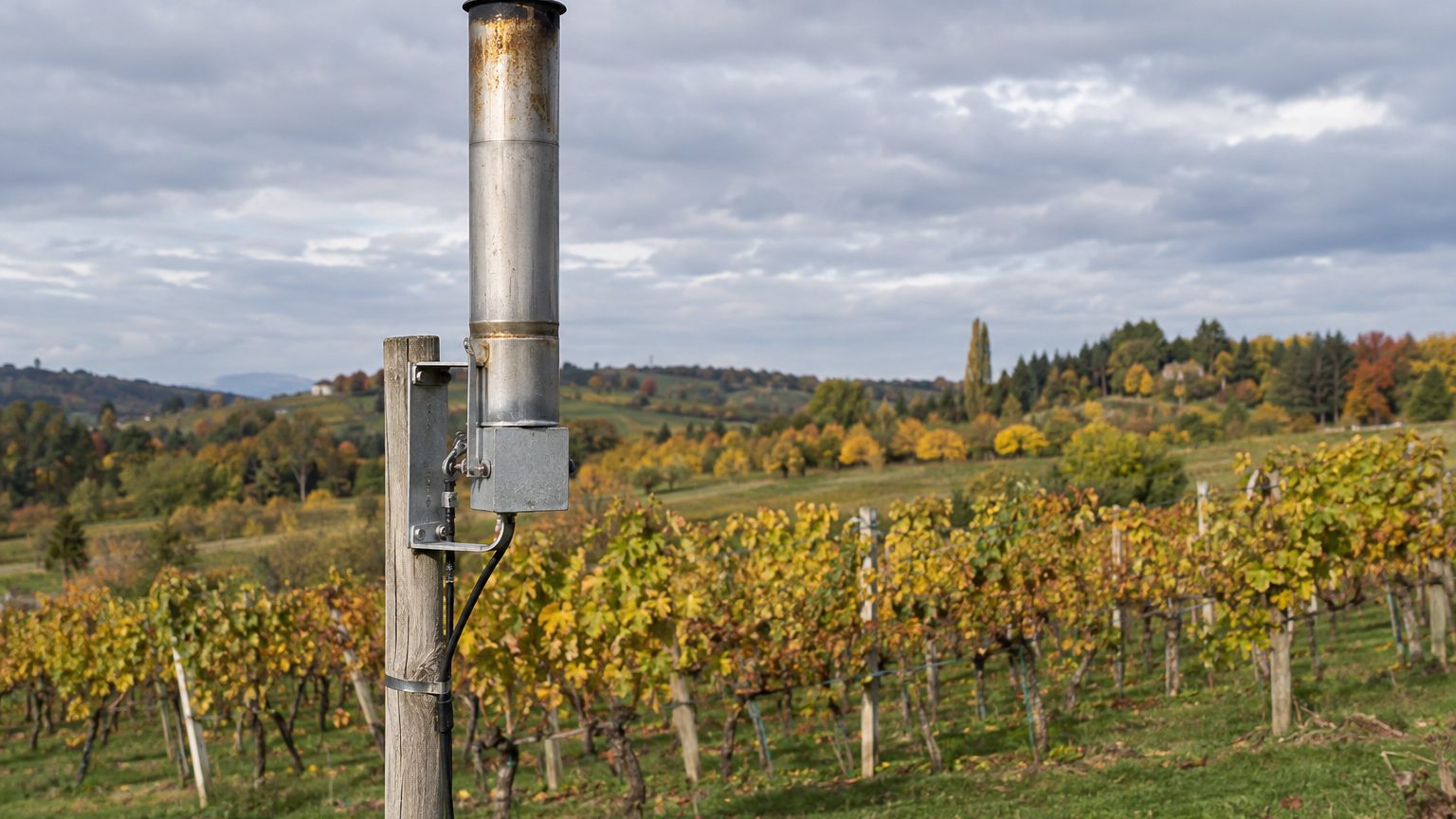
To protect vineyards and orchards from hail, French volunteers manually trigger generators that multiply hailstones. Each threatening storm is thus seeded with silver iodide to produce more ice, with a wager: smaller pellets that melt before reaching the ground. Anelfa, the National Association for the Study and Fight Against Atmospheric Calamities, has led this operation since 1951 over about 66,000 square kilometers.
More hailstones, therefore, but of a much smaller size.
- 1170 silver iodide generators are manually activated by volunteers during threatening storms across 66,000 km²
- By multiplying freezing nuclei, the method fragments water into thousands of small hailstones that melt before reaching the ground
- Anelfa claims an effectiveness of 40 to 60% in reducing damage, funded by the agricultural professions themselves
A Network of Volunteers Across 12% of the Territory
Anelfa operates 17 ground-based generator networks, concentrated mainly in the West and Southeast. When compared to France’s 551,000 km² of metropolitan territory, the 66,000 km² covered account for roughly 12%—a homegrown calculation, but one that conveys the scale. For the 2026 campaign, 1,170 generators ensure hail prevention, while 1,513 hail gauges document the falls. A network does not form by chance: the minimum is 15 generators spaced about 10 km apart.
The triggering is not automatic. When risk is forecast, Anelfa sends an alert message asking operators to switch the generators on and off. The voice message goes out several hours before the storm, based on the forecasts from Keraunos and in liaison with Météo‑France.
Behind each device lies a person, often a winemaker or a neighbor, who leaves their dinner to go light a burner. Two to three volunteers per post can supervise the startup, avoiding reliance on a single person on a stormy evening. Hailstorms rarely strike at a time that suits everyone.
How to Trigger Hail to Reduce Its Damages
A destructive hail event begins with a few large hailstones sharing the supercooled water in a thundercloud. Silver iodide has a crystal structure close to that of ice: frozen crystals can form on its particles. By injecting these nuclei into the updrafts, one multiplies the starting points, and the available water is distributed among many more hailstones. Each stays small, falls more slowly, and has a chance to melt, at least partially, before reaching a cluster or a roof.
Anelfa reports an effectiveness of 40 to 60%.
This figure comes from the association itself, which relies on hail gauges—polystyrene plates marked by impacts. They read a 50% reduction in the kinetic energy of the hailstones. The scientific community remains divided on the true extent of the method’s reach, and there is no obligation to settle the matter here: it is a result measured by those who operate it.
What Hail Costs, and Who Pays for the Burners
According to Anelfa, hail-related losses reached about €780 million in France in 2018, with roughly a third allocated to crops and agricultural goods. The rest concerned buildings and cars, underscoring that hail damage goes beyond the fields.
In Armagnac, storms on June 3 and June 19, 2022 affected a quarter of the vineyard, which covers 20,000 ha. On this area, 2,100 ha were destroyed at 75–100%. The figures appear in a written question submitted to the Senate on July 7, 2022. For a winemaker, a few minutes of storm were enough to wipe out an entire year’s harvest.
Facing this risk, agricultural professions fund themselves. In Lot-et-Garonne, the indicative cost is €100,000 for 50 diffusers, or €2,000 per device, covered by the profession. The department was among the first to start the 2026 campaign, as of March 25, along with Dordogne and Prévigrêle.
The storm season ends, but the prevention campaign runs from April to October: this is the time when volunteers store the burners and the association reviews its performance. Tanks are emptied, chimney temperature readings are compiled, and the polystyrene plates reveal the year’s impacts.
Sources: lejma.fr | questions.assemblee-nationale.fr
