
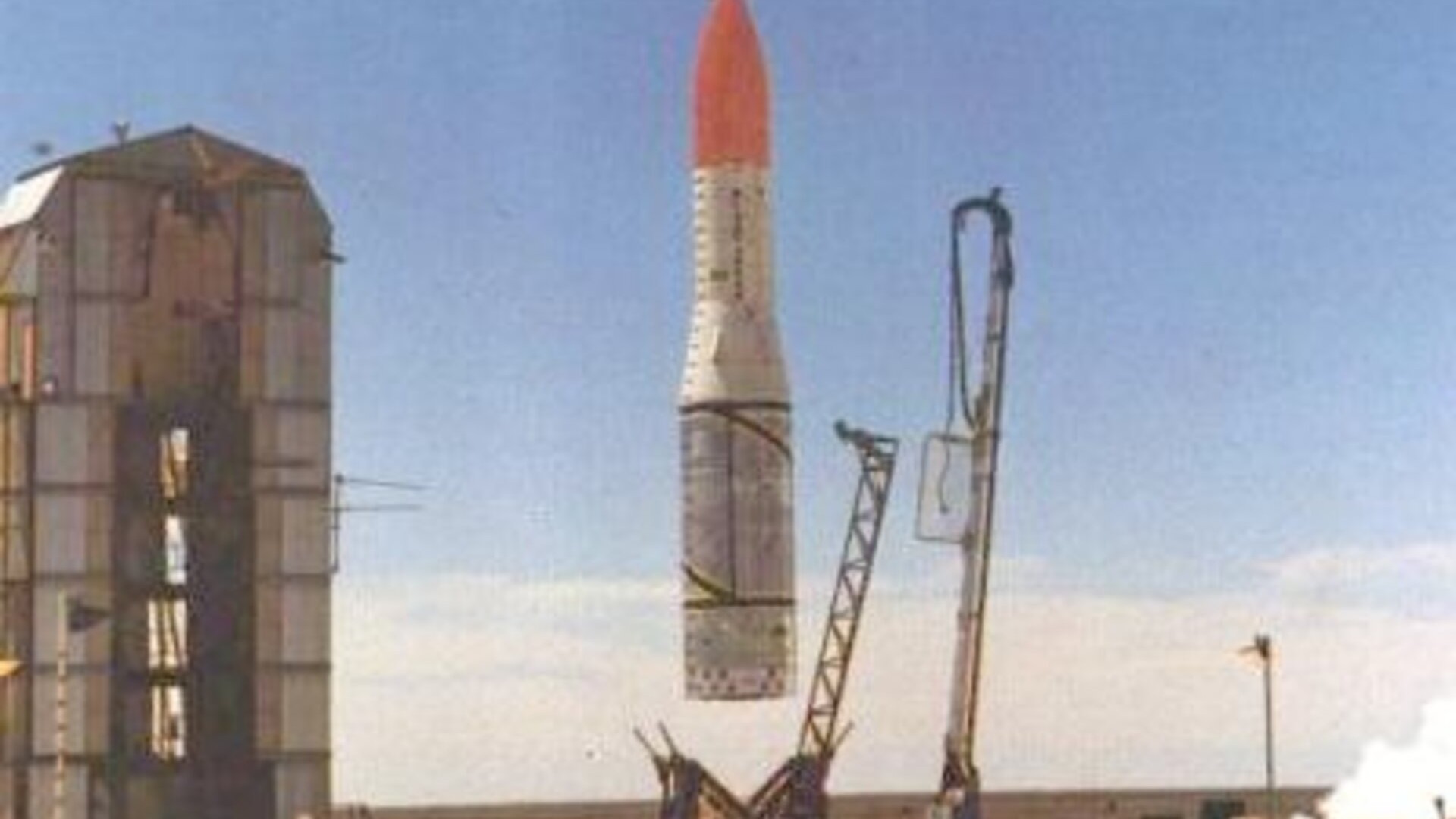
Fifty-five years. That is the time the United Kingdom took between its one and only successful fully domestic orbital launch and its next attempt. On 28 October 1971, the Black Arrow rocket placed the Prospero satellite into orbit from the Australian desert of Woomera. Since then, no British launcher has launched again. And the most astonishing thing in this story is that the program had already been canceled by the government three months before this success.
Key takeaways
- A space program canceled… that nonetheless achieved its final launch by administrative accident
- The Prospero satellite still operates in orbit after 53 years, but no one can control it anymore
- The United Kingdom is attempting a grand space return with a German rocket from Scotland in 2025
One shot too many… or a last chance
The affair borders on bureaucratic absurdity. In July 1971, the British government announced the cancellation of the Black Arrow program, three months before its successful Prospero launch. Official reason: the public purse. The official justification was economic: the government believed it would be cheaper to launch British satellites with United States Scout rockets, offered at reduced prices by the Americans.
Calendar coincidence did the rest. With the fourth rocket and the second satellite already en route to Australia, it was deemed more costly to turn back and dismantle everything than to simply proceed with the launch. Prospero did not fly because of a political decision, but because canceling it would have cost more than letting it go ahead. An irony that not even a screenwriter would dare to script.
The result, however, was unequivocal. On 28 October 1971, the fourth rocket, Black Arrow R3, lifted off from the Australian desert. It climbed into the atmosphere, and its third stage fired perfectly, placing its payload into a stable low Earth orbit. Britain thus became the sixth nation to launch a satellite, with Prospero, also known as X3, placed into orbit by a Black Arrow rocket from Woomera.
Prospero, the forgotten satellite that still orbits
This small 66-kilogram craft looked modest on paper. It was meant to test technologies for communications satellites, with two experimental solar cell devices, telemetry and power systems, as well as a micrometeoroid detector. Its name in itself tells the story of the program: until ground stations in Alaska picked up its first signals 40 minutes after launch, confirming it was indeed in orbit, the satellite carried the code name X3. It was later renamed Prospero, after the wizard in Shakespeare’s The Tempest.
The wild part is that this device still works today, at least in orbit. It remained operational until 1973, and was contacted every year for more than 25 years thereafter. It was contacted each year until 1996, when the ground station was dismantled and the access codes apparently lost. Since then, Prospero has been circling in silence, with no one able to speak to it, or even truly control it. Officially, its mission has lasted 53 years, 6 months and 27 days, with a planned deorbit in 2070. A century of flight for an object its own creators can no longer reach: hard to find something more British.
A decision that cost dearly, and not only in pride
The economic reasoning that killed Black Arrow turned against its author almost instantly. The Ministry of Defence had calculated that the Scout rocket would be cheaper to use than maintaining Black Arrow, but once the program was canceled and Britain’s rocket program abandoned, the cheap Scout launch option disappeared. The United Kingdom found itself without a national launcher and without the cheap alternative that had justified the cut.
The fifth unit, R4, never flew. It is the last Black Arrow ever built. It never flew because the program had been canceled, its planned satellite Miranda having eventually been placed into orbit by an American Scout in 1974. It now sits in the Science Museum in London, a museum piece frozen at the precise moment when Britain’s space ambitions were halted. The United Kingdom thus became the only country to have developed, then abandoned, a rocket capable of placing satellites into orbit.
Fifty years on, the United Kingdom gives it another try
The story could finally turn a new page, and not from an Australian desert this time. On the Scottish island of Unst, in the Shetland, the SaxaVord spaceport is set to host what would be the first orbital launch ever attempted from British soil. The German company Rocket Factory Augsburg is preparing the maiden flight of its RFA One rocket; the project has weathered its share of setbacks: a static-fire incident in August 2024 destroyed the first stage on the pad. After a complete rebuild, the company now aims for a launch from SaxaVord starting 10 August, with a five-week window opened for a ‘test flight.’
The symbolism is strong, even if the rocket is not British. Europe remains in the throes of a launch-capability crisis and relies on American companies like SpaceX to place satellites into orbit, something RFA One intends to change. For now, the only purely national launcher ever to put a British satellite into orbit remains elusive, fifty-five years after Black Arrow. Prospero, meanwhile, continues its silent patrol at more than 500 kilometers altitude, deaf to any call, but very much alive in the sky.
Sources: n2yo.com | sciencemuseum.org.uk
