
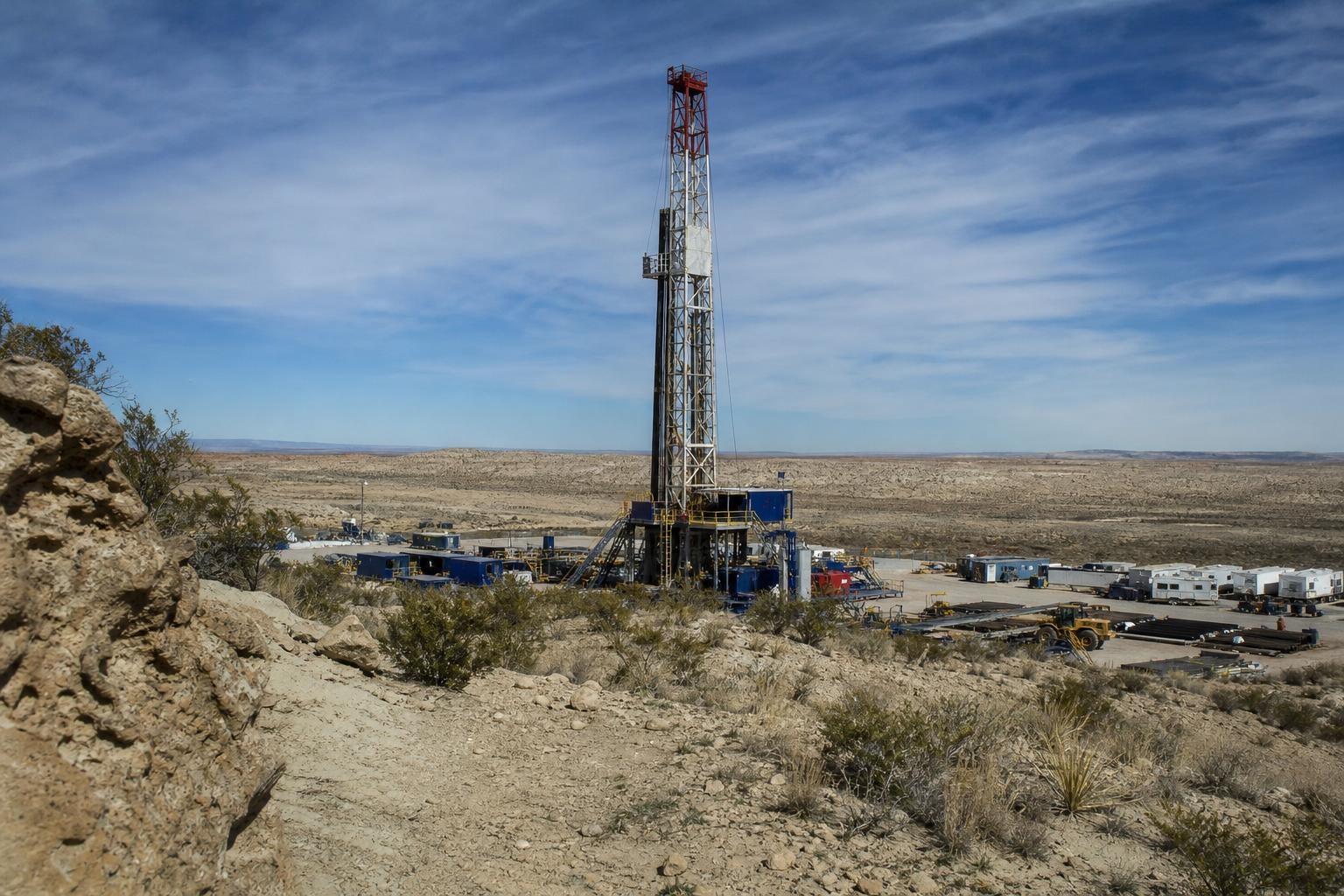
A vast new estimate has sharpened the world’s focus on America’s energy heartland. Beneath the scrub and pumpjacks of West Texas and southeastern New Mexico, government geologists say there’s an ocean of “undiscovered, technically recoverable” oil locked in layered rocks—an assessment so large it resets the scale for what a single U.S. formation can hold.
The scale—and what it really means
The U.S. Geological Survey’s tally points to roughly 46 billion barrels of oil within stacked plays of the Permian Basin. The agency calls it the largest continuous assessment it has ever made in one geologic setting, reflecting the unique density of “stacked” benches and intervals.
Crucially, this is not a booking of proved reserves. It represents what could be produced with today’s technology, given sufficient price, infrastructure, and access. As one oft-repeated industry refrain goes, “This is a resource estimate, not a reserve booking.”
The resources are continuous—spread across vast, low-permeability rocks rather than trapped in discrete pools—so operators rely on long laterals and intensive hydraulic fracturing to unlock the molecules.
Geology, stacked
Beneath the mesa and mesquite, the Permian is a layer cake of shales and tight sands. Names like Wolfcamp and Bone Spring have become shorthand for “stacked pay” that lets producers drill multiple zones from the same pad.
Depths often exceed two miles, where brittle, organic-rich rocks respond to precise stimulation. Each bench brings its own pressure, fluid, and mineral quirks; getting completions right is part physics, part craft.
“Geology sets the stage; prices write the script,” one reservoir engineer likes to say, capturing how rock quality and market cycles intertwine.
Technology pushed the frontier
Modern shale production is an engineering system. Longer horizontals, tighter stage spacing, and high-proppant designs have lifted well productivity while compressing drilling and completion cycle times.
Pad development and “cube” concepts reduce surface impact and enable multi-zone sequencing, though they introduce parent–child well interference that must be modeled and mitigated. Data science now steers bit and frac fleet, optimizing designs by bench, pressure regime, and landing zone.
The result is a machine that can scale—until geology, logistics, or capital say otherwise.
Economic stakes and market gravity
The implications stretch from Midland to Riyadh. At competitive break-evens, Permian barrels shape global supply expectations, hedge curves, and OPEC+ strategy. When pipelines lag rigs, local price discounts widen; when midstream expands, barrels flow to coasts.
Mergers have consolidated top-tier acreage, chasing contiguous blocks that suit long-lateral development. Drilling inventory quality—counted in “tier-1” locations—is the coin of the realm, dictating capital efficiency and free cash priorities.
For consumers, more low-cost supply can cushion price spikes. For producers, discipline on growth sustains returns in a market that punishes overreach and rewards cash yield.
Environmental and social footprint
Every barrel carries a footprint in land, water, and air. Produced water management remains a defining challenge, with recycling up but disposal linked to induced seismicity in parts of the basin.
Methane intensity has improved at many operators, yet leaks and episodic flaring still erode climate gains. Policy tools—from tighter LDAR rules to methane fees—are pushing measurement and abatement up the cost curve.
Communities see jobs and royalties alongside traffic, dust, and noise. “Energy abundance should travel with accountability,” one New Mexico policymaker argues, pressing for safeguards that scale with activity.
How big is “46 billion” in context?
- It’s roughly a year’s worth of global consumption, depending on demand and decline assumptions.
- Developed over decades, it could underpin U.S. net exports, reinforcing energy security narratives and trade balances.
- It remains sensitive to price, policy, and pace—rocks are fixed, but outcomes are human choices.
Constraints still matter
Resource is not the same as through-put. Rigs, crews, and frac spreads set near-term ceilings. Pipelines, power, and sand supply can pinch as growth cycles. Federal leasing rules affect New Mexico acreage, while Texas sits mostly on private land.
Water strategy is now core strategy: sourcing, recycling, disposal, and seismic response. Electrified frac fleets and grid tie-ins can cut on-site emissions, but power availability is its own planning hurdle.
Why this changes the conversation
A resource base of this magnitude extends the runway for U.S. oil leadership, even as the world accelerates electrification and efficiency. It signals that geology still holds surprises in mature basins, where stacked stratigraphy can multiply what surface maps suggest.
At the same time, it underlines a pivot from “growth at any cost” to “value with constraints.” Capital markets prize returns; policymakers prize cleaner barrels; communities prize responsible, predictable operations.
As the USGS puts it, the resource is “undiscovered, technically recoverable.” The next chapter—what’s actually produced—will be written by the interplay of rock, technology, economics, and the social license to operate.