
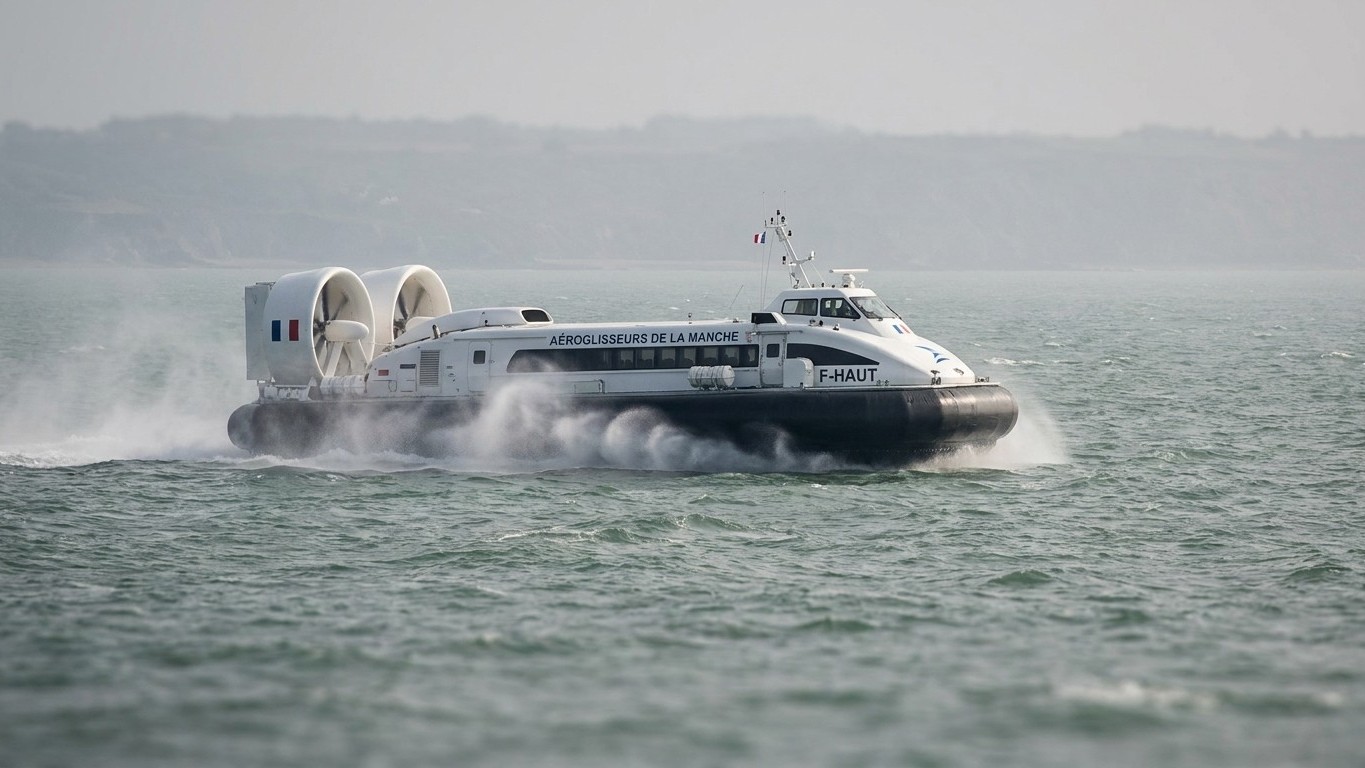
A hovercraft capable of linking Dover to Calais in about thirty minutes, without ever touching the water surface: this is what the United Kingdom commercialized as early as 1968. What eventually stopped this beacon of British engineering had nothing to do with a storm in the Channel or a mechanical failure. The true cause lies in two words: economic profitability. Between the price of kerosene and the competition from a tunnel bored beneath the sea, the SR.N4’s adventure ended on a simple accounting calculation, not on a shipwreck.
Key takeaways
- A craft capable of gliding over the Channel in just 35 minutes, with the capacity of a Boeing 747
- Four gas turbines consumed about a ton of kerosene per hour – a fatal weakness in a shifting economic landscape
- It wasn’t a storm that halted it, but a tax decision and the emergence of unexpected competition
A technical feat born of British ingenuity
The principle almost reads like magic: lifting a ship weighing several hundred tons on a cushion of air, kept aloft by a flexible skirt that barely brushes the crests of the waves. It is this idea, developed by radar engineer Christopher Cockerell, that gave birth to the hovercraft concept, first tested during a Calais–Dover crossing in 1959. The SR.N4, built by the British Hovercraft Corporation on the Isle of Wight, embodied its industrial culmination. First launched on February 4, 1968, the SR.N4 of the British Hovercraft Corporation remained the largest passenger hovercraft in the world, evolving from early Mark I models to Mark II, then to elongated Mark III versions by 16.9 meters.
Under the hull, four Rolls-Royce Proteus gas turbines turned as many swiveling propellers mounted on pylons, providing both lift and propulsion. A staggering detail: each turbine burned one ton of fuel per hour. In its Mark III version, the craft could carry up to 60 cars and 418 passengers, roughly the capacity of a Boeing 747 resting on water. All of this was launched at a cruising speed that placed the vehicle in a category of its own on the English Channel.
Thirty minutes to cross the Channel
Initially operated by Hoverlloyd and Seaspeed from four hoverports (Pegwell Bay and Dover on the English side, Calais and Boulogne on the French side), the service merged in 1981 under the Hoverspeed banner, operating from the Dover West hoverport. The standard crossing, covering roughly thirty kilometers, averaged 35 minutes—a performance that earned the craft its nickname of the “Concorde of the seas.” An informal record even set: the fastest crossing in the service’s history, achieved in 1995, took a mere 22 minutes. When empty, without passengers or vehicles aboard, the craft could go even faster than on its normal commercial rotations.
The SR.N4 even enjoyed its cinematic moment: Princess Margaret boarded Sean Connery in a James Bond film shot in the early 1970s. But the service’s popularity was not built solely on the screen. The hovercraft crossing of the Channel reached its peak in a year when 3 million passengers were carried, at a time when speeding across the Channel was still a novelty for British vacationers accustomed to traditional ferries.
What really doomed the SR.N4
So, if neither the swell nor mechanical failures brought it down, what did condemn it? The answer lies in a set of economic factors far more prosaic than any sea incident. First, the opening of the Channel Tunnel in 1994 offered a direct, fast, weather-insensitive rail alternative—a compelling argument against a hovercraft that sometimes had to cancel runs due to strong winds. The road service closed in October 2000, partly due to competition from the tunnel’s new rail service.
But the final blow came from elsewhere, perhaps the most surprising: the end of duty-free sales on board. According to other analyses, the end of on-board duty-free in 1999 made the hovercraft unprofitable, as sales of tax-free goods aboard generated more profit at that moment than ticket sales, and as spare parts grew scarce, the SR.N4 was withdrawn from service. It wasn’t the sea that felled these giants of the waves, but a European tax regime change combined with engines that were incredibly durable yet alarmingly voracious, at a time when replacement parts were increasingly scarce. On October 1, 2000, the Princess Anne and the Princess Margaret performed their final commercial crossings between Dover and Calais, greeted by a crowd of onlookers eager to witness the end of an era.
A solitary princess in a museum
The fate of the last two survivors of the fleet illustrates how preserving industrial heritage can hinge on a thread. The two hovercraft were initially stored side by side at the Hovercraft Museum in Lee-on-the-Solent, Hampshire, at the former HMS Daedalus air and naval base. But a real estate project almost sealed their shared fate in scrap metal. A petition launched in 2016 helped save one of the two: a three-year lease was granted to the museum in August 2016, with the intention of transferring the craft permanently, and Princess Anne was chosen to be restored in a Seaspeed-era livery.
Her twin sister did not receive the same chance. In March 2018, Princess Margaret was dismantled at Lee-on-Solent, with parts salvaged to complete the restoration of her survivor. Today, Princess Anne remains the last representative in the world of this class of giant hovercraft, displayed in a museum that claims a collection of more than 60 hovercraft of various designs. A unique relic of a time when Britain bet on compressed air to reinvent sea crossings, before an economy more merciless than any wave closed the chapter.
Sources: tripadvisor.com | change.org
