
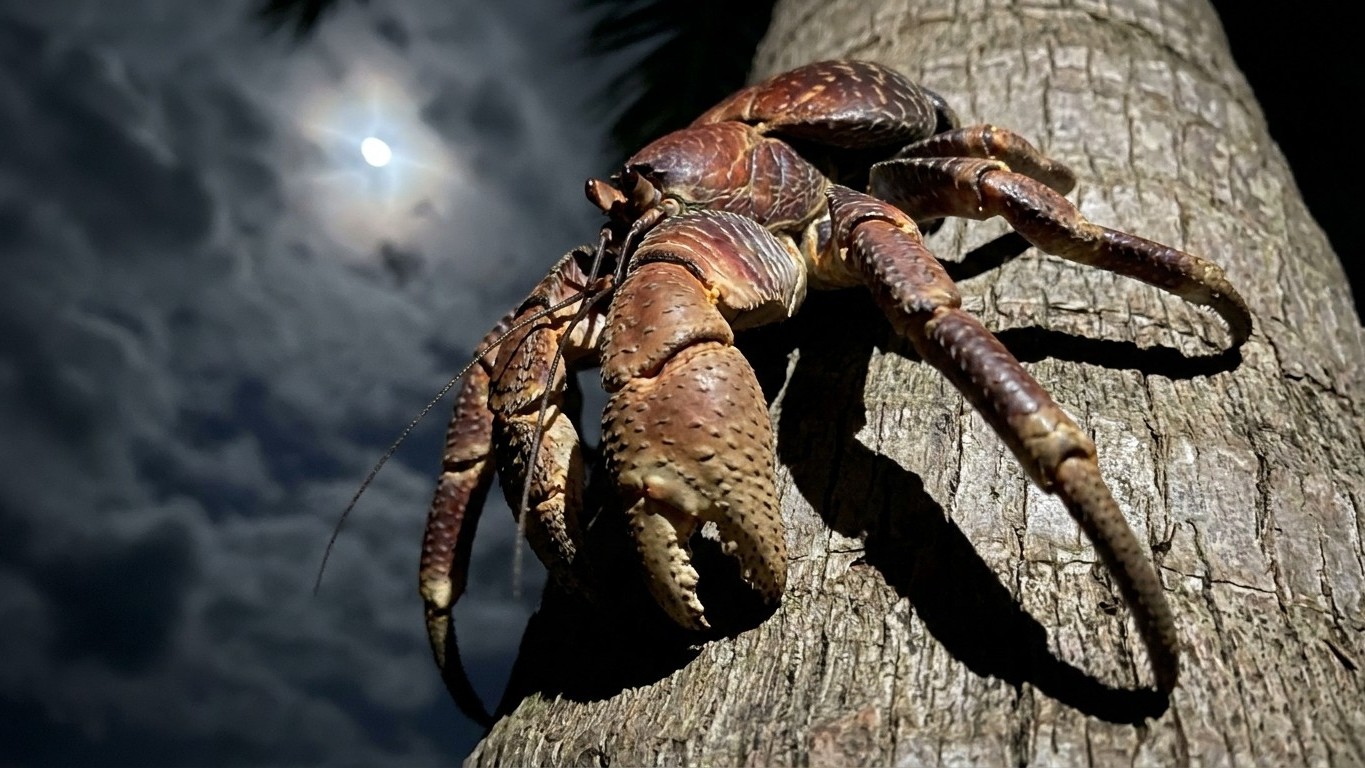
A crustacean capable of breaking the bone of a seabird in the dead of night, of climbing a coconut palm to surprise its prey, and whose claw develops a strength never recorded in any other member of its family. This is not science fiction: this is the coconut crab, Birgus latro, the largest terrestrial arthropod in the world, and its reputation as a stealthy killer now rests on precise scientific data.
Key Takeaways
- Its claw exerts a force equivalent to the weight of a refrigerator crashing onto a toe
- Scientists observed it actively hunting seabirds at night, not merely scavenging
- Its incredible strength amounts to about 90 times its body weight—no other crustacean comes close
A claw that literally crushes the records
In 2016, a Japanese team from the Okinawa Churashima Foundation, led by Shin-ichiro Oka, sought to quantify what many had long suspected: the Herculean strength of this claw. The researchers measured the pinch force of the chelipeds on 29 wild coconut crabs, weighing from 33 grams to 2.12 kilograms. The maximum force measured ranged from 29.4 to 1,765.2 newtons, showing a strong positive correlation with body mass. Published in the journal PLOS ONE under the title “A Mighty Claw,” the study is impressive: the strongest specimen pinched with a force equal to the weight of a refrigerator dropping onto a toe.
The most staggering part remains the extrapolation. Based on the correlation between pinch force and body mass, the potential force of the largest crab reported in a previous study (4 kg) would reach 3,300 newtons, far surpassing the pinch force of other crustaceans as well as the bite force of most terrestrial predators. To put this number in perspective, the canines of a lion bite with about 1,315 newtons, and some of its molars can crush with 2,024 newtons, according to a 2007 study. A two-kilogram crab already rivals the jaws of a big predator. Only crocodiles clearly outrun them, with bites exceeding 16,000 newtons.
What most astonishes researchers is the ratio of force to body size. Oka himself confided that his teams anticipated a powerful claw, but “we expected the force to be very strong. But the actual powers surpassed our expectations,” he explained, noting that the pinch force represented about 90 times the animal’s body weight. Scaled to a 65-kilogram human, it would amount to the ability to crush something with several tons of force using just the fingers.
Why such an oversized claw?
This strength is not merely an evolutionary accident. The coconut crab shares a common ancestor with terrestrial hermit crabs of the genus Coenobita, but in adulthood it shed its dependence on shells to protect its abdomen, developing a calcified body instead. This independence from shells removed constraints on body size and likely led to the development of new functions tied to its large claws. Freed from the shell constraint, the animal could grow without bound and turn its claw into a heavy-duty predation tool.
This force is primarily used for a much more prosaic purpose: opening coconuts. As anyone who has ever found themselves on a deserted island knows, the coconut is not an easy feast to obtain. Opening it demands resolve, perseverance, and a particularly stubborn claw. But this same weapon, originally designed to crack a tropical shell, proved devastatingly effective against living prey.
A nocturnal predator that hunts seabirds
It was on the isolated Chagos archipelago in the Indian Ocean that biologist Mark Laidre of Dartmouth College first documented this hunting behavior. In March 2016, during a two-month expedition, he observed the scene in the middle of the night. On March 2, 2016, under the cover of darkness, he witnessed a coconut crab attack and kill an adult red-footed booby. The bird slept on a low branch. The crab had climbed into the tree and attacked the seabird in its nest, on a branch near the ground. The predator broke the bird’s wing, causing it to fall from the nest, before sinking its deadly claws into its body.
The most troubling part followed. The species had previously been considered purely scavengers, but Laidre recounts that things became “rather macabre” after the arrival of other coconut crabs, which began to eviscerate the still-living bird. The initial attacker dragged the still-living bird away, and the crustaceans fought among themselves. For several hours, the crabs tore the bird apart, carrying it away and consuming it piece by piece. A few days earlier, the researcher had already found a disturbing clue while exploring a burrow. The first evidence of vertebrate predation by coconut crabs appeared when he cataloged the burrow of a crab on February 5, 2016: at the bottom lay the carcass of a almost-adult red-footed booby, one of the island’s largest birds.
This role as a local super-predator intrigues scientists. Laidre suspects that coconut crabs act as the “masters of the atoll,” capable of regulating the presence of ground-nesting birds on the islands they inhabit. An ecological role long overlooked, given the image of a scavenging, slow, and harmless crustacean that has long clung to the lore surrounding the species.
A fascinating giant, but threatened
Despite this newly emphasized reputation, the coconut crab remains largely little known. Its population status is not well established: the IUCN lists it as “Data Deficient.” But there is a suspicion that human predation and habitat destruction could reduce its numbers. Present on numerous Indo-Pacific islands where coconut palms grow, it has sometimes been locally exterminated to safeguard commercial crops—a paradox for an animal whose name, and its legendary strength, derive from this very fruit. Next time a coconut palm seems a touch too silent at night, it may be wise not to linger.
Sources: journals.plos.org | ncbi.nlm.nih.gov
