
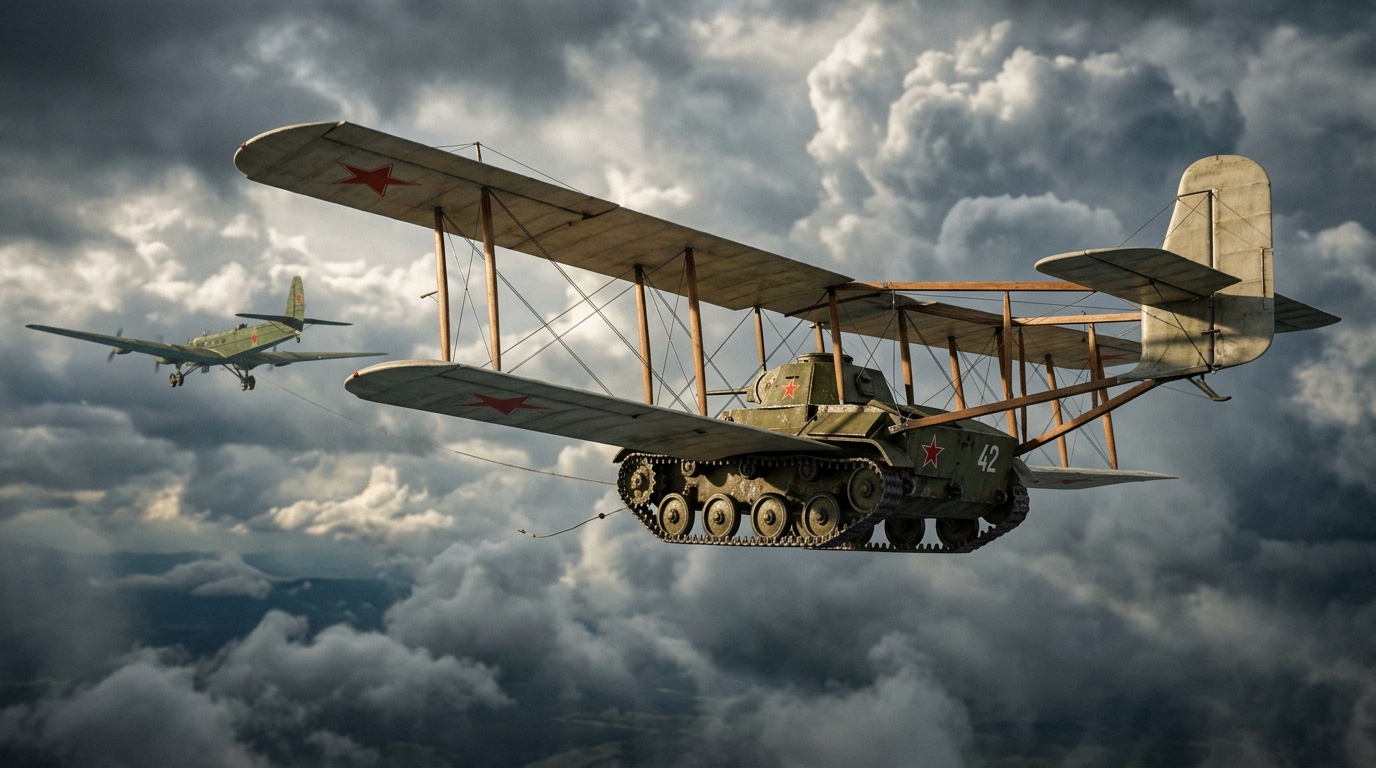
Imagine the scene: an assault tank, with its tracks and armor, suddenly lifting off the ground to glide silently through the sky, like a colossal bird of metal. This isn’t a shot from a science-fiction film, but a real event that occurred above the Moscow countryside in the midst of World War II. At a moment when wartime urgency pushed engineers to rethink the laws of physics, the Soviet Union made a bold, almost fantastical technical bet: to make a multi-ton armored vehicle fly by grafting wings worthy of a commercial airliner onto it. A look back at an aeronautical experiment that was as brief as it was extraordinary.
- In 1942, engineer Oleg Antonov conceived the A-40, a lightened T-60 tank equipped with wooden and fabric wings spanning 18 meters to be dropped behind enemy lines.
- On September 2, 1942, towed by a Tupolev TB-3, the contraption actually took off and glided for a few minutes before the towing aircraft, overheating, was forced to release it prematurely.
- Due to the lack of an aircraft powerful enough to tow a fully armed tank at 160 km/h, the project was abandoned after this single flight, despite the technical success of the landing.
- A Tank That Grows Wings: The Wild War-Born Idea
- 18-Meter Wingspan to Make the Incredible Fly
- The Flight That Was Enough to Seal the Project’s Fate
- An Engineer’s Dream Turned into a Historical Footnote
A Tank That Grows Wings: The Wild War-Born Idea
At the heart of the conflict, the Red Army faced a major logistical dilemma: how to supply partisans and isolated troops behind enemy lines efficiently? Parachuting troops and light supplies is one thing, but delivering a tank capable of defending itself is another. The idea of dropping an entire tank from an aircraft may seem utterly absurd on paper. Yet the shortage of logistical means pushed Soviet engineers toward increasingly extreme solutions.
It is in this context that Oleg Antonov, an engineer who would later become a leading figure in Soviet aviation, proposed a concept that would make any physicist raise an eyebrow: directly graft wooden and fabric wings onto the hull of a light T-60 tank. Not a proper fuselage as such, no separate cockpit for a dedicated pilot—the tank itself would become literally the airplane, with a driver at the controls of the flight. On paper, the calculation almost seemed to hold up. The T-60 weighs around 7 tons, a weight theoretically transportable provided one had wings large enough and a well-designed tail. The crucial question remained: would the theory survive the takeoff test?
18-Meter Wingspan to Make the Incredible Fly
To give form to this project named A-40, engineers designed a pair of biplane wings with an impressive 18-meter wingspan, paired with a cross-braced, twin-boom tail. The visual result was striking: a gigantic glider, almost regal, literally grafted onto the stout frame of a miniature armored beast. This hybrid machine quickly earned the nickname Krylya Tanka, simply meaning the tank’s wings.
The tank kept its engine and tracks, essential for returning to base after touchdown, but its turret, its armament, ammunition, and even its headlights were removed to minimize weight as much as possible. In this project, every kilogram counted when the ultimate aim was to keep several tons of steel in the air. On September 2, 1942, the moment of truth finally arrived at the Bykovo airfield near Moscow. A heavy bomber, the Tupolev TB-3, took on the task of towing the craft, since the initially planned Petliakov Pe-8 was unavailable that day. The tank-glider gradually detached from the ground, glided for several minutes over the Russian countryside, then landed almost normally. An undeniable technical feat, immediately followed by a hard reality.
The Flight That Was Enough to Seal the Project’s Fate
At the controls of this extraordinary device stood Soviet test pilot Sergei Anokhin, who did indeed manage to bring the craft back to the ground without damage. But the feedback from this single flight was unequivocal. From the moment of takeoff, the aerodynamic drag generated by the tank proved so considerable that the TB-3’s engines began to overheat dangerously, threatening a catastrophic stall for both aircraft.
Facing this risk, the bomber pilot had no choice but to jettison the glider-tank prematurely, which nevertheless managed to glide and land smoothly in a field near the airfield. Once on the ground, the crew detached the wings and tail, which had become useless, and simply towed the T-60 back to base on its tracks. The anecdote may provoke a smile today, but it reveals a far more serious problem: no Soviet aircraft of the era possessed enough power to tow this assembly under operational conditions, that is, with a fully armed and armored tank at the minimum required speed of around 160 kilometers per hour. The concept remained viable only in isolated tests, but in wartime it became completely unusable. The military authorities quickly decided: the program was abandoned after this single flight, and the prototype never flew again.
An Engineer’s Dream Turned into a Historical Footnote
The A-40 Antonov tank epitomizes the trial-and-error nature of technological exploration born from urgent conflict. It is the portrait of a bold idea, backed by appealing theoretical calculations on paper, that inevitably collided with a manufacturing reality that could not keep pace. The removal of ammunition, necessary to lighten the machine, posed a major tactical problem in itself: what good is dropping a tank behind enemy lines if it arrives on the ground unarmed?
This project also marks the early steps of Oleg Antonov, who would later become one of the great names in Soviet cargo aviation thanks to the design bureau that bears his name today. Far from hindering his career, this spectacular failure only reinforced his reputation as an engineer willing to explore the boldest ideas. Today, this anecdote remains a fascinating symbol of that particular period in military history, where the improbable deserved at least one try, even if only to fly seven tons of steel over the front lines.
This tale of the Soviet flying tank reminds us how war has often served as a testing ground for ideas that, in peacetime, would probably never have left the drawing board. Between tactical necessity and technological gamble, the A-40 stands as a unique testament to creativity compelled by circumstance. So, as drones and autonomous vehicles redefine modern military strategies, doesn’t this historical anecdote invite us to question the future quirky inventions that necessity will, sooner or later, compel?
