
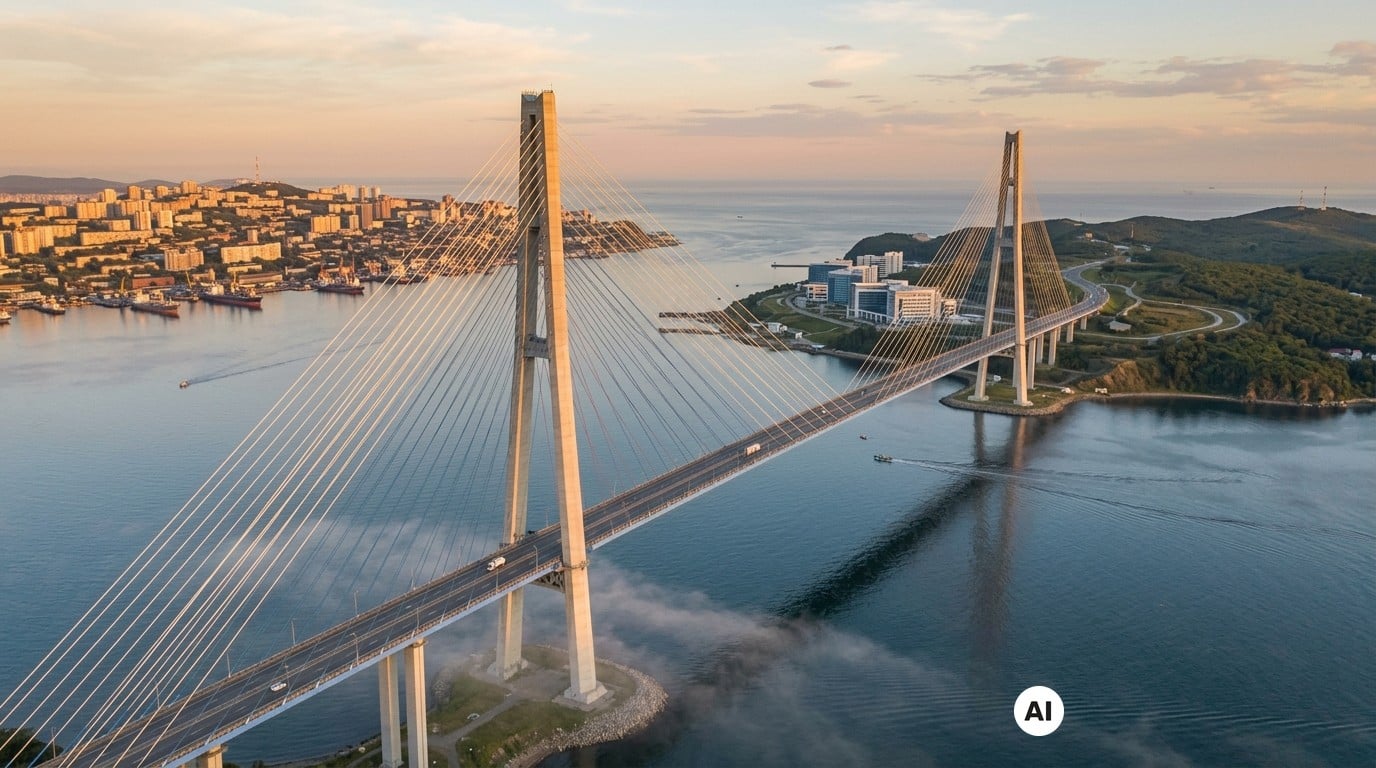
Inaugurated in July 2012 in Vladivostok, the Russky Bridge cost about $1.1 billion. At its opening, it boasted the world’s largest central span for a cable-stayed bridge, with 1,104 meters between its two pylons. It was built for the APEC summit, held on Russky Island, which at the time had just over 5,000 inhabitants.
A World Record, 16 Meters Ahead of the Previous
The bridge crosses the eastern Bosphorus Strait, which separates the island from the peninsula on which the city sits. Its central span measures 1,104 meters, 16 meters longer than the Sutong Bridge in China, which previously held the record. The main structure spans 1,885 meters, and its total length reaches 3,100 meters with the access viaducts.
Its four-lane deck rests on 168 cable-stays, with lengths ranging from about 136 to 580 meters. It rises to 70 meters above the water. The two reinforced concrete pylons soar to 320.9 meters, which, according to Structurae, place them second in the world behind the Millau Viaduct. The deck of the central span is steel. The bridge is designed to withstand temperatures from -40 °C to 40 °C and winds of 36 m/s.
A summit organized on the island’s campus
The bridge was designed for the APEC summit (Asia-Pacific Economic Cooperation). This organization brings together each year the leaders of several regional economies. The 2012 edition took place in September on the campus of the Far Eastern Federal University, on Russky Island. This campus had been built specifically for the occasion, and was then intended to host the university.
About $6 billion was allocated to develop the island and Vladivostok ahead of the summit. Construction of the bridge began in 2009, with the first pylons starting in September of that year. The structure was completed in July 2012 and opened by the Prime Minister at the time, Dmitry Medvedev. Its official name was bestowed on September 3, 2012. According to Bridge Design & Engineering, it was one of two major cable-stayed bridges built in Vladivostok before the summit.
An island long closed off
Before the bridge, the island was difficult to access. For nearly 150 years, it housed forts and military batteries. Until recently, even Vladivostok residents needed special permission to go there. In 2010, it had 5,360 inhabitants, spanning about 97 km².
Authorities envisioned a very different future for it. The plans approved at the summit included turning it into a resort and building a federal presidential residence for the President of Russia, in Boyarin Bay. In April 2019, the island also hosted the meeting between Vladimir Putin and the North Korean leader Kim Jong-un.
An oversized project?
According to Structurae, the bridge’s capacity is 50,000 vehicles per day, ten times the island’s population. This gap fuels criticism: some media outlets branded the structure a “vanity bridge” costing a billion dollars, a symbol of power projection. Proponents of the project argue that Russia’s Far East had lacked modern infrastructure for decades, and that the bridge now links the university campus to the city.
The symbol of a project designed for an event
The Russky Bridge embodies both an engineering prowess and the limits of a development conceived primarily for a one-off event. Its real usefulness remains a matter of debate.
Sources : Russky Bridge – Wikipedia ; Russky Island – Wikipedia ; Russky Bridge – Structurae ; Eastern promise – Bridge Design & Engineering ; Russky Bridge: Russia’s Billion-Dollar Vanity Bridge – Amusing Planet
Article prepared with the help of AI · Our method
