
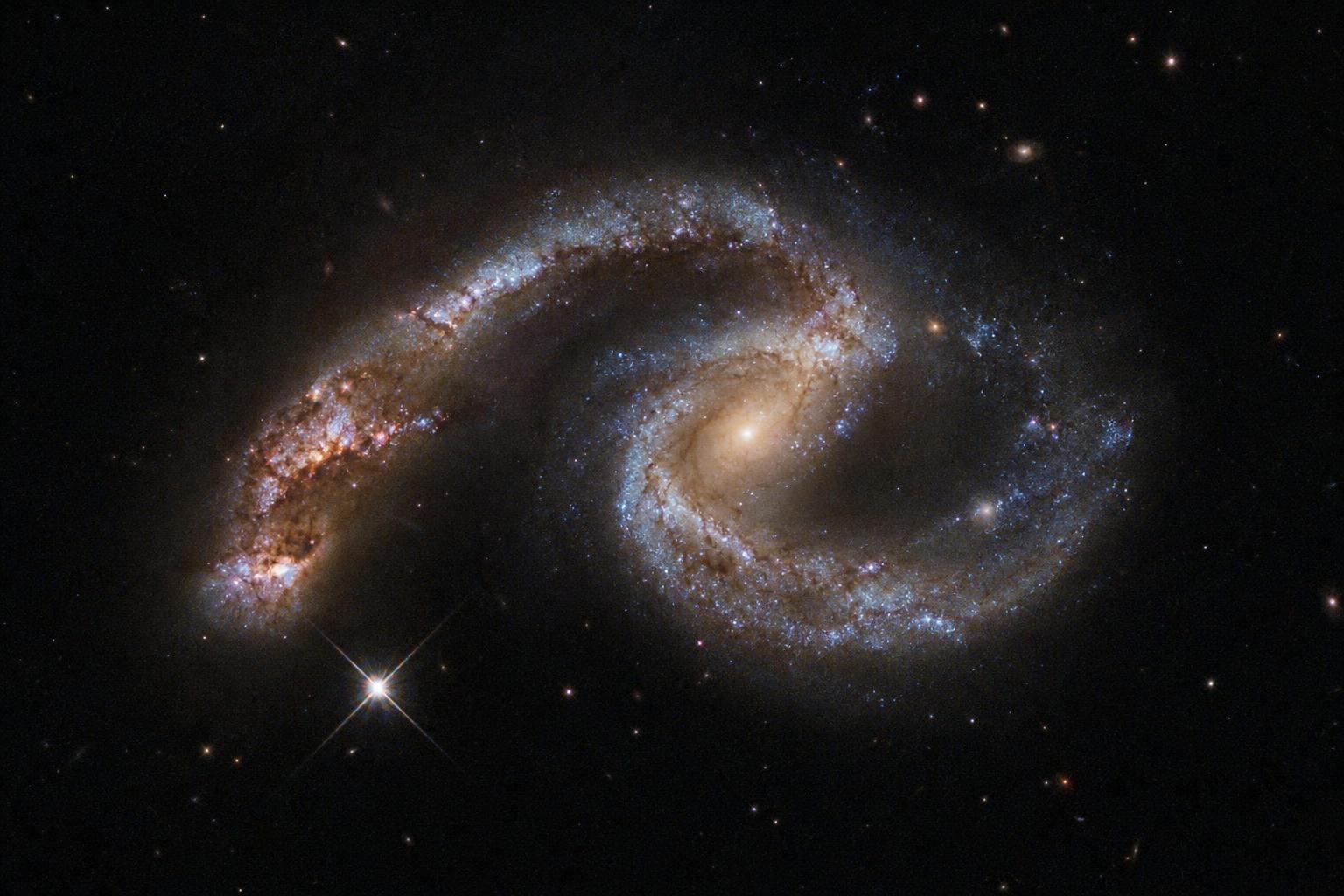
A faint, dark knot where no galaxy should be. That’s what new observations from the James Webb Space Telescope appear to reveal: a compact source of gravity embedded in the turbulent bridge between two interacting galaxies. The signal is subtle yet insistent, the kind of cosmic riddle that makes astronomers say, “wait, what?”
If the interpretation holds, this object is a black hole that isn’t obviously anchored to a bright host. It sits in the messy corridor of gas and dust torn loose by a galactic collision, as if it formed right there, amid the violence, rather than inside a long-lived stellar nursery. “It’s like spotting a campfire in the middle of a landslide,” one researcher quipped. “Brief, blazing, and telling us the land is truly moving.”
A surprise in the merger’s midstream
Most black holes we find are tethered to a galaxy’s bright core, or they betray themselves inside star-forming regions. This candidate, by contrast, appears stranded in a tidal flow: the elongated streams that colliding galaxies pull from one another. That makes it an outlier, a potential seed growing far from a familiar cradle.
Mergers are factories for chaos. Gas slams into gas, angular momentum gets shuffled, and dense knots collapse. JWST’s infrared view can pierce the choking dust, turning a confused smear into a layered story. Here, the story hints at a compact, rapidly feeding engine, lighting up surrounding material with hard, energetic radiation.
What JWST actually saw
Using mid- and near-infrared filters, JWST isolates emission from warm dust, ionized gas, and molecular hydrogen. In the tidal region, a point-like source stands out with colors and line ratios consistent with an accreting black hole, not merely a knot of massive stars. Its spectrum shows signs of fast, hot gas and potential broad features associated with an active galactic nucleus.
The location is the twist. There’s little in the way of a bound stellar bulge around it, and the local light is dominated by shredded, streaming material. “The data whisper, not shout,” as one team member reportedly said. “But the pattern is unnervingly clear.”
How could such a beast arise?
If this compact engine is what it seems, there are a few paths nature might have taken:
- A dense gas clump in the tidal bridge collapsed directly into a heavy seed, bypassing a normal stellar phase.
- A smaller black hole was kicked from one galaxy’s center during a previous interaction and started feeding where it landed.
- Two or more stellar remnants merged in a crowded, dust-choked nexus, snowballing into a more massive object.
Each route demands extreme conditions—very high gas density, rapid cooling, and a way to avoid disruptive feedback that would blow the fuel away.
Why it matters for cosmic history
The early universe grew monsters fast. Within a billion years after the Big Bang, we already see supermassive black holes powering bright quasars. How did they get so big, so quickly? One answer invokes “direct collapse” seeds: black holes born heavy from pristine, cooling clouds, not from dying stars. Another leans on relentless mergers and hyperactive feeding.
A black hole nascent in a tidal stream would be a rare, local analogue—a nearby lab for testing physics we usually push back to cosmic dawn. Catching one in the act suggests that given the right pressure, radiation, and angular-momentum drain, nature can spawn massive seeds outside tidy galactic centers.
“Think of it as a black hole born in the wild,” a scientist remarked. “No cradle, no city, just the open road and a tank full of fuel.”
What it will take to be sure
Extraordinary claims need careful crosschecks. Follow-up spectroscopy at higher resolution can lock down gas velocities, line profiles, and ionization signatures. Radio and X-ray observations could clinch the accretion picture, or alternatively highlight a compact starburst imposter. Mapping the stellar mass distribution with deeper imaging would test whether a faint host is hiding in the glare.
Timing matters, too. If the source flickers on human timescales, that favors an active nucleus over a slow-burning cluster. Variability can be the telltale heartbeat of a feeding black hole.
The bigger picture
Galactic collisions are engines of change. They ignite stars, stir magnetic fields, and, apparently, may mint new black holes in transit. JWST’s acuity is turning what once looked like smeared chaos into resolvable mechanisms, unveiling not just where things are, but how they come to be.
No single observation will rewrite the textbook, but each carefully vetted anomaly widens the field of the possible. If this object truly grew in the merger’s midstream, it strengthens the case that black hole seeding is opportunistic—where gas gets dense, cool, and trapped, gravity takes the lead.
Between the wrecked galaxies, a small, stubborn point of light keeps eating. The universe, it seems, is happiest when it finds new ways to collapse, and new theaters in which to perform.
