
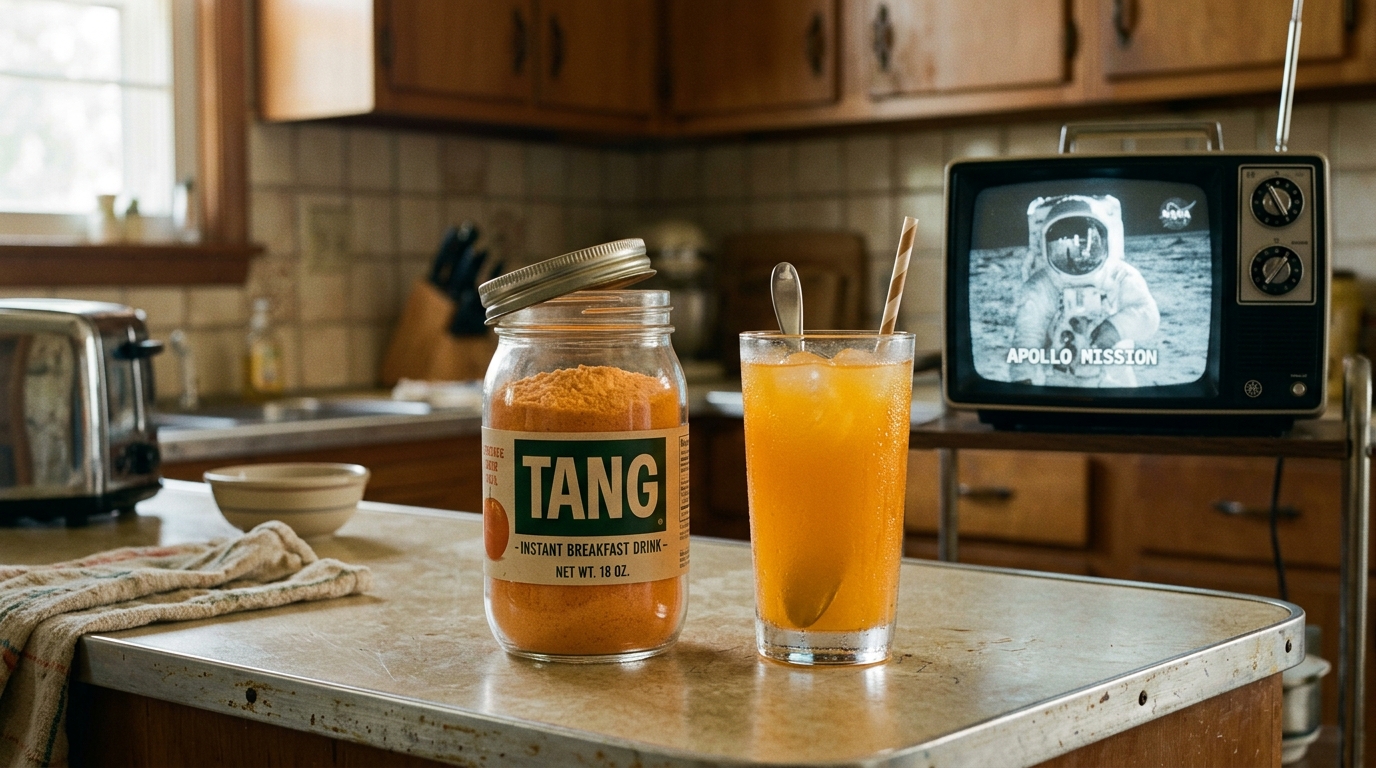
There are stories that endure across decades with such unwavering regularity that we end up treating them as absolute truth. The Tang powder tale is one of them. In the collective imagination, this orange, sweet beverage would have been born behind the scenes of the space race, crafted to quench the astronauts of the Gemini program in the mid-1960s. A pretty legend, but it collapses as soon as you scratch beneath the surface. For Tang existed long before NASA took an interest, and its inventor bore little resemblance to an aerospace engineer. A look back at a stubborn misunderstanding, and at the little-known history of a chemist who simply wanted to reinvent breakfast juice.
- Tang was invented in 1957 by chemist William A. Mitchell of General Foods, then commercialized in 1959, three years before its use by NASA.
- NASA boarded Tang aboard Mercury and Gemini capsules not for its nutritional value, but to mask the metallic taste of water recycled by life-support systems.
- It was this association with spaceflight that transformed Tang from a commercial failure into a genuine pop phenomenon.
- The true father of Tang never imagined rockets
- 1959, the year Tang quietly invaded American shelves
- How NASA adopted an invention that wasn’t theirs
- Why the space myth ended up erasing the real story
The true father of Tang never imagined rockets
The man behind this miracle powder was named William A. Mitchell, a food chemist employed by the American giant General Foods from 1941 to 1976. Far from NASA laboratories and their concerns about zero-gravity survival, Mitchell tackled a far more down-to-earth challenge: how to offer consumers a fruit beverage that was practical, economical, and easy to preserve, without hauling liters of liquid juice or worrying about rapid spoilage. In 1957 he developed the formula, in collaboration with another company chemist, William Bruce James. Together they produced a flavored-powder blend that, when mixed with water, was intended to recreate the taste of orange juice.
What stands out is Mitchell’s versatility. This same chemist was also responsible for Cool Whip, that famous whipped-cream-in-a-can, the legendary Pop Rocks that crackle on the tongue, and even powdered eggs intended for the military. A résumé that boasted more than 70 patents filed over his career. If anything, space was not his primary preoccupation: his playground was the supermarket, not the orbital station.
1959, the year Tang quietly invaded American shelves
Internally, the product carried a fairly evocative code name: Tang Flavor Crystals, literally Tang flavor crystals. A designation that clearly reflected General Foods’ initial ambition: to offer an almost futuristic experience for its time, a drink that transformed almost magically when water was added. The product was ultimately launched commercially in 1959, three full years before the first inhabited spaceflight would use it.
The catch was that the American public did not rush to the aisles to buy it. The early commercial push was notably laborious: the orange powder struggled to convince, and sales remained modest. In other words, before becoming a symbol of modernity for space, Tang was first a near-total commercial flop—a product in the crowded postwar American supermarket landscape, with neither a strong identity nor a compelling selling point.
How NASA adopted an invention that wasn’t theirs
The turning point came in 1962, when NASA chose to take Tang aboard the Mercury capsule during John Glenn’s historic flight, the first American to orbit the Earth. Three years later, in 1965, the powder reappeared during the Gemini program, the era most people associate with Tang. But contrary to the rosy image, the agency did not order this formula or fund its development.
The real reason for its inclusion aboard missions had little to do with nutrition or energy for the astronauts. The objective was far more pragmatic: to mask the unpleasant taste of water recycled by the capsule’s life-support systems. This water, produced in part by fuel cells, carried a metallic flavor that was hardly appetizing. Dissolving a little Tang offered crews a straightforward way to make their hydration rations more palatable. A technical sidestep, almost anecdotal, that would nevertheless prove transformative for the brand.
Why the space myth ended up erasing the real story
It was precisely the association with the Gemini program that propelled Tang from a forgotten product to a genuine commercial phenomenon. General Foods’ advertising campaigns did not hesitate to ride the wave of the space-hero image, capitalizing on the public’s feverish fascination with space exploration during the Cold War. The general public often encountered Tang for the first time through coverage of space missions, without ever knowing its prior existence on grocery-store shelves.
This simple perception gap was enough to forge a durable urban legend: since everyone linked Tang with astronauts, it seemed logical, in the collective imagination, that the drink had been specially designed for them. The chronological reality, though straightforward, was swept aside by the power of the image. Space storytelling—far more marketable than a chemist trying to move stock of flavored powder—ended up eclipsing the facts themselves.
This story ultimately illustrates a fascinating phenomenon: how a chance alignment of images can literally rewrite the perceived origin of a common object. William Mitchell never aimed to fuel astronauts; he simply wanted to create a convenient drink for American families. And while Tang owes its lasting fame to space conquest, its birth was entirely the work of a methodical chemist and his sense for food innovation, long before rockets entered the equation. The next time you spot that bright orange sachet on a shelf, you might think less of Gemini and more of the General Foods lab where it all really began.
